Plywood vs. MDF: Which is Better for Kitchen Cabinets?
When evaluating plywood vs mdf kitchen cabinets for high-end residential estates, commercial multi-family developments, and hospitality casework, trade professionals must look beyond surface aesthetics. Choosing the correct core substrate dictates structural deflection under heavy quartz slabs, screw-holding retention over thousands of hardware hinge cycles, and long-term dimensional stability in variable hydrothermal environments.
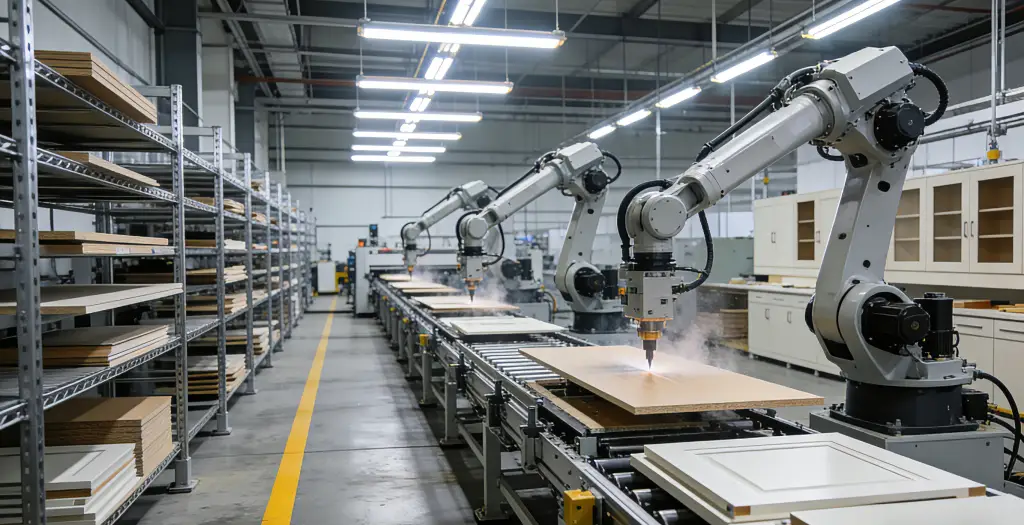
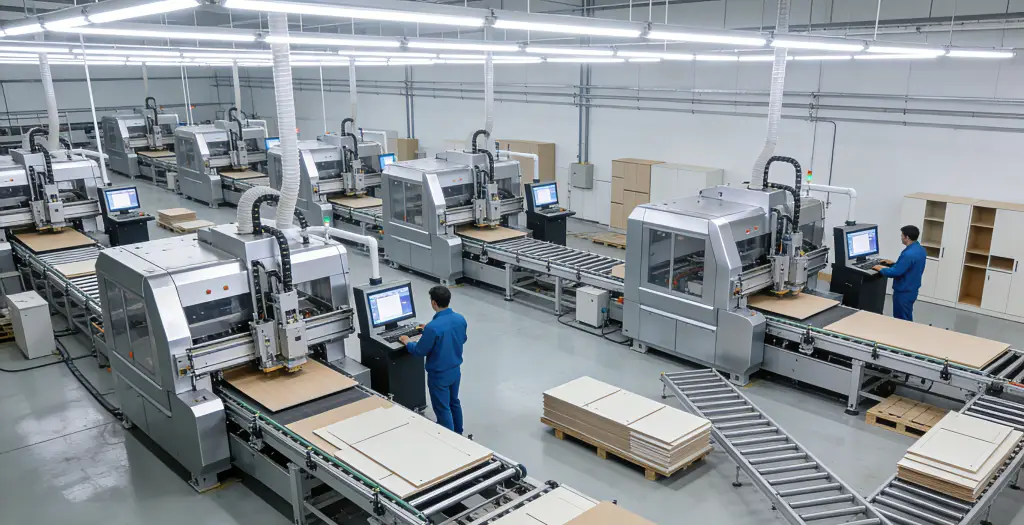
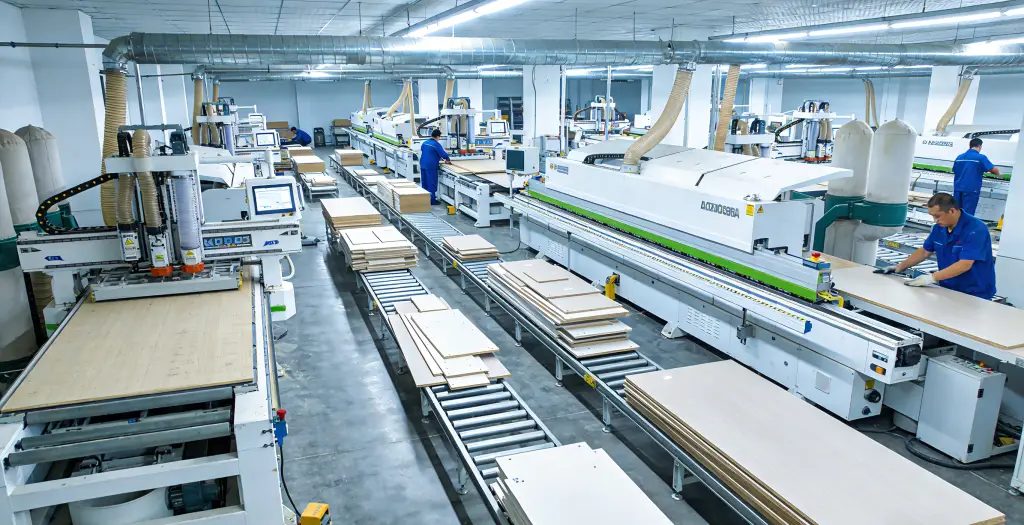
As an architectural millwork and custom cabinetry manufacturer, ALLAND delivers precision-engineered cabinetry packages directly from our automated production facility to general contractors, custom home builders, and interior architects across North America. This engineering guide examines the microscopic material science, structural load capacities, and manufacturing workflows required to specify durable cabinetry that withstands decades of real-world use without jobsite call-backs.
The Foundation: Why Plywood is King for the Kitchen Carcass
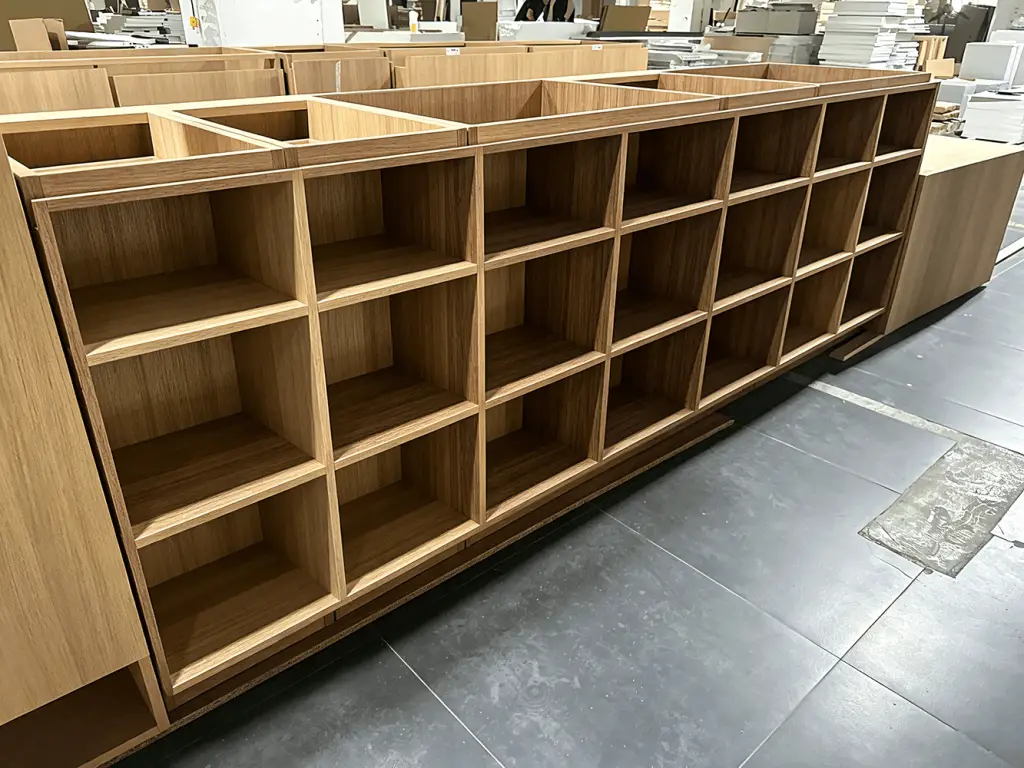
The kitchen carcass (or cabinet structural box) serves as the primary load-bearing chassis of the entire culinary space. It must carry the dead load of dense 3cm engineered quartz countertops, resist localized moisture intrusion around sink plumbing junctions, and maintain plumb rigidity against non-square drywall framing. Multi-layer rotary-cut hardwood veneer plywood remains the uncontested industry benchmark for structural casework.
1. Superior Structural Integrity and Cross-Grain Mechanics
Plywood is fabricated by bonding an odd number of hardwood veneer layers (typically 7 to 9 plies for 3/4″ board) using moisture-resistant thermosetting adhesives under extreme hydraulic compression. Each successive veneer sheet is rotated 90° relative to the adjacent layer. This cross-laminated grain orientation evenly distributes tensile and compressive stresses in both horizontal and vertical axes.
For a commercial-grade kitchen carcass, this mechanical architecture eliminates localized grain cleavage and prevents structural deflection. A standard 36″ (914 mm) wide plywood cabinet shelf will support stacked ceramic dinnerware, heavy cast-iron Dutch ovens, and countertop small appliances without bowing over continuous years of service.
2. Hydrothermal Moisture Resistance and Real-World Lifespan
Kitchen environments experience continuous hydrothermal fluctuations caused by dishwasher steam exhaust, cooking vapor, and undermount sink plumbing condensation. When standard MDF core is exposed to standing water or trapped humidity, its compressed wood fibers absorb moisture rapidly, leading to permanent thickness swelling, core crumbling, and edge-banding failure.
Cross-bonded exterior-grade birch plywood utilizes waterproof phenolic or melamine resin bonding. The alternating veneer grain barriers create a physical tortuous path that blocks moisture capillary migration. This directly highlights the impact of material quality on kitchen cabinet lifespan—plywood casework maintains its dimensional geometry and structural cohesion for 25 to 30+ years, even in challenging coastal or high-humidity climates.
3. Elite Fastener Retention & High-Cycle Screw-Holding Power
For general contractors and trade installers, fastener withdrawal resistance dictates jobsite installation speed and hardware reliability. Plywood’s layered natural solid wood grain provides exceptional mechanical friction for deep coarse-thread casework screws (such as GRK or Confirmat fasteners).
When heavy Blum Clip-Top Blumotion hinges or full-extension undermount drawer slides are subjected to thousands of high-traffic slamming cycles, the solid wood fibers resist hole elongation and thread stripping. Plywood eliminates the common failure mode seen in particleboard or soft fiberboard, where heavy pantry doors or deep pot drawers pull hinge screws completely out of the cabinet side gables.
📋 Factory Engineering Specification
ALLAND exclusively fabricates cabinet box structures using 3/4″ (18mm) AA-Grade Birch Plywood certified to CARB Phase 2 and EPA TSCA Title VI formaldehyde emission standards. All internal surfaces are factory-pre-finished with a UV-cured antimicrobial clear topcoat, providing zero-VOC off-gassing and effortless wipe-clean maintenance.
The Aesthetic Edge: When to Utilize MDF in Cabinetry
While structural birch plywood is the unrivaled king for cabinet boxes, premium High-Density Moisture-Resistant MDF (Medium Density Fiberboard) represents the gold standard for custom painted cabinet doors, Shaker profiles, and architectural decorative panels:
Micro-Smooth Paint Canvas: Formed from refined micro-wood fibers compressed with synthetic resin under high pressure, MDF possesses zero natural open wood grain, knots, or mineral streaks. It provides a glass-like substrate for automated robotic spray application of 2K catalyzed polyurethane paints, achieving flawless ultra-matte, satin, or high-gloss architectural finishes without grain telegraphing.
Precision Monolithic CNC Routing: Unlike plywood whose layered edges will tear, splinter, and expose raw end-grain when routed, high-density MDF routes with surgical precision. ALLAND’s 5-axis German CNC machines mill complex 1-piece Shaker recesses, beveled profiles, and fluted panel details with ultra-sharp 90° inside corners and crisp edge lines.
Total Climate Stability & Zero Seam Checking: Natural solid wood 5-piece shaker doors naturally expand and contract across dry winters and humid summers, causing noticeable hairline paint cracks (“seam checking”) along rail-and-stile joints. Monolithic 1-piece MDF doors are isotropic (expanding uniformly in all directions at microscopic rates), completely eliminating paint cracking along door joints.
Plywood vs. MDF: The Hybrid Strategy for Durable Kitchen Cabinets
To deliver truly durable kitchen cabinets that maximize project ROI while eliminating warranty service calls, leading North American general contractors and developers specify the Hybrid Engineering Strategy. Rather than blindly using one material for the entire build, this method allocates each substrate to its exact mechanical engineering strength:
Structural Chassis (Cabinet Boxes, Sub-Tops, Back Panels, and Shelves): 3/4″ (18mm) Multi-Ply Plywood. Secures a bulletproof, water-resistant carcass capable of supporting massive 3cm natural quartzite tops and heavy appliance towers with zero center sag.
Aesthetic Façade (Door Fronts, Drawer Heads, Applied End Panels, and Moldings): 3/4″ High-Density MDF. Finished in multi-stage 2K polyurethane lacquer or wood veneer skins, delivering a flawless luxury surface that will never warp, cup, or show paint-line hairline fractures.
When you customize kitchen cabinets with ALLAND, our engineering team optimizes your architectural floor plans to this commercial-grade hybrid specification, delivering custom estate aesthetics with institutional structural durability.
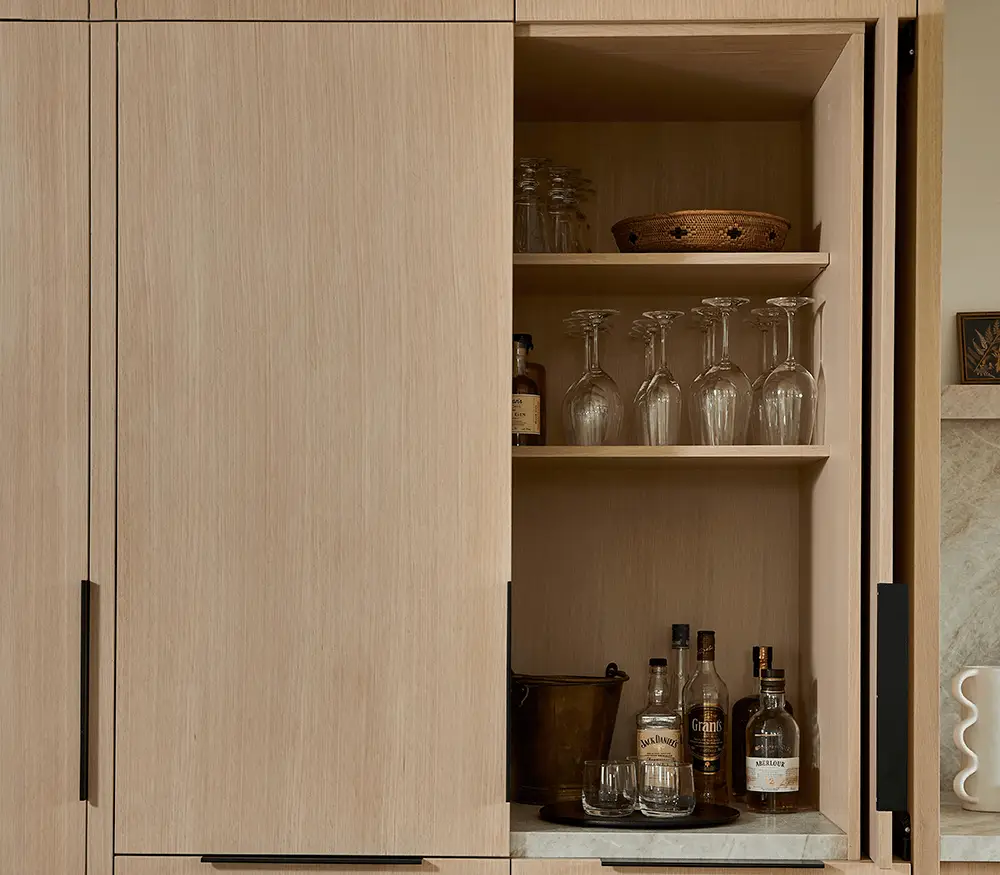
Partner with a Factory for Custom Plywood & MDF Kitchen Cabinets
As an export-oriented custom cabinetry manufacturer with over 15 years of technical millwork experience and thousands of residential units delivered across the United States and Canada, ALLAND bridges the gap between architectural vision and factory-direct precision. We understand that a general contractor’s reputation relies completely on jobsite fitment and material longevity.
By sourcing your custom casework directly from our advanced production lines, your project gains definitive engineering advantages:
1:1 CAD Engineering & Interference Audits: Every blueprint is verified by our engineering desk, modeling 32mm system boring, corner filler clearance offsets, and built-in appliance cutouts before CNC cutting begins.
Zero-Defect 100% Factory Dry-Fit Pre-Assembly : We fully assemble all cabinet runs, drawer glides, corner filler posts, and appliance panels horizontally on our quality control floor prior to export crating, providing high-resolution photo and 4K video inspection sign-offs.
Rigid Export Crating & Jobsite Logistics: Packed in heavy-duty reinforced ISPM-15 compliant export crates with high-density EPE corner protectors, ensuring zero freight abrasions from our factory floor to your jobsite.
Request a 48-Hour Factory CAD Review & Plywood vs. MDF Cabinetry Estimate
Sourcing durable plywood carcasses or custom-painted MDF door packages for your development? Upload your architectural plans, cabinet schedules, or CAD drawings (.pdf / .dwg). ALLAND’s engineering desk will audit your substrate specifications, calculate material requirements, and deliver an itemized factory quotation within 24 to 48 hours.