
Architecting a rich, grounding culinary interior within a modern luxury estate requires a careful balance between bold architectural geometry, material depth, and seamless functional storage. For custom home builders, general contractors, and interior architects, incorporating dark stained oak cabinets presents a sophisticated design statement: establishing dramatic visual contrast while preserving the organic, open-grain tactile authenticity of premium hardwood millwork.
When specifying large-scale cabinetry packages across expansive open-concept floor plans, standard off-the-shelf modular systems frequently fail to satisfy contract-grade standards. Field-stained job-site cabinetry often suffers from uneven stain absorption, blotchy grain patterns, and severe finish degradation near high-moisture prep zones. Our custom cabinetry facility addresses these critical B2B pain points through advanced factory-controlled finishing and precision joinery engineered for North American luxury builds.
Design Strategies for a Modern Dark Oak Kitchen
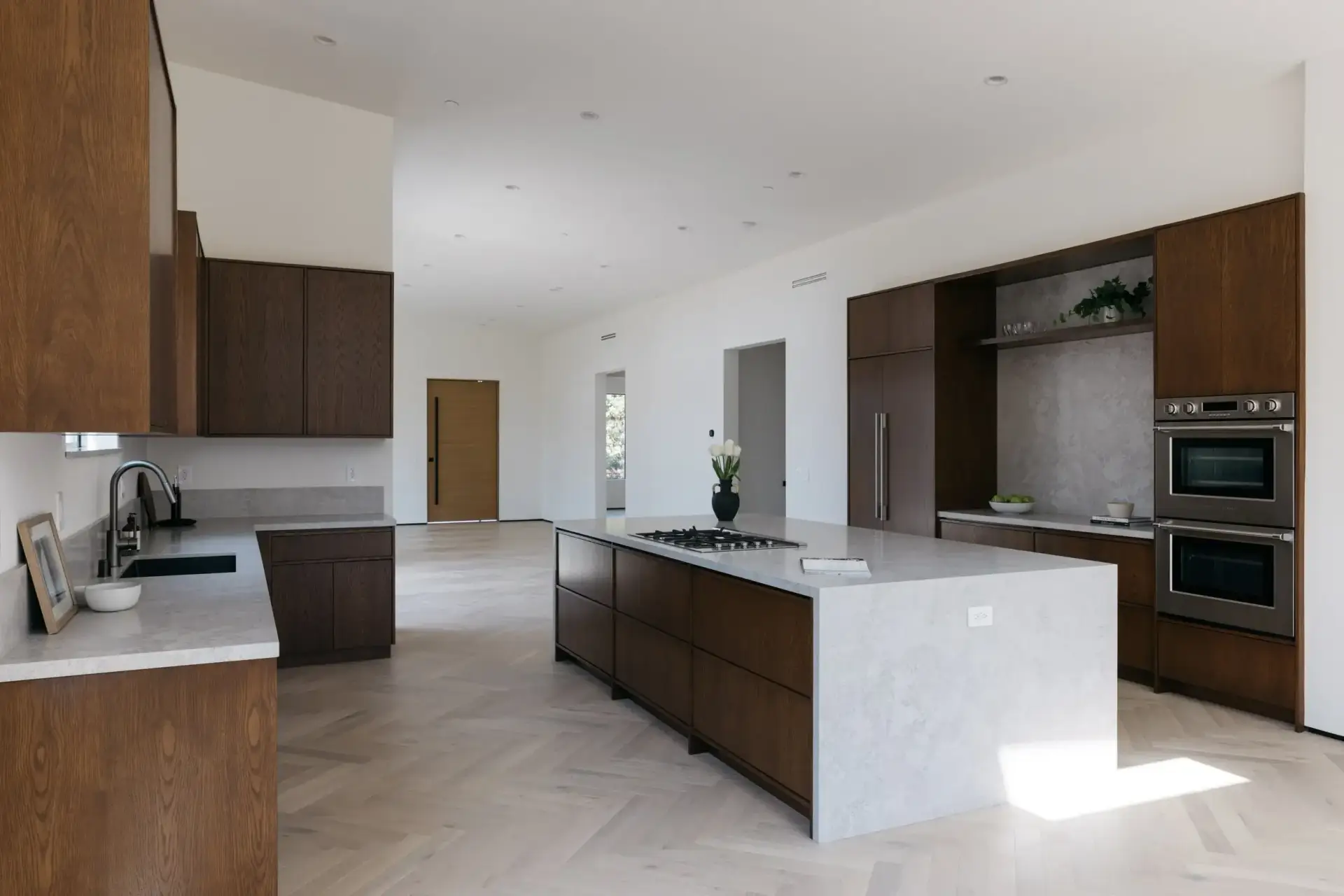
Designing a contemporary dark oak kitchen requires a thoughtful balance between rich, dark-stained millwork and light-reflecting architectural surfaces. When dark wood elements are paired incorrectly, large cabinet banks can visually overwhelm an interior space. Successful execution relies on strategic lighting, open sightlines, and contrasting countertop selections that accentuate the deep grain structure of the wood.
Executing high-end dark oak cabinets kitchen projects involves three primary spatial elements:
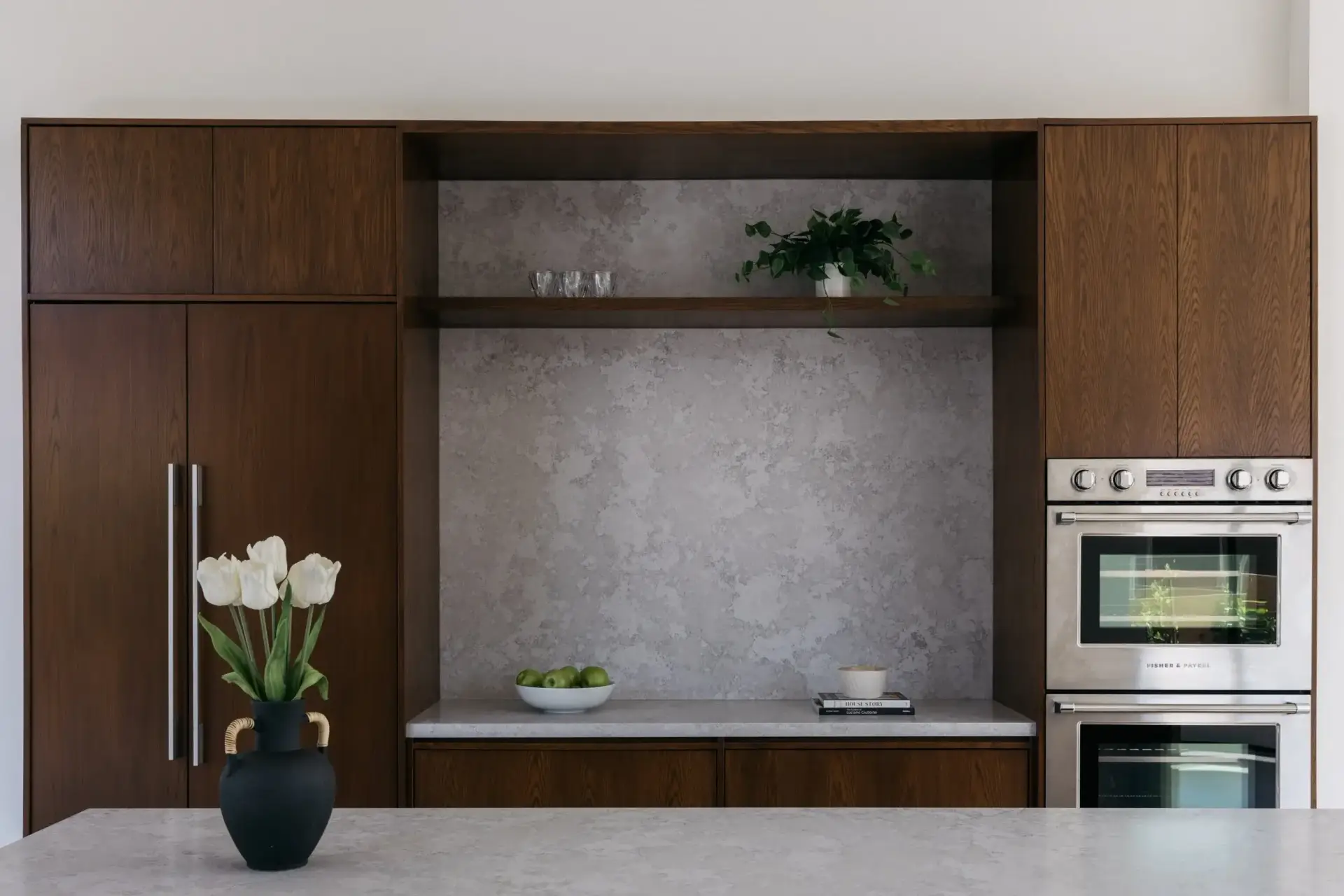
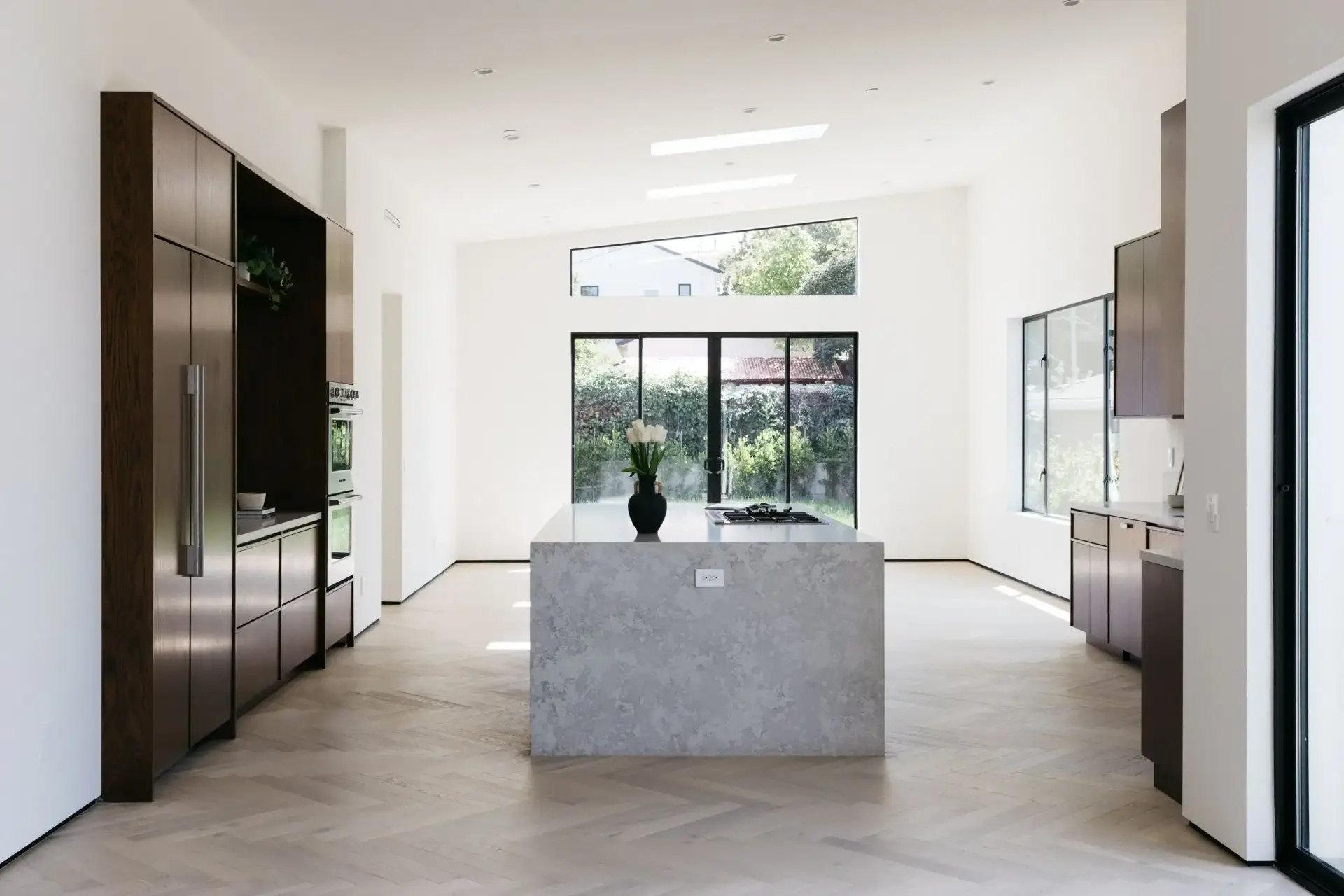
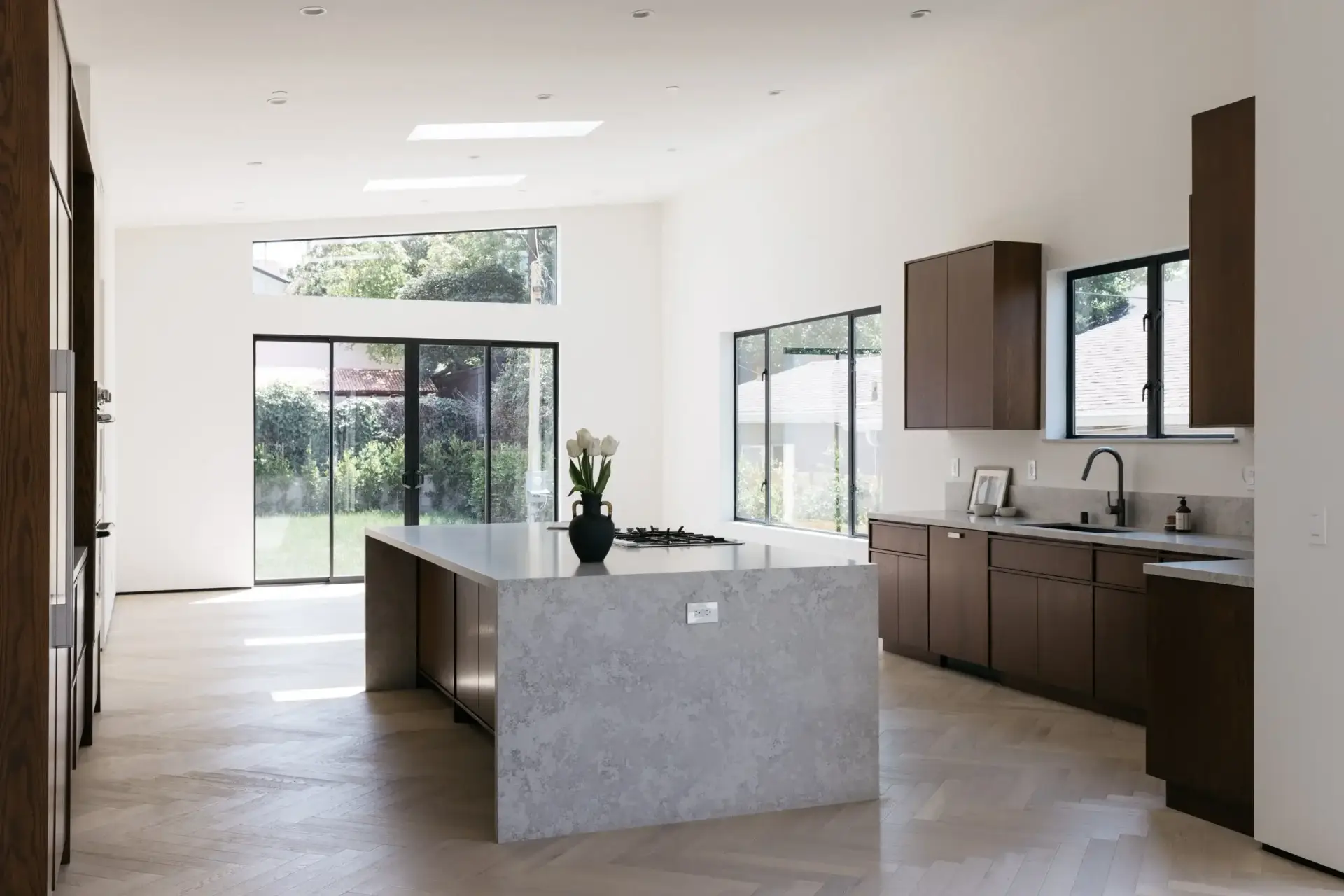
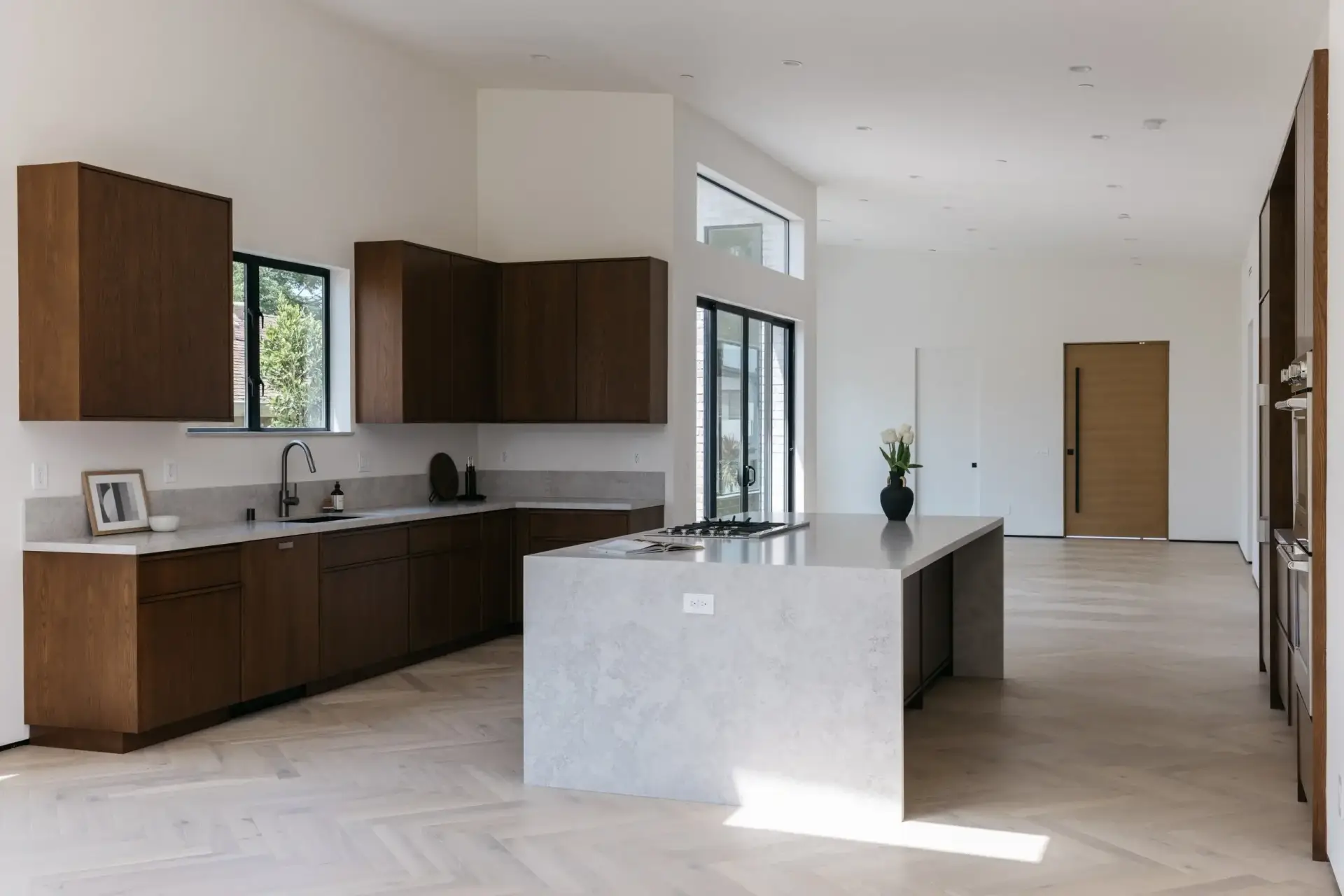
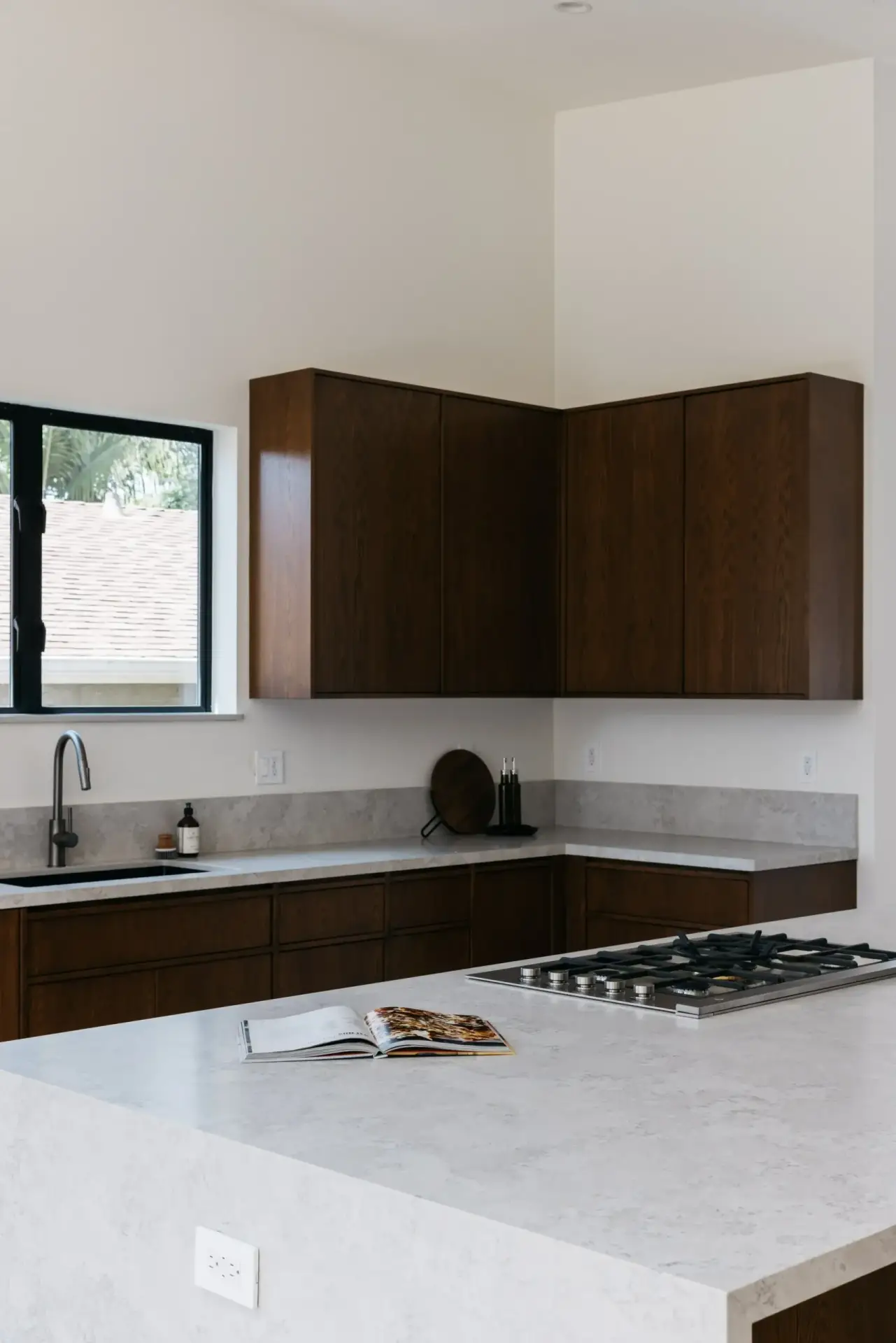
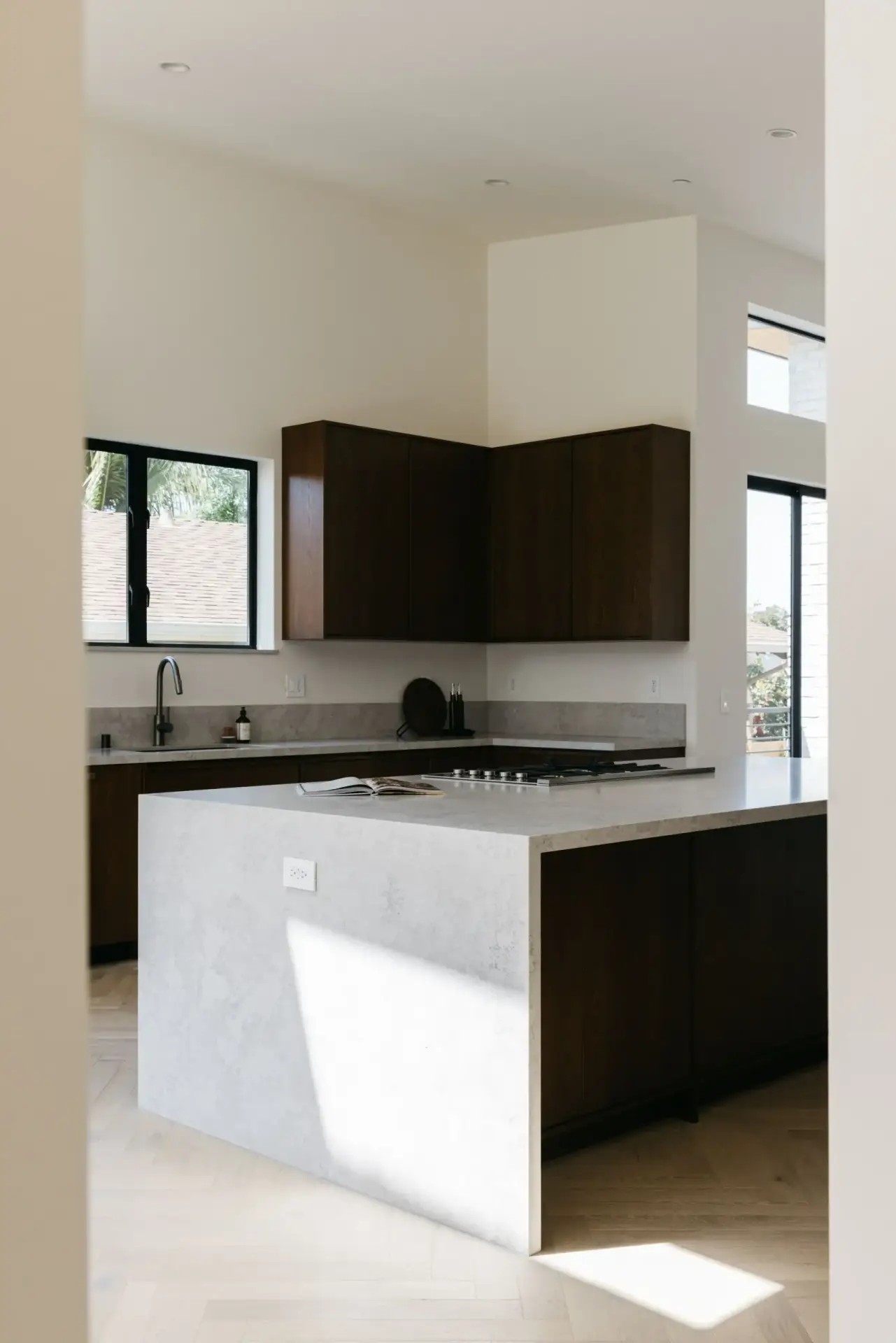
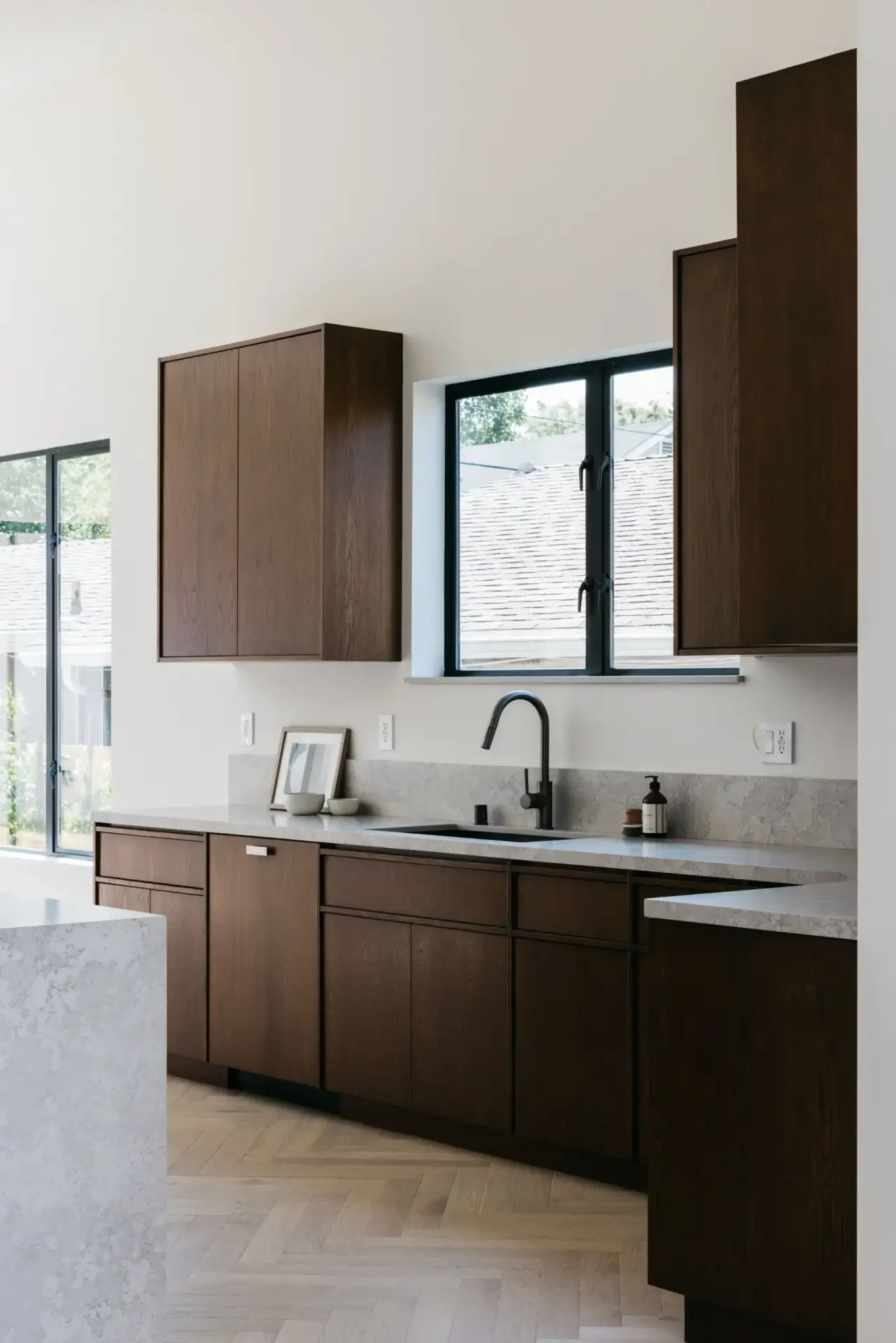
Perimeter Slab Cabinet Runs: Executed in dark espresso white oak veneer with flush-inset door reveals and concealed hardware.
Central Waterfall Preparation Island: Wrapped in light gray quartz slabs to create an immediate focal center that brightens the room.
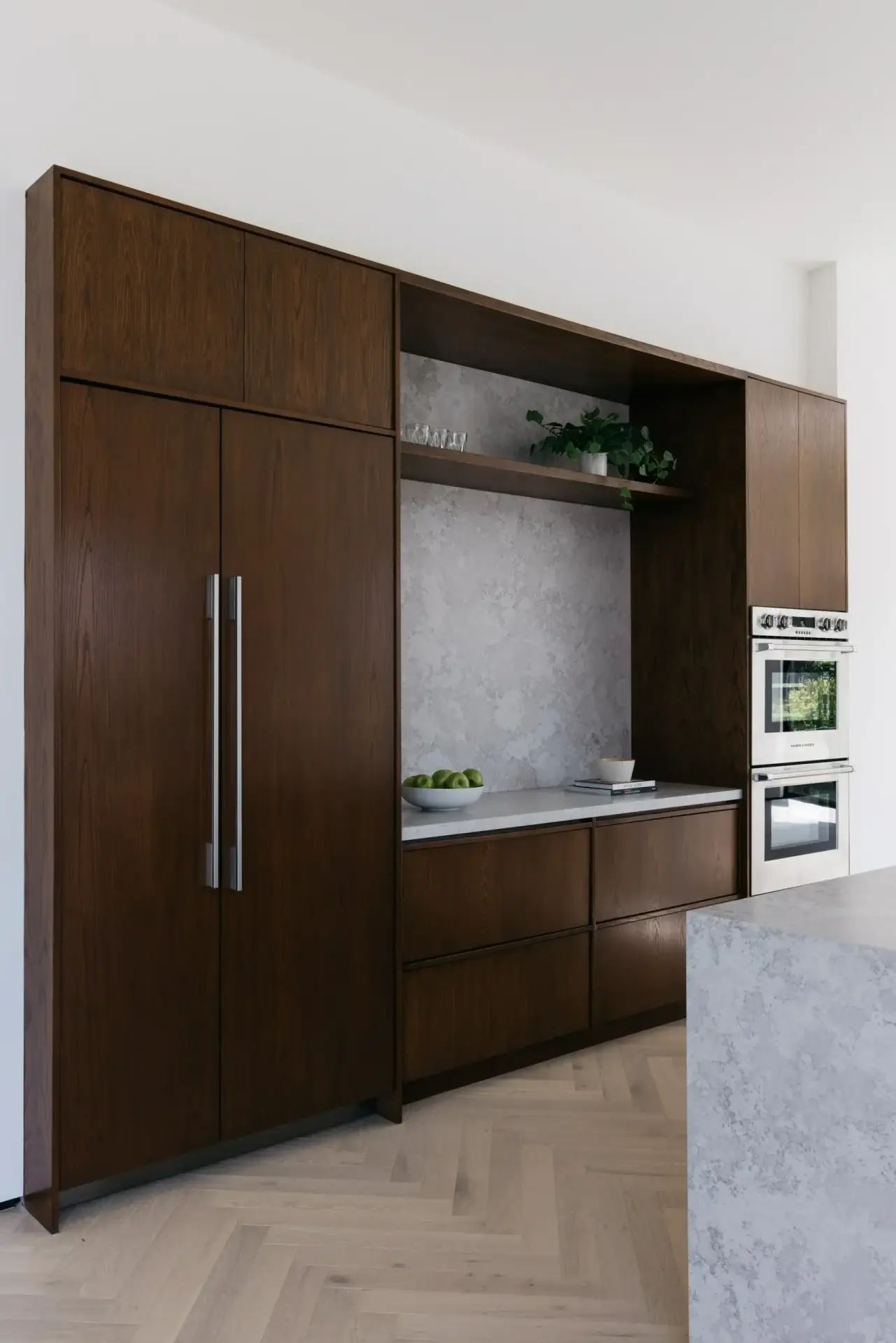
Tall Architectural Storage Towers: Integrating panel-ready refrigeration, double wall ovens, and open display alcoves into a continuous wood elevation.
When these architectural zones are engineered with precise reveal margins, the cabinetry establishes a grounded, furniture-grade presence across the entire main floor plan.
Balancing Dark Oak Kitchen Units with Light Quartz Countertops
Creating visual depth across an expansive kitchen footprint relies on stark material contrast. Pairing dark oak kitchen units with light-colored stone surfaces prevents the workspace from feeling dim while drawing attention to the fine craft of the cabinetry.
Selecting complementary materials for a modern, warm minimalist kitchen includes:
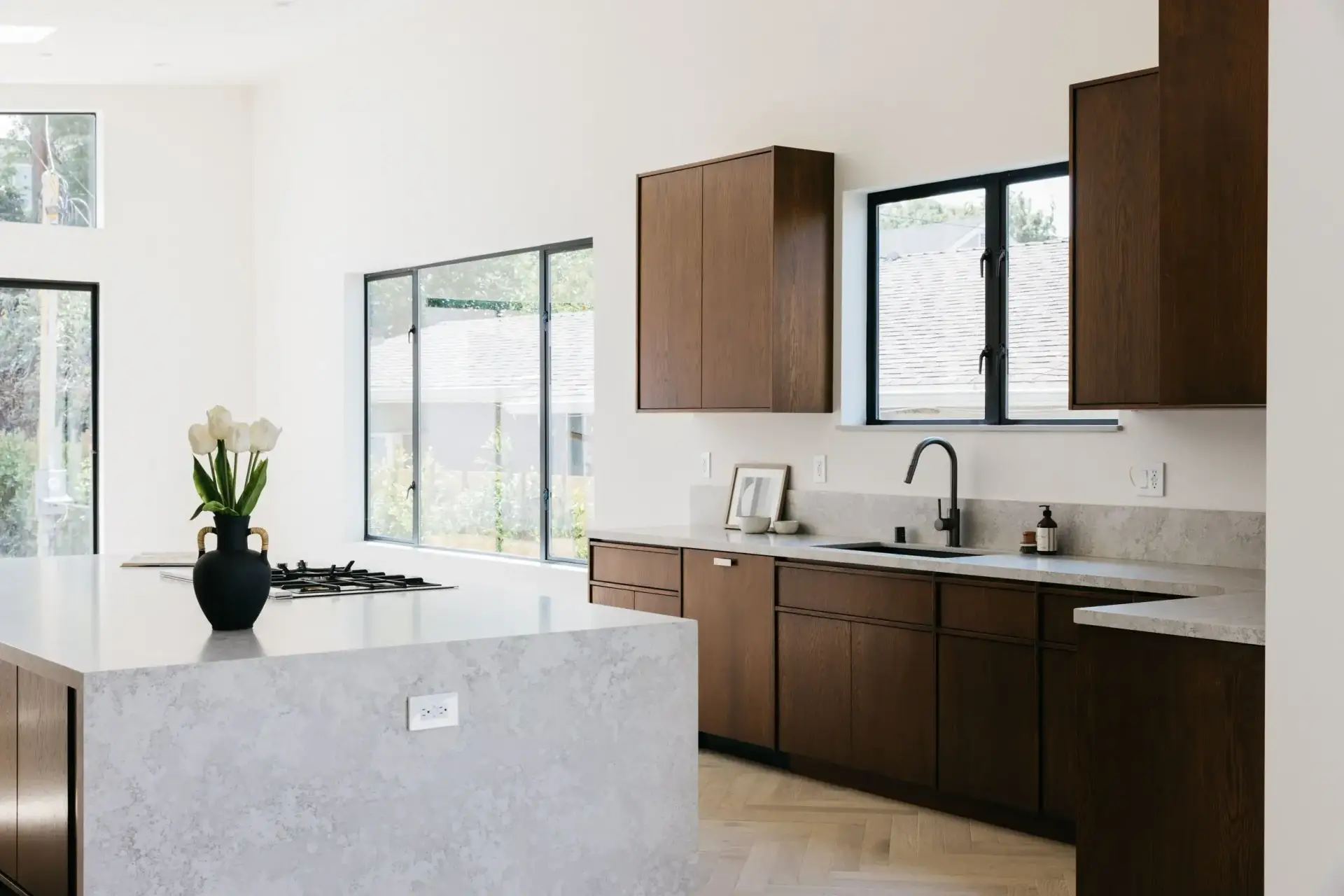
Dark Architectural Elements: Deep espresso-stained white oak cabinet fronts, black window mullions, and matte black plumbing hardware.
Light Reflective Surfaces: Light gray veined quartz countertops, matching full-height quartz backsplashes, and light herringbone oak flooring.
In a carefully executed dark oak cabinet layout, the soft neutral stone surfaces bounce natural daylight across the room, illuminating the subtle brown undertones and textured grain lines of the dark-stained oak doors.
Coordinating Backsplash Tile and Countertop Choices
Determining the right backsplash with oak cabinets and dark countertops or light stone surfaces is essential for establishing seamless wall elevations. Continuous full-height stone backsplashes eliminate grout lines, providing a clean background behind secondary prep counters and sink runs.
When opting for oak cabinets with dark stain, running matching stone slabs up to the underside of upper wall cabinets creates an uninterrupted vertical line. This design approach simplifies cleaning behind high-use prep zones while highlighting the floating geometry of dark upper storage boxes.
Material Science of Staining Oak Cabinets Darker
Achieving a flawless, saturated finish when staining oak cabinets darker requires specialized timber selection and multi-stage factory application. White oak is an open-grain hardwood characterized by prominent earlywood pores and long medullary rays. If stained incorrectly on a job site, dark pigments collect unevenly in open pores, causing dark blotches and muddy grain definitions.
Our automated finishing facility eliminates finish inconsistencies through a four-step industrial staining process:
Precision Surface Calibration: Flat-cut white oak veneers are sanded with calibrated multi-stage abrasive belts to open timber pores evenly without tearing wood fibers.
Deep-Penetrating Wipe Staining: Custom-formulated dark walnut stains are hand-rubbed and wiped mechanically across panel faces, driving rich pigments into open pores while leaving raised grain clear.
Non-Yellowing Sealer Application: Dual coats of post-catalyzed conversion varnish sealer lock in color pigments and seal the wood substrate against moisture.
10-Degree Extra-Matte Conversion Topcoat: An ultra-low sheen topcoat protects dark oak stained cabinets from scratching, household chemicals, and UV darkening without adding artificial plastic glare.
Why White Oak Outperforms Red Oak for Dark Finishes
Selecting the correct oak species is critical when engineering dark stained oak cabinets. While both white oak and red oak belong to the same timber family, their cellular structures respond differently to dark stain pigments.
The visual performance of white oak substrates far outperforms traditional red oak in dark-stained applications:
Red Oak Considerations: Contains strong natural pink and reddish undertones. When dark stains are applied, these underlying red tones bleed through, creating a warm, cherry-like tint that conflicts with cool modern color schemes.
White Oak Superiority: Features natural olive-gray and neutral brown undertones. Applying a dark stain on oak cabinets made of white oak yields a clean, neutral espresso color with crisp black grain accents and zero unwanted red reflection.
By standardizing our production on architectural-grade American white oak, our factory delivers consistent, cool-toned dark finishes that align perfectly with modern architectural drawings.
Veneer Edge Banding and PUR Adhesive Sealing
A common failure point in contract-grade cabinetry is edge-tape delamination. Unsealed cabinet edges exposed to steam near dishwashers or ovens often absorb ambient moisture, causing edge banding to peel and core materials to swell.
Our facility prevents edge failures by applying 2mm thick solid white oak edge banding using high-temperature PUR (Polyurethane) adhesive. Applied under heavy pneumatic pressure, this waterproof bond seals the edge completely. Skilled craftsmen hand-bevel every edge, creating an impact-resistant seam that matches the front slab veneer face.
Structural Load Bracing and Carcass Integrity
Luxury estate kitchens frequently feature thick, heavy stone countertops, such as 3-centimeter quartz, quartzite, or marble slabs. A primary failure point in commercial millwork installations is carcass deflection caused by weak cabinet box construction. When base cabinet carcasses sag under stone weight, adjacent slab doors bind, drawer slides misalign, and stone seams crack.
To eliminate structural movement, our factory constructs cabinet carcasses using heavy-duty 3/4-inch multi-ply marine-grade plywood. Unlike standard particleboard or low-density MDF carcasses, multi-ply plywood provides exceptional screw-holding strength, cross-laminated shear resistance, and complete moisture immunity.
Each base unit incorporates solid hardwood corner gussets, full-depth 3/4-inch back panels, and interlocking dado joinery. This rigid box architecture distributes stone weight evenly across the floor plane, guaranteeing zero carcass deflection under heavy island installations.
Moisture Mitigation and Environmental Stability Protocols
Wood is a hygroscopic material that continuously exchanges moisture with surrounding ambient air. In high-end residential construction, ambient moisture fluctuations represent a major threat to custom millwork. Kitchen environments present unique humidity microclimates, subject to localized steam from dishwashers, cooking vapor, and seasonal HVAC shifts.
To protect custom dark-stained white oak components from humidity-induced stress, our factory enforces strict moisture mitigation standards throughout raw material storage, processing, and finishing:
Kiln-Drying Moisture Calibration: All timber logs and hardwood veneers are kiln-dried to a stabilized 6% to 8% internal moisture content prior to slicing and pressing.
Balanced Core Counter-Veneering: To prevent panel cupping, every door panel receives identical veneer species and thickness on both front and back faces, balancing surface tension.
Full-Carcass Moisture Barriers: Unexposed cabinet backs, drawer bottoms, and interior carcass edges receive protective polyurethane sealing to prevent ambient moisture absorption.
By maintaining these environmental engineering controls, our custom cabinetry maintains dimensional stability across diverse North American climate zones—from humid coastal regions to dry arid interior states.
Functional Appliance Camouflage and Bathroom Custom Millwork
High-end residential design emphasizes integrated storage that keeps utilitarian appliances hidden behind clean timber elevations. Utilizing custom panel kits allows large refrigeration units and wall ovens to blend into surrounding wall paneling.
Panel-Ready Appliance Integration
Exposed stainless steel refrigerator doors can disrupt the visual flow of a dark oak kitchen. Our engineering office produces custom panel-ready door kits matched to exact manufacturer appliance dimensions.
Reinforced with internal aluminum bracing, tall dark oak cabinet panels remain flat under the weight of heavy appliance door handles. Concealed heavy-duty pivot hinges allow doors to open smoothly while maintaining uniform 1/8-inch reveals against adjacent storage towers.
Floating Dark Oak Bathroom Vanities
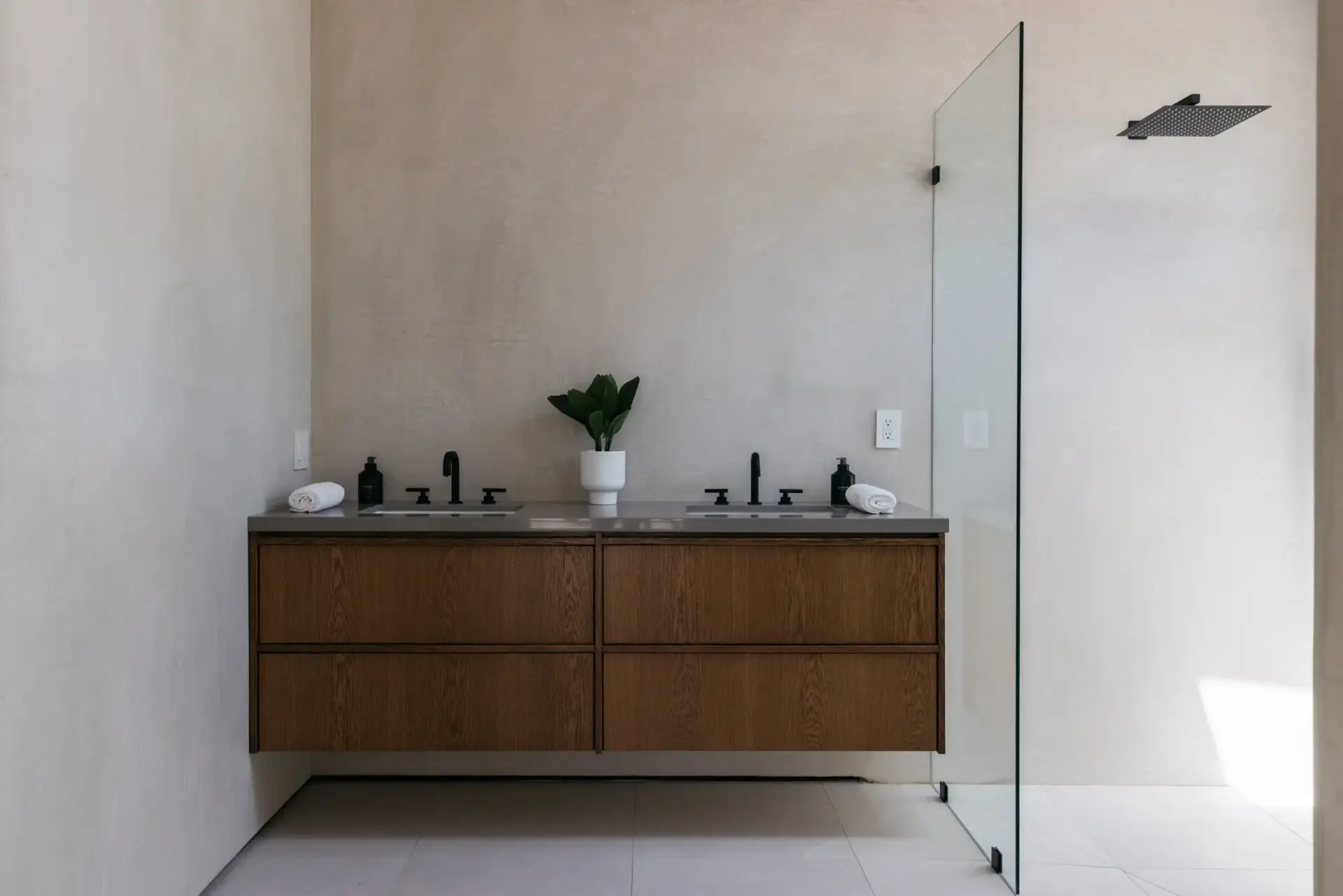
Extending custom dark-stained millwork into primary bathrooms establishes material continuity throughout the home. Floating double-sink vanities mounted off the floor create a weightless visual effect while providing deep storage drawers for personal items.
Constructed using moisture-resistant cores and treated with waterproof polyurethane topcoats, these dark-stained vanities withstand high-humidity bathroom environments without surface clouding or seam swelling.
Advanced European Hardware and Precision Tolerances
The daily tactile experience of custom cabinetry depends on hardware performance. Minimalist slab cabinetry requires hardware systems that operate silently, support heavy static loads, and allow 3D micro-adjustment during field installation.
Our manufacturing facility equips all cabinet runs with premium European hardware systems, including concealed Blumotion soft-close slides and 3D adjustable clip-top hinges. Drawer slides are load-tested to withstand 100-pound dynamic capacities across 100,000 cycles, ensuring smooth operation under heavy cast-iron cookware.
For flush-inset door applications, 3D adjustable hinge plates allow installation teams to micro-adjust door positions along three axes (depth, height, and side-to-side). This precise adjustability ensures that reveal gaps remain perfectly uniform at 1/8-inch across all cabinet fronts, preserving the clean geometric symmetry required by modern architectural drawings.