
Custom Shaker Kitchen Cabinets: Architectural Engineering Guide
Specifying shaker kitchen cabinets for high-end residential and multi-family developments is a balancing act between timeless transitional design and strict structural millwork engineering. While the clean, recessed-panel geometry of the Shaker door has remained a staple in North American homes for over two centuries, today’s architectural standards require far greater precision than traditional carpentry ever demanded. General contractors, architects, and developers face real jobsite challenges when installing custom cabinetry: seasonal moisture expansion, hairline paint fractures along five-piece framing joints, wood movement across varying climate zones, and maintaining razor-thin perimeter reveals.
To achieve an enduring, high-performance installation, manufacturing custom shaker cabinet doors requires a deep understanding of timber physics, industrial coating chemistry, and specialized joinery mechanics. Whether specifying crisp painted finishes for a contemporary urban condo or hand-wiped natural hardwoods for an organic modern estate, every component—from the internal core substrate to the outer protective topcoat—must be engineered to resist warp, sag, and surface degradation. This technical specification guide walks through the structural fundamentals, finishing options, timber species selections, and emerging profile proportions that define modern bespoke Shaker casework.
Finished Shaker Cabinet Door Systems: Painted vs. Wood Stained Execution
Selecting the surface finish for a finished shaker cabinet door is not merely an aesthetic choice; it is an engineering decision that directly dictates how the cabinetry behaves under changing environmental conditions. Wood is an anisotropic, hygroscopic material, meaning it absorbs and releases atmospheric moisture as seasonal relative humidity fluctuates. In standard solid timber doors, vertical stiles expand across their tangential grain width while horizontal rails remain dimensionally static along their longitudinal fiber. This differential expansion creates continuous shear stress at the joints. When engineering custom cabinetry, the finishing system must either flex with the natural respiration of the timber or rely on an engineered composite core to isolate the surface coating from dimensional movement.
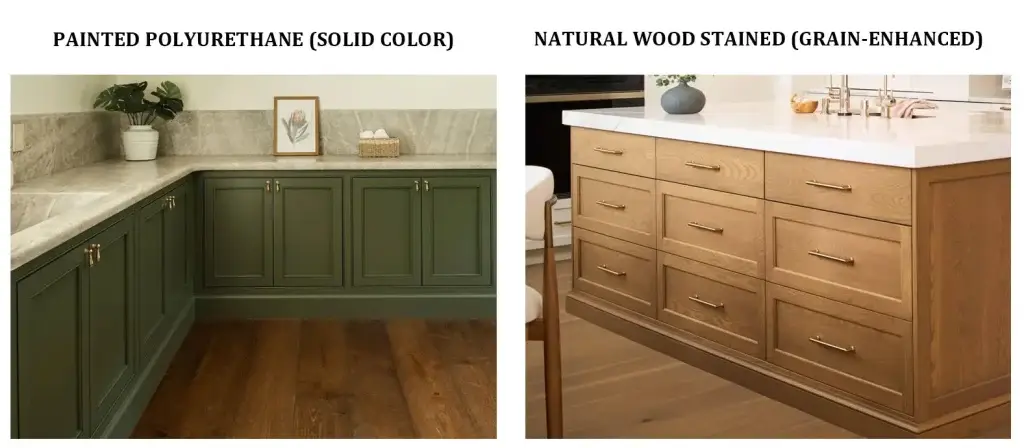
1. Painted Shaker Cabinet Doors: Multi-Step Polyurethane Formulation
Specifying painted shaker cabinet doors in luxury residential projects requires an impeccably smooth, grain-free surface that remains intact across decades of seasonal shifts. When opaque enamel or lacquer finishes are sprayed over traditional all-solid-wood five-piece doors, natural wood movement beneath the cured coating inevitably stretches the paint film. This structural shifting creates visible hairline fractures—widely known in the millwork trade as “bridge cracking” or “joint lines”—wherever the vertical stiles meet the horizontal rails. In climate-controlled homes, this hairline cracking is one of the leading causes of customer warranty claims and builder call-backs.
To prevent joint failure on the jobsite, architectural-grade casework employs hybrid substrate engineering. We construct paint-grade doors by combining dense, solid Hard Rock Maple frames with deep-routed, high-density moisture-resistant (MR) MDF center panels compliant with TSCA Title VI and CARB Phase 2 regulations. The solid maple perimeter provides structural rigidity, high impact resistance against edge dings, and screw-holding strength for 3D-adjustable European concealed hinges. Meanwhile, the homogeneous MR-MDF center panel exhibits zero directional grain movement, providing a stable foundation that prevents the cured paint film from bridging and tearing along the interior frame.
Our factory finishing protocol applies a multi-step catalyzed polyurethane (PU) system within cleanroom environments. Raw door slabs pass through automated wide-belt sanding machines before receiving two heavy coats of high-build PU sealer to close the wood pores and prevent moisture ingress. Following automated inter-coat denibbing and hand-sanding with 400-grit abrasives, technicians apply two topcoats of catalyzed pigmented PU lacquer. This factory-cured formulation achieves a durable surface that meets KCMA performance benchmarks, allowing custom color matches to any Sherwin-Williams or Benjamin Moore formulation (△ E < 1.0) while resisting household chemicals, cooking oils, and boiling water steam.
2. Wood Stained Kitchen Cabinets: Natural Hardwood Grain Enhancement
Unlike solid paint coatings designed to conceal the underlying substrate, wood stained kitchen cabinets celebrate the tactile depth, medullary rays, and organic pore structures of authentic timber. Achieving an architectural-grade stained finish requires deep pigment penetration that enhances grain definition without creating muddy blotches or uneven saturation across different timber densities.
Our custom staining process utilizes hand-wiped, penetrating solvent-borne stains formulated with micro-ground trans-oxide pigments. Prior to stain application, assembled five-piece doors are sanded sequentially along the natural grain up to 220-grit abrasives to open the wood pores evenly. Master finishers apply the stain by hand, wiping with the natural grain direction so the deeper heartwood pores absorb the exact saturation needed for visual depth, while the surrounding timber grain retains its clarity and natural luster.
To preserve the appearance of stained doors in high-humidity kitchen conditions, we seal the finished timber using high-solid conversion varnishes or UV-cured acrylic polyurethane clear coats. These advanced topcoats incorporate specialized UV absorbers and hindered amine light stabilizers (HALS) that shield natural timber lignin from photochemical degradation. This chemical protection prevents pale woods like White Oak from shifting amber over time and shields dark woods like Black Walnut from fading under direct ultraviolet exposure. Sheen levels can be calibrated from an organic 5% dead-matte to a smooth 20% satin luster, providing a water-resistant barrier that preserves the natural feel of the wood.
Select Shaker Cabinet Door Materials: Hardwood Species & Core Engineering
The structural durability, weight capacity, and long-term stability of a custom millwork project rely heavily on proper timber species selection. When evaluating a select shaker cabinet door, architects, general contractors, and developers must balance grain density, natural moisture resistance, and dimensional movement ratings against the environmental conditions of the project location.
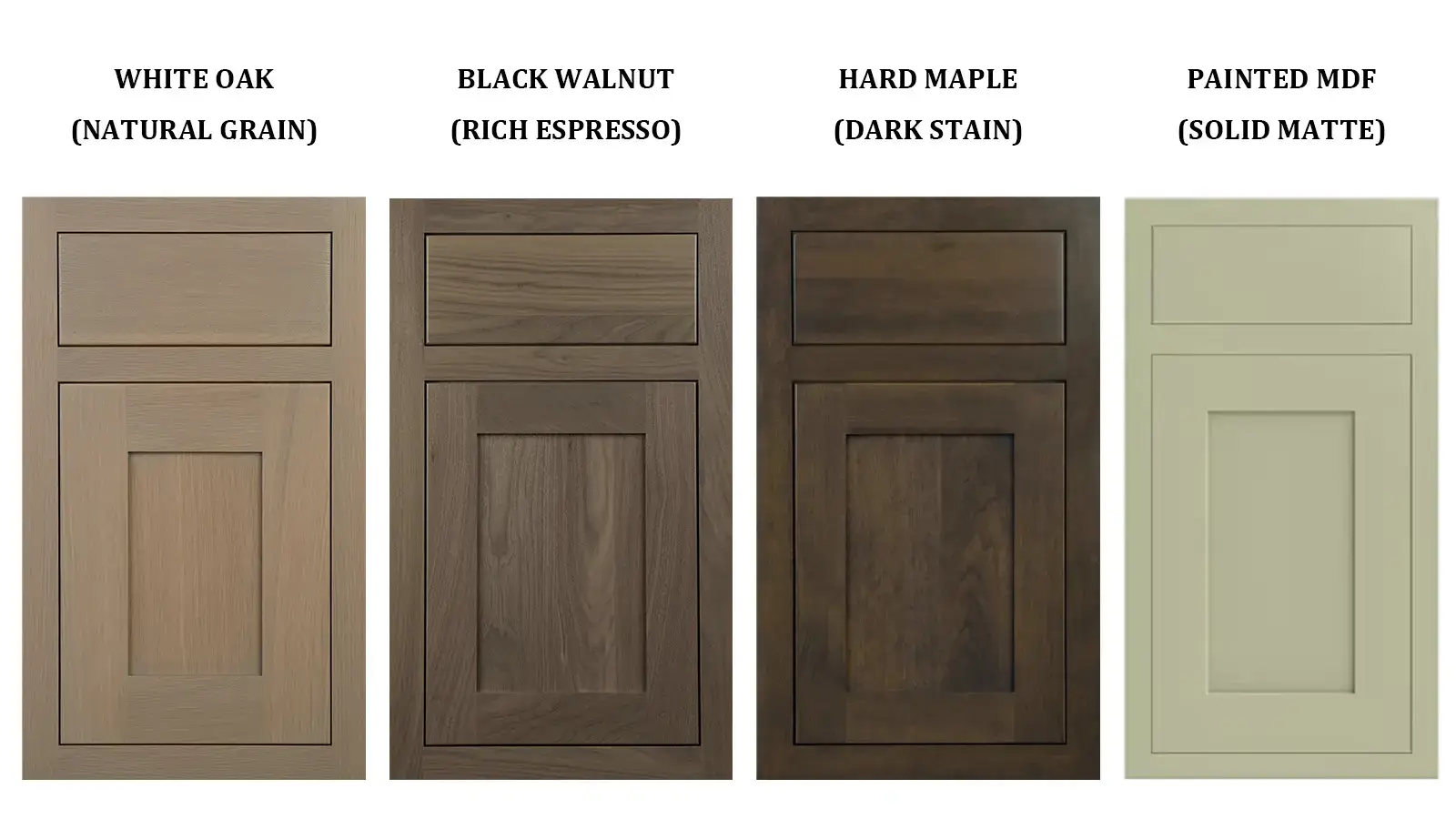
1. White Oak Shaker Kitchen Cabinets: Plain-Sawn vs. Rift-Sawn Dynamics
White oak shaker kitchen cabinets have established themselves as the premier choice in modern architectural interiors. Classified botanically as Quercus alba, North American White Oak features a dense Janka hardness of 1,360 lbf, delivering robust resistance to dents, scratches, and jobsite abrasions. Unlike Red Oak, White Oak possesses closed vascular channels filled with microscopic crystalline outgrowths known as tyloses. These tyloses seal the wood’s internal pores, creating high natural resistance to water penetration and rotting, which makes White Oak exceptionally reliable for coastal properties, humid southern regions, and heavy-use culinary prep zones.
The method used to saw the raw log at the timber mill directly defines both the visual grain character and the mechanical movement of the finished cabinet door:
Plain Sawn (Flat Sawn): Cut tangentially across the growth rings, plain-sawn boards display classic, sweeping “cathedral” arches. While visually dynamic, plain-sawn cuts exhibit a higher tangential shrinkage coefficient (10.5%). In five-piece cabinet doors with wide stiles, flat-sawn lumber requires stable interior humidity control to prevent subtle cupping across wide panels.
Quarter Sawn: Cut radially at a 90-degree angle to the annual growth rings, quarter-sawing exposes the wood’s medullary rays, creating distinctive “tiger stripe” flake patterns. This orientation reduces seasonal expansion and contraction by nearly 50% compared to flat-sawn timber, providing structural stability in variable climates.
Rift Sawn (Architectural Standard): Milled at a precise 45-degree angle to the growth rings, rift-sawing produces an ultra-tight, vertical linear comb grain with zero ray flake distractions. Because rift-sawn timber expands and contracts at a nearly identical rate across both radial and tangential axes, it offers superior dimensional equilibrium (0.15 mm expansion coefficient). This makes it the preferred timber for high-end modern Shaker profiles, full-overlay doors, and seamless sequence-matched cabinetry.
2. Walnut Shaker Kitchen Cabinets: Architectural Grade Luxury
American Black Walnut (Juglans nigra) remains one of the most sought-after hardwoods in bespoke residential cabinetry, offering a depth of tone that cannot be matched by staining lighter woods. With a Janka hardness of 1,010 lbf, Walnut achieves an ideal balance of surface density and dimensional stability, allowing precision CNC tooling to carve clean, crisp profile reveals without fiber splintering or edge chipping. Its heartwood features rich chocolate tones, deep espresso swirls, and subtle amber sapwood variations that create natural visual warmth.
When fabricating walnut shaker kitchen cabinets, maintaining continuous wood grain flow across adjacent cabinet runs is essential. In custom shop environments, raw lumber is hand-sorted to achieve balanced grain alignment, matching horizontal and vertical flow across drawer stacks, appliance panels, and tall pantry banks. To protect Walnut’s natural heartwood oils without creating an artificial, plasticky gloss, doors are finished with non-yellowing catalyzed conversion varnishes formulated at an ultra-low 5% dead-matte sheen. This preserves the tactile, organic texture of the hardwood while shielding the casework from cooking moisture and everyday wear.
3. Maple Shaker Kitchen Cabinets: The Paint-Grade & Light-Stain Standard
Hard Rock Maple (Acer saccharum) is the workhorse timber for high-traffic custom kitchens where durability and impact resistance are primary considerations. Boasting a Janka hardness rating of 1,450 lbf, Hard Maple outperforms both Oak and Walnut in crushing strength, making it the ideal hardwood framing material for busy residential family kitchens, multi-family apartment runs, and commercial hospitality installations.
The tight, closed-pore anatomical structure of Hard Maple is its defining manufacturing advantage. Unlike open-grained hardwoods such as Oak or Ash, Maple contains no open vascular pores on its surface. When machined for maple shaker kitchen cabinets, CNC mortise-and-tenon profiling yields clean 90-degree internal frame corners with zero end-grain tear-out. For painted cabinet applications, Hard Maple stiles and rails provide a smooth surface that prevents wood grain from telegraphing through cured polyurethane topcoats. When light, pale stains are specified, technicians apply specialized pre-stain wood conditioners to equalize absorption, preventing splotchiness and ensuring a clear, luminous natural finish.
4. MDF Shaker Cabinet Doors: Zero-Expansion Engineering
While solid timber carries natural appeal, high-density Medium Density Fiberboard (MDF) has become an essential material in precision architectural woodworking. In contemporary casework, builders and architects specify high-density, moisture-resistant (MR) MDF panels manufactured in strict compliance with TSCA Title VI and CARB Phase 2 emission standards, featuring core densities exceeding 800 kg/m³.
The primary engineering benefit of mdf shaker cabinet doors lies in their isotropic dimensional stability. Because MDF consists of refined wood fibers bonded under intense heat and hydraulic pressure with synthetic resins, it possesses no internal grain direction. As a result, it exhibits zero directional expansion or contraction across seasonal humidity cycles. When specified for luxury painted kitchens, high-density MDF center panels eliminate the joint movement that causes paint cracking on solid timber doors.
Custom manufacturing facilities produce MDF Shaker doors in two distinct construction formats:
One-Piece Monolithic Routed Doors: Precision-milled from a single solid slab of MR-MDF on 5-axis CNC routers. Because the entire door is a single continuous panel without physical joints, it is structurally impossible for the door to crack, warp, or separate along the frame seams.
Five-Piece Composite Doors: Built with solid Maple perimeter framing and an MDF floating recessed center panel. This delivers the traditional shadow lines and crisp inner profiles of true five-piece joinery while ensuring the center panel remains dimensionally stable in any climate.
Shaker Cabinet Kitchen Ideas: Contemporary Architectural Profiles & Trends
Contemporary architectural millwork has evolved the standard Shaker door from a simple farmhouse fixture into an adaptable design element. When developing shaker cabinet kitchen ideas for custom residences, understanding the nuances of specific shaker cabinet door profiles allows designers to manipulate shadow depth, frame proportions, and perimeter reveal gaps to complement the architectural language of the home.
1. Slim Shaker Cabinets Kitchen: The Modern Minimalist Benchmark
Traditional Shaker doors rely on wide framing stiles measuring between 2-1/4″ and 3″ (57 to 76 mm). While appropriate for rustic farmhouses, modern residential design demands cleaner, lighter horizontal lines. Slim shaker cabinets kitchen designs—frequently referred to as skinny Shaker or micro-Shaker—narrow the perimeter stiles and rails down to a lean 1/2″ to 3/4″ (12.7 to 19 mm) border surrounding a crisp 1/4″ (6 mm) recessed panel.
Engineering an ultra-slim framing profile requires reinforced joinery. Because narrowing the frame reduces the contact surface of a standard mortise-and-tenon joint, our factory reinforces every corner joint using high-density internal beech dowels and industrial PUR structural adhesives. This prevents corner joint failure when doors are subjected to continuous dynamic loads from heavy soft-close hardware. Slim Shaker doors bridge the gap between traditional five-piece woodwork and modern European flat-slab casework, pairing with integrated J-pull handles, top-edge finger pulls, or concealed touch-latch systems.
2. Inset Shaker Kitchen Cabinets: Precision Flush Joinery
While full overlay cabinetry positions the door slab in front of the cabinet box, inset shaker kitchen cabinets seat the entire door flush inside a 3/4″ solid hardwood face frame. This construction represents the standard of bespoke American and English cabinetry, creating an authentic furniture-grade aesthetic that highlights the joinery skills of the maker.
The engineering challenge of inset construction lies in manufacturing tolerances. Because the door is nested inside a rigid perimeter frame, there is zero tolerance for error. Our automated CNC sizing equipment holds door-to-frame reveal gaps to a strict ≤ 1.5 margin around all four edges. To ensure this reveal remains true despite seasonal shifts or structural settling, all inset doors are fitted with heavy-duty 3D-adjustable concealed hinges from Blum or Salice, allowing field installers to adjust horizontal, vertical, and depth alignment on site. Cabinet end gables are also factory-fitted with integrated 2″ (50 mm) scribe margins to absorb wall out-of-plumb variances without distorting the square face-frame.
3. Beaded Shaker Cabinet Doors: Classic Architectural Shadow Lines
For residences requiring classical architectural character without heavy ornamental moldings, beaded shaker cabinet doors provide a balanced, tailored aesthetic. This profile integrates a delicate 1/4″ (6 mm) rounded bead routed directly along the inside perimeter edges of the stiles and rails, framing the recessed flat center panel.
The construction of a beaded Shaker door demands precise joinery. While the structural frame utilizes 90-degree mortise-and-tenon or dowel joints, the interior decorative bead must be precision coped or mitered at exactly 45 degrees where the rails meet the stiles. This craftsmanship eliminates visible end-grain gaps along the interior corners. The curved bead casts a soft secondary shadow line within the frame, softening the stark geometry of the standard Shaker recess and providing a tailored profile for Hamptons coastal homes, traditional townhouses, and formal historic restorations.
4. 2 Tone Cabinets Kitchen: Multi-Material Contrast Formulations
In large open-plan spaces, monolithic single-color cabinetry can appear visually overwhelming. Specifying a 2 tone cabinets kitchen layout allows architects to divide functional zones, lower the visual center of gravity, and create tactile contrast between perimeter wall storage and the central kitchen island.
Proven two-tone specifications pair color mass with material texture:
The Organic Transitional Scheme: Perimeter tall storage and wall cabinets are finished in a light painted lacquer (such as Benjamin Moore Chantilly Lace or Sherwin-Williams Alabaster) to reflect natural light and visually expand the room. The central island and low base runs are fabricated in Natural Rift Sawn White Oak or American Black Walnut with a clear matte finish, grounding the workspace with natural hardwood warmth.
The High-Contrast Modern Scheme: Deep charcoal or matte navy base cabinetry is paired with crisp white upper cabinets, establishing a strong horizontal datum line across the cooking zone.
When engineering multi-material installations, maintaining consistent reveal gaps and aligning handle heights across differing substrates is critical. In shop-drawing production, elevation drawings are cross-audited to verify that horizontal reveals, shadow lines, and integrated channel profiles align across painted and wood-stained cabinetry runs.
While Shaker doors remain a defining standard in transitional cabinetry, selecting the right door profile often involves comparing recessed frames with modern slab panels, raised traditional fronts, and integrated fluted textures. To explore our comprehensive anatomical breakdown of custom millwork door styles, substrates, and European hardware compatibility, read our complete guide to custom cabinet doors and profiles →
Architectural Decision Matrix: Substrate, Profile & Finish Specifications
The specification table below provides general contractors, architects, and developers with clear engineering baselines when ordering custom shaker cabinet doors across diverse North American residential and multi-family project types:
| Project Type | Target Architectural Style | Recommended Substrate | Recommended Shaker Profile | Finish Specification | Moisture Stability Rating | Target Budget Tier |
| Luxury Single-Family Estate | Organic Modern / High-End Transitional | Rift Sawn White Oak or American Walnut | Slim Shaker (1/2″ Stile) or Inset Shaker | 5% Dead-Matte UV-Cured Acrylic Polyurethane | ★★★★★ (Extreme Stability) | High-End Bespoke |
| Multi-Family High-Rise | Contemporary Urban Minimalist | TSCA Title VI Moisture-Resistant High-Density MDF | Slim Shaker (3/4″ Stile) or 1-Piece Routed | Catalyzed Polyurethane Matte Lacquer (Sherwin-Williams) | ★★★★★ (Zero Joint Movement) | Value Engineering |
| Coastal Waterfront Residence | Hamptons Transitional / Coastal Classic | Solid Hard Maple Frame + Marine Plywood / MDF Core | Beaded Shaker or Standard 2-1/4″ Shaker | 4-Stage Marine-Grade Polyurethane Enamel | ★★★★ (High Expansion Control) | Premium Luxury |
| Boutique Hotel & Hospitality | Modern Commercial Luxury | Natural Black Walnut or Rift Sawn White Oak Veneers | Standard Shaker (2-1/4″ Stile) | High-Solid Conversion Varnish (Scratch Resistant) | ★★★★ (Commercial Durability) | Commercial Tier |
| ADU / Secondary Suite | Clean Modern Functional | Paint-Grade Maple / TSCA Certified Plywood Core | Standard 5-Piece Shaker | Water-Borne Catalyzed PU (Low-VOC Compliance) | ★★★★ (Heavy Duty Longevity) | Compact Scalable |
Engineering Custom Shaker Kitchen Cabinets With ALLAND
At ALLAND, we specialize in manufacturing blueprint-driven custom kitchen cabinetry and architectural millwork for North American builders, general contractors, and residential developers. What sets our Shaker manufacturing apart is not just authentic door detailing, but our complete engineering and moisture-mitigation framework:
Zero-cracking joinery: Hybrid solid-hardwood frames and moisture-resistant MDF cores engineered to eliminate seasonal paint joint fractures.
Precision reveal engineering: German CNC automated machining centers holding door gaps to strict tolerances (≤ 1.5 mm).
Verified material compliance: Full TSCA Title VI and CARB Phase 2 certified core substrates with low-VOC polyurethane finishes.
Ocean-safe export crating: Full 1:1 factory dry-fit assembly followed by ISPM-15 fumigated export plywood crating with reinforced corner guards.
Shaker cabinetry represents just one core pillar of our architectural millwork capabilities. As a direct manufacturer, we fabricate blueprint-driven casework spanning full-overlay frameless construction, traditional face-frame inset joinery, and matching architectural wall paneling. Review our full manufacturing matrix in our architectural guide to custom cabinet doors, or send your project specifications below to get a direct factory quote.
Request a Factory CAD Review & Estimate for Your Shaker Project
Planning custom shaker kitchen cabinets for an upcoming single-family estate, multi-family development, or commercial build? Send us your architectural drawings, door schedules, or CAD files (.pdf / .dwg). Our millwork engineers will audit your clearance tolerances and deliver an itemized factory quotation within 24 to 48 hours.