
White Oak vs Maple Cabinets: How to Choose
When evaluating premium domestic hardwoods for high-end residential millwork, project architects, general contractors, and builders frequently compare white oak vs maple cabinets. In custom North American construction, selecting between these two premier hardwoods is not merely an aesthetic choice between organic tactile grain and smooth planes; it is an engineering decision dictated by cellular pore anatomy, moisture-driven expansion thresholds, and finishing chemistry.
Both species deliver exceptional structural longevity, yet they serve fundamentally different architectural roles. Hard maple represents the industrial gold standard for glass-smooth painted cabinetry, fine perimeter frames, and solid dovetail cabinet drawers. Conversely, white oak—particularly quarter-sawn and rift-cut selections—serves as the definitive benchmark for natural tactile grain and contemporary minimalist casework. Understanding their mechanical behavior, door profile construction dynamics, and budget yield variables ensures that specifying custom cabinets for kitchen projects delivers lasting dimensional stability without unexpected budget inflation.
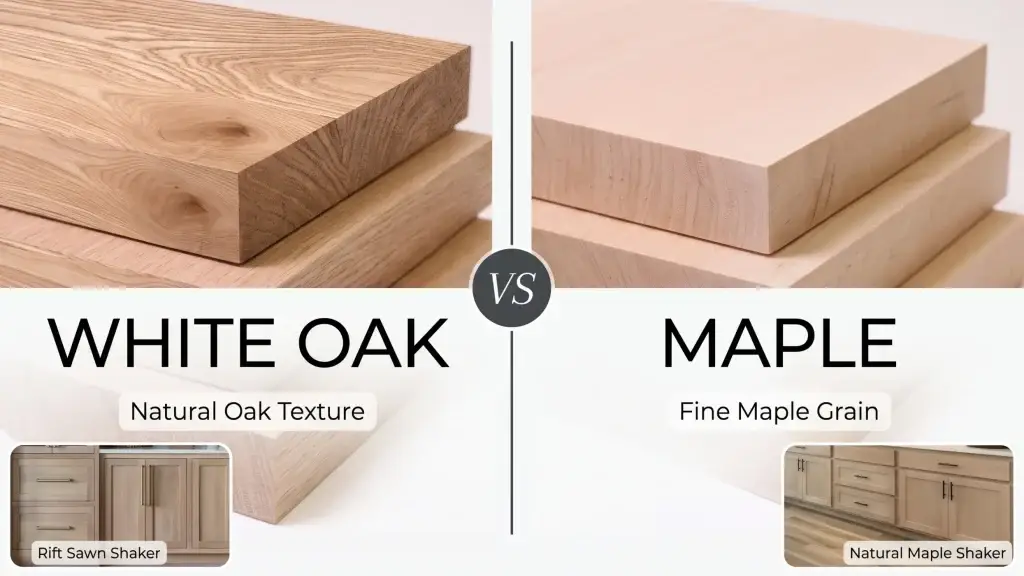
| Engineering Parameter | Hard Sugar Maple (Acer saccharum) | American White Oak (Quercus alba) | Millwork Significance |
| Janka Hardness Rating | 1,450 lbf (6,450 N) | 1,360 lbf (6,050 N) | High resistance to impact, denting, and daily jobsite wear |
| Cellular Pore Anatomy | Diffuse-Porous / Closed-Pore Structure | Ring-Porous / Open-Pore Structure | Governs paint absorption vs. stain depth and cerused grain definition |
| Dimensional Stability (T/R Ratio) | Tangential: 9.9% / Radial: 4.8% (2.06) | Tangential: 10.5% / Radial: 5.6% (1.87) | Predicts seasonal movement across width under fluctuating indoor relative humidity |
| Tannin Chemistry | Very Low Tannin Content | High Natural Tannic Acid Concentration | Inherent rot/fungal resistance; dictates chemical reactivity with ebonizing stains |
| Primary Architectural Use | Ultra-Smooth Dead-Matte Paint, Dovetail Boxes | Rift-Cut Architectural Grain, Wire-Brushed Finishes | Governs whether millwork relies on solid lumber or sequence-matched veneers |
Specifying for an upcoming residential project?
Request an Architectural Finish Sample Box — Includes 5 GU dead-matte painted hard maple swatches, sequence-matched rift white oak veneer panels, and custom-stained wood profiles.
Wood Mechanics & Cellular Anatomy: Density, Hardness, and Stability
Understanding the structural behavior of custom casework begins at the microscopic cellular level. Both hard maple and American white oak are dense, heavy-duty hardwoods capable of withstanding decades of residential wear, but their microscopic vascular structures dictate how they react to mechanical stress and seasonal indoor climate changes.
Hard Maple: The Closed-Pore Structural Powerhouse
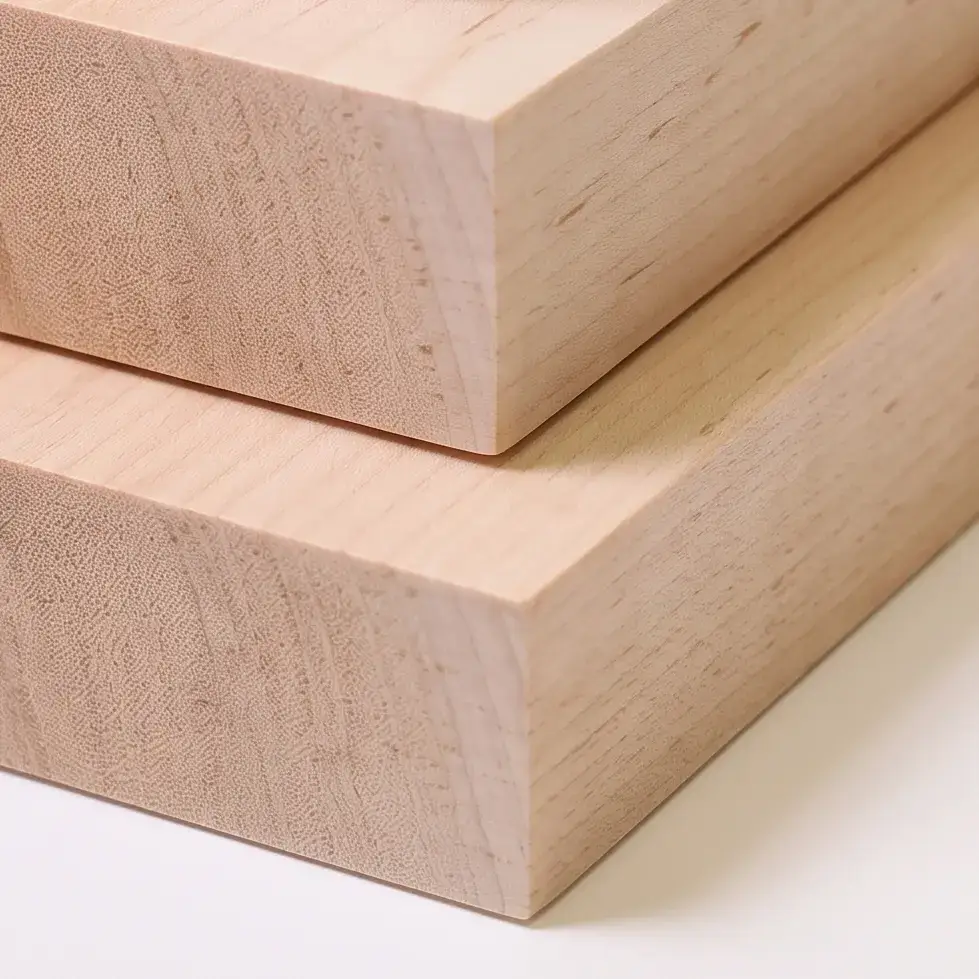
Hard sugar maple (Acer saccharum) possesses a diffuse-porous anatomy characterized by microscopic, tightly packed pores distributed evenly across annual growth rings. With a Janka hardness rating of 1,450 lbf, it is one of the hardest commercially available domestic woods in North America. This cellular density provides exceptional compression strength, tight screw-holding integrity, and superior resistance to surface indentations.
Because maple has virtually no open surface vascularity, it presents a dense, non-fibrous surface. However, maple exhibits significant volumetric shrinkage across its tangential axis when exposed to dry winter air. When specifying solid maple for wide casework components, millwork engineers must account for cross-grain dimensional movement to prevent seasonal binding across drawer openings.
White Oak: Open Vascularity and Natural Durability
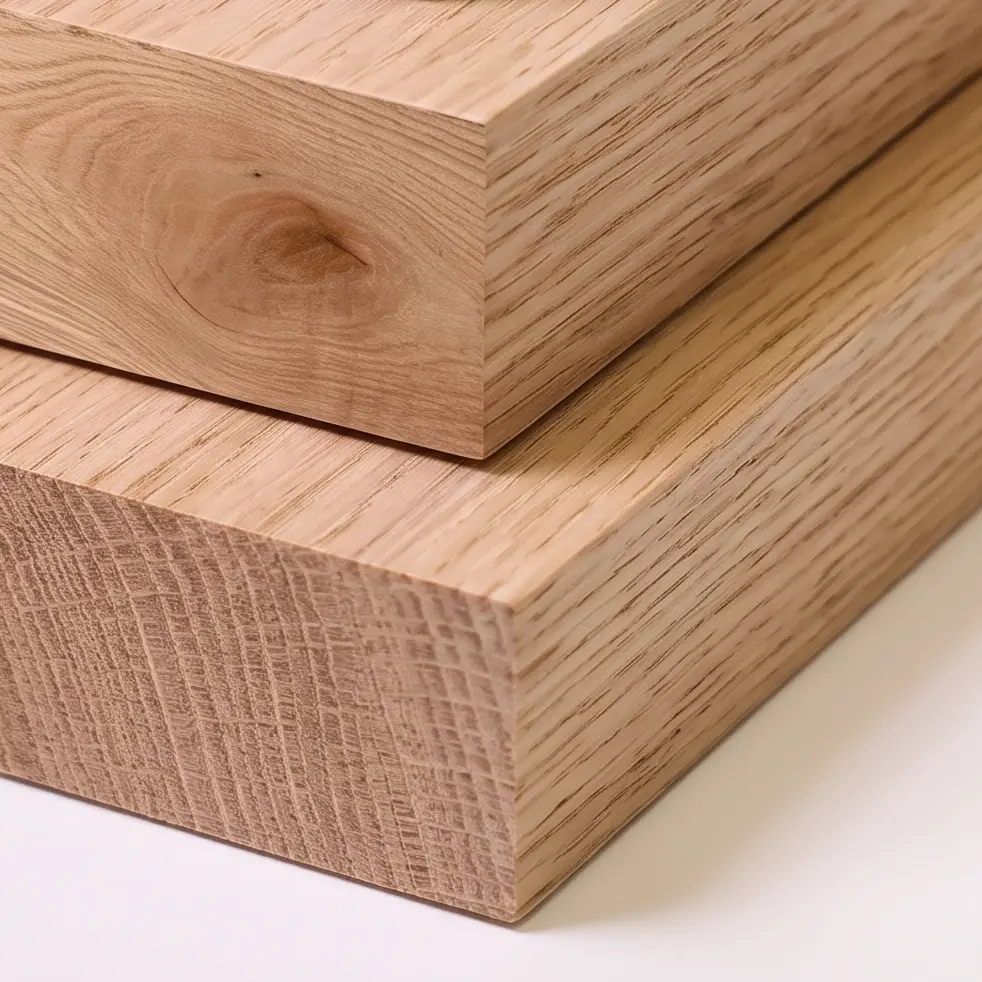
American white oak (Quercus alba) is classified as a ring-porous wood with large, open earlywood vascular tubes and visible medullary rays. Despite a slightly lower Janka hardness of 1,360 lbf compared to hard maple, white oak demonstrates superior transverse shear strength.
Crucially, white oak’s cellular pore cavities are naturally filled with microscopic crystalline structures known as tyloses. These tyloses seal the wood’s vascular cells, preventing water infiltration and capillary action. Combined with high natural concentrations of tannic acid, white oak is inherently resistant to fungal decay and wood-boring insects. This anatomical barrier makes white oak the superior structural substrate for high-moisture millwork applications, including under-sink sink bases and coastal luxury environments.
Surface Finishing Dynamics: Seamless Lacquer vs. Architectural Grain
Surface finishing highlights the most distinct functional divide between maple and white oak. The cellular structure of each species determines whether it serves as an ultra-smooth substrate for high-performance paint or an expressive canvas for architectural stains.
Hard Sugar Maple Finishing Workflow: Closed-pore substrate received with multi-pass sanding, followed by high-solids polyurethane primer, and finished with 5 GU dead-matte paint. This yields a monolithic, porcelain-smooth surface with zero grain telegraphing.
Rift-Cut White Oak Finishing Workflow: Open-pore anatomy processed with wire-brushed texturing or architectural staining, finished with non-yellowing clear UV flat sealers. This produces linear vertical grain with tactile depth and natural light diffusion.
Why Maple Dominates Painted Cabinetry
For high-end transitional and modern kitchens requiring satin, matte, or dead-matte painted finishes (<5 Gloss Units), hard maple is the premier solid wood choice. Because maple lacks large, open vascular canals, liquid primers and high-solids polyurethane topcoats cure without “grain telegraphing”—the common defect where recessed wood pores telegraph through cured paint as tiny pinholes or uneven troughs.
When manufacturing natural maple cabinets kitchen layouts with clear coats, maple yields a warm, creamy blond appearance with fine, subdued curly or bird’s-eye figures. However, when specified for pigmented coatings, maple accepts multi-stage catalyzed finishes to create a porcelain-smooth, monolithic surface that cannot be replicated on coarse-grained woods.
White Oak Grain Architecture: Plain Sawn vs. Rift Sawn
White oak is rarely specified for opaque paint because its prominent open pores create a rough texture under enamel. Instead, it is the premier choice for architectural stains, reactive ebonizing, and wire-brushed low-luster sealers.
The aesthetic and structural value of white oak depends directly on the log breakdown pattern:
Plain Sawn (Flat Sawn): Sliced tangential to growth rings, producing dramatic cathedral arches. While popular in rustic installations, cathedral grain can look busy across large architectural spans and exhibits higher seasonal movement across panel widths.
Quarter Sawn: Cut radially at a 90-degree angle to annual rings, revealing straight parallel grain accompanied by reflective ribbon-like fleck marks (medullary rays).
Rift Sawn: Cut at a precise 45-degree angle to growth rings, intentionally slicing past medullary rays. This specialized milling produces rift white oak cabinets featuring exceptionally tight, vertical pencil-straight grain without medullary fleck. For modern minimalist and contemporary Euro-style kitchens, rift-sawn oak provides continuous linear uniformity across multi-panel runs.
Casework Dynamics: Shaker Mechanics, Slab Panels, and Dovetail Drawers
A primary failure point in custom residential millwork is mismatching lumber species with door construction profiles or using substandard joinery in high-cycle components. Wood naturally expands across its grain as indoor relative humidity fluctuates through seasonal heating and cooling cycles.
The Shaker Dynamic: Solid Rails and Engineered Center Panels
For traditional 5-piece frames, oak shaker kitchen cabinets and maple shaker kitchen units utilize solid lumber for the 3/4″ perimeter stiles and rails. In a high-quality shaker door, five individual components assemble using mortise-and-tenon or precision dowel joinery:
Controlling Hairline Joint Cracks in Maple: On painted maple shaker kitchen units, temperature swings cause solid wood stiles and rails to move perpendicular to each other at the 90-degree corner joints. Over time, this natural movement can fracture standard brittle paint films, creating hairline joint fractures. To eliminate this, industrial manufacturing incorporates a floating center panel cushioned by elastomeric compression barrel spacers (Spaceballs), allowing the solid perimeter frame to expand without binding the center panel.
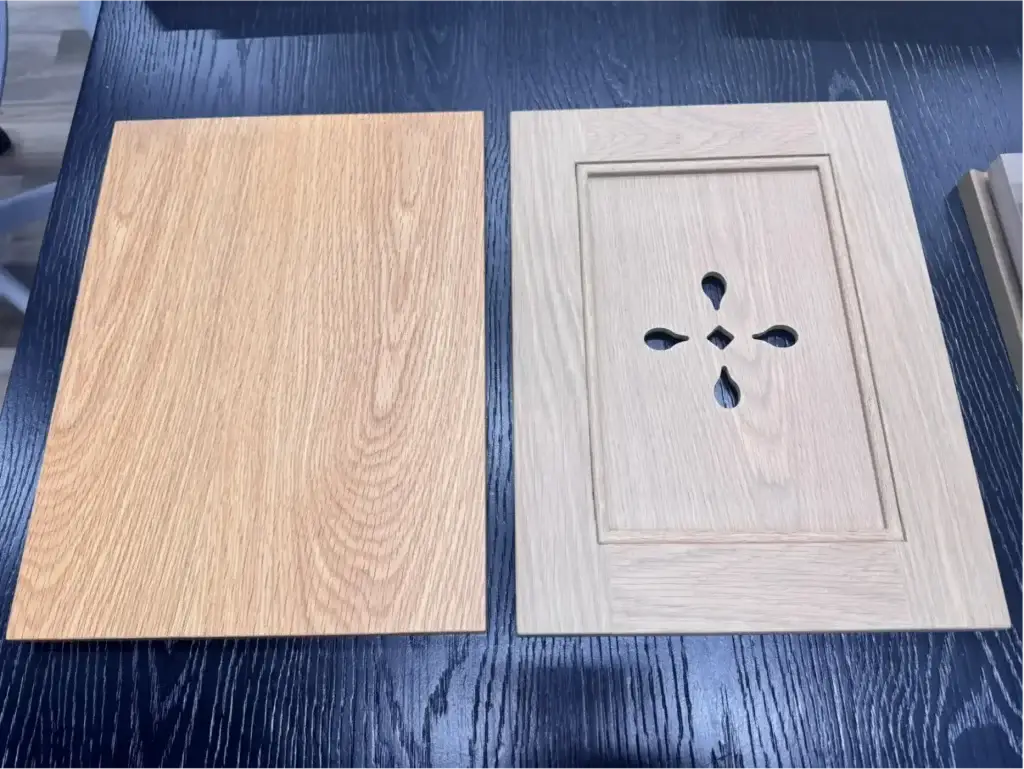
Grain Continuity in Oak Shakers: When manufacturing oak shaker kitchen cabinets, assembling solid oak frames around a matching flat center panel requires careful lumber selection. If the center panel uses flat-sawn cathedral oak while the stiles are quarter-sawn, the mismatch creates visual tension. Premium installations specify sequence-matched rift veneer panels set within solid rift oak stiles.
The Slab Door Paradox: Veneer vs. Solid Wood
A frequent question raised by builders and homeowners is veneer vs solid wood cabinets for modern, flat-panel slab doors.
In modern architectural millwork, wide, full-height slab cabinet doors (such as 8-foot or 9-foot tall integrated pantry panels) should never be fabricated from wide glued-up solid hardwood boards. Solid lumber across a 24-inch or 36-inch wide slab door will cup, bow, or warp by 1/4″ to 1/2″ as interior humidity changes, breaking the critical 1/8″ reveal line and preventing concealed soft-close hinges from latching.
True engineering stability requires specifying architectural wood veneer pressed over a cross-laminated 18mm CARB P2 plywood core or water-resistant high-density core. For panels exceeding 84 inches (2,100mm) in height, factory-installed dual concealed mechanical door straighteners (tensioner rods) are routed flush into the panel back. These tensioners provide bi-directional adjustment to keep tall modern slab doors plumb over decades of continuous HVAC operation.
Kinetic Performance: Solid Maple Dovetail Cabinet Drawers
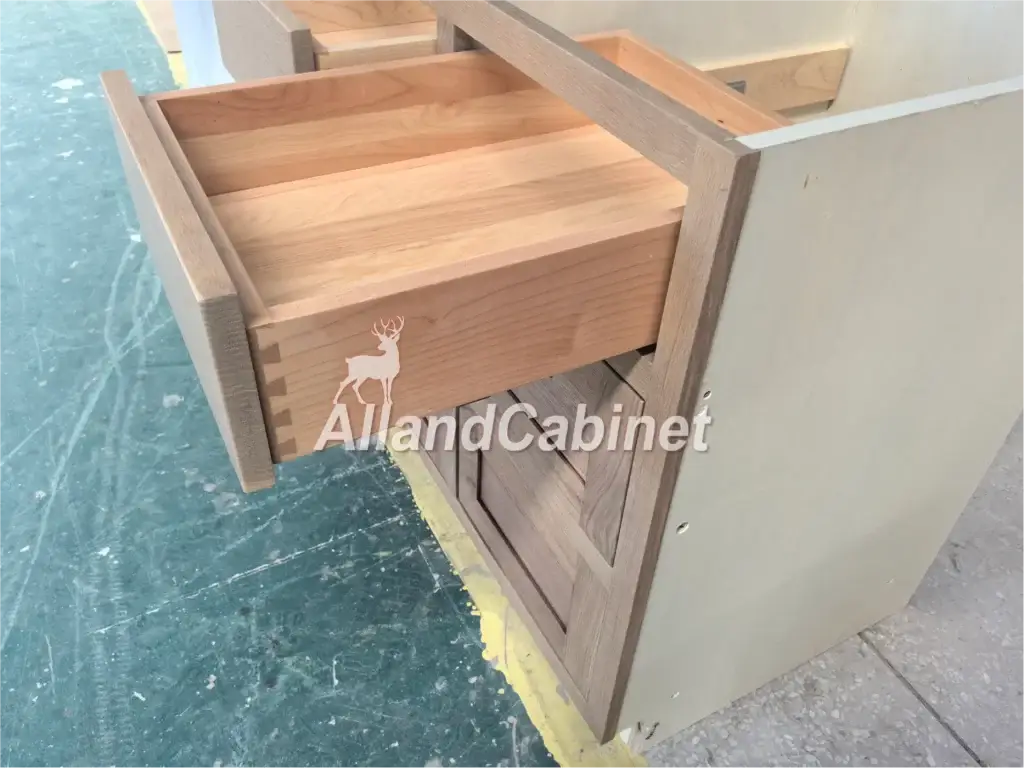
While cabinet doors define exterior aesthetics, drawer boxes endure the highest mechanical cycles in residential kitchens. Premium cabinetry specifications mandate solid wood dovetail cabinet drawers over nailed or dowelled particleboard assemblies.
Solid hard maple is the North American standard for dovetail construction. Its 1,450 lbf Janka rating and tight closed grain resist the continuous impact of heavy cookware, cutlery abrasion, and hardware stress. Interlocking English dovetail pins provide mechanical tensile strength that prevents box separation under heavy dynamic loads. Paired with concealed undermount full-extension soft-close runners rated for 40kg to 70kg, solid maple dovetail cabinet drawers ensure lifetime functional alignment without sagging or racking.
Line-Item Cost Architecture & Value Engineering
When planning kitchen renovations or new multi-unit residential developments, evaluating custom kitchen cabinet cost requires transparent material allocation. Cabinetry budgets vary significantly based on species selection, lumber grading, and milling recovery factors.
The Cost Variables: Why Rift White Oak Commands a Premium
Hard sugar maple is widely sourced from northeastern North American commercial timber forests with high yield efficiency, providing stable board costs. Plain sawn white oak carries a comparable material baseline.
However, rift white oak cabinets command a 25% to 40% cost premium over standard hard maple. This cost difference is driven by lumber recovery physics: milling logs at a continuous 45-degree angle to annual rings produces narrow boards and generates up to 50% saw-kerf and wedge off-fall waste. Sourcing continuous, sequence-matched FAS-grade rift oak flitches across an entire kitchen requires grading and culling hundreds of linear board feet of raw lumber.
The 3 Project Budget Tiers
Tier 1: Architectural Luxury (Rift Sawn White Oak Focus): Designed for custom homes specifying seamless floor-to-ceiling runs, handleless aluminum Gola channels, and waterfall stone perimeters. Uses consecutive flitch-matched rift white oak architectural veneer over marine-grade cores.
Tier 2: Premium Transitional (Painted Hard Maple Focus): Designed for tailored residential estates. Features 5-piece solid hard maple shaker kitchen units coated in 5-stage catalyzed dead-matte polyurethane paint (<5 GU), paired with solid maple dovetail cabinet drawers.
Tier 3: Hybrid Value-Engineered Casework: Blends material strengths across functional zones to optimize custom kitchen cabinet cost without aesthetic compromise:
Visual Focal Points: Island surrounds, open display shelving, and range hood surrounds specify rift-cut white oak;
Perimeter Storage: High-wear perimeter cabinet banks utilize painted maple shaker door profiles;
Drawers & Boxes: Solid hard maple dovetail cabinet drawers matched to 18mm formaldehyde-free multi-ply plywood carcass boxes.
Procuring factory direct casework eliminates unnecessary dealer margins. Commercial builders interface directly with our engineering department at ALLAND to refine CAD submittals straight into industrial CNC production, providing line-item transparent bill-of-materials (BOM) pricing for every cabinet box.
Climate Resilience: Adapting to North American HVAC Cycles
Residential millwork in North America faces harsh environmental cycles. Homes in the Northeast and Midwest cycle between high summer humidity and dry winter forced-air heating, with indoor relative humidity (RH) swinging from 65% down to 20%. In coastal regions, persistent salt-laden humidity challenges wood finishes.

White Oak Performance in High-Moisture Environments
Thanks to its natural internal tyloses and high tannic acid content, American white oak is the superior technical selection for installations prone to moisture exposure. It resists fungal breakdown around undermount kitchen sinks, built-in dishwasher air cavities, and coastal island installations. When treated with non-yellowing, exterior-grade clear UV sealers, white oak retains dimensional stability without the wood rot risks common to softer hardwoods.
Maple Maintenance in Forced-Air Environments
Hard maple performs best in controlled indoor environments maintained within 35% to 55% relative humidity. In homes with dry forced-air heating, solid maple components shrink across the grain if the wood was not seasoned to proper baseline moisture levels. Specifying hard maple for custom millwork requires verifying that raw timber undergoes precision kiln-drying down to an internal moisture content (MC) of 8% to 10% before CNC processing.
Factory Quality Assurance Protocol for Direct Millwork Procurement
Sourcing custom cabinetry directly from offshore manufacturing facilities requires removing installation risks before shipping containers leave the plant. Rectifying dimensionally warped solid wood components or mismatched door finishes on a North American jobsite costs significantly more under domestic emergency trade rates. At our ALLAND production facility, we safeguard millwork through three quality-control protocols:
Phase 1: Dual-Dimensioned Shop Drawing Standardization
Before automated cut-lists are released to CNC nesting centers, our drafting team produces comprehensive architectural shop drawing submittals. Every cabinet run is dual-dimensioned in metric manufacturing units and North American feet/inches.
Appliance specifications—including rough-in cutouts for Sub-Zero, Wolf, Thermador, and Miele built-in refrigeration—are verified against manufacturer technical manuals. Service cavities (rear air gaps) behind base and tall units are dimensioned to accommodate plumbing rough-ins and electrical junction boxes without cutting into structural drawer backs on site.
Phase 2: 1:1 Full-Scale Horizontal Factory Dry-Fit Staging
Prior to export packaging, entire cabinetry runs—including perimeter tall units, range walls, center islands, and integrated dovetail cabinet drawers—are pre-assembled on leveled workshop floors. Quality control technicians use precision digital laser levels to verify consistent 1/8″ door reveals, confirm smooth alignments across Gola profile junctions, check soft-close slide clearances, and test push-to-open mechanical releases under full load. Every cabinet box is labeled with a sequence number correlating directly to the approved architectural floor plan.
Phase 3: Marine Moisture-Barrier Packaging & Direct Containerization
To protect custom millwork during intermodal ocean transit, all finished wood components are wrapped in impact-resistant corner edge protectors and sealed in heavy-duty polyethylene shrink-film barriers to prevent salt-air moisture ingress.
Cabinets are packed in fully enclosed, heat-treated fumigation-free plywood crates reinforced with heavy-gauge steel banding. Crates are blocked, strapped, and weight-balanced inside 40-foot HQ shipping containers to eliminate shifting, structural racking, and panel abrasion during transoceanic shipping.
Request Your Itemized Line-Item Cabinetry Takeoff
Choosing between white oak and hard maple for custom millwork does not require navigating speculative dealer markups or managing uncoordinated trade timelines. Achieving architectural precision begins with rigorous construction drawings, verified substrate physics, and direct industrial collaboration.
General contractors, project developers, and architectural design firms are invited to submit their floor plans, elevation PDFs, or CAD schedules for engineering review. The project engineering and millwork drafting team at ALLAND provides a comprehensive takeoff package within 48 business hours, complete with:
Full-scale metric and imperial dual-dimensioned shop drawing submittals detailing structural reveals, rough-in cavities, and appliance clearances;
Fully itemized, line-item manufacturing cost breakdowns detailing materials, door profiles, solid dovetail cabinet drawers, and kinetic hardware;
Direct-shipped architectural finish sample boxes, including dead-matte painted hard maple swatches, sequence-matched rift white oak veneer samples, and custom wood stain formulations.