
Which Grain is Best? Rift vs. Plain Sawn White Oak Cabinets Kitchen
In luxury residential architecture and high-end property development, specifying a white oak cabinets kitchen package has permanently transitioned from a passing trend into an enduring architectural standard. Architects, general contractors, and luxury homeowners favor natural White Oak (Quercus alba) for its organic warmth, structural integrity, and calm, linear grain discipline that seamlessly bridges modern minimalism with transitional comfort.
However, for the professional builder and developer, specifying natural timber is as much an engineering responsibility as it is an aesthetic asset. Without an understanding of cellular moisture mechanics, annular growth-ring geometry, and tannic acid reactivity, large-scale custom oak millwork faces severe jobsite liabilities: bowed 10-foot tall pantry doors, joint separation in frameless casework, failed miter corners, and blotchy amber discoloration.
At ALLAND, custom cabinetry is engineered as an architectural sub-system. We combine precision CNC joinery, automated positive-pressure clean rooms, and sustainable forest sourcing to ensure long-term stability. This technical whitepaper breaks down cellular biology, grain-cutting physics, door style adaptations, and industrial finishing protocols to help you specify high-performance custom kitchen cabinetry packages built to last for generations.
1. The Biological Advantage: Why Quercus Alba Over Quercus Rubra?
When clients request “Oak Cabinets,” they typically envision a light, organic stain tone. For construction professionals, specifying natural timber begins at the cellular anatomy level. At ALLAND, we exclusively engineer custom cabinetry using genuine American White Oak (Quercus alba) rather than Red Oak (Quercus rubra) to eliminate moisture-induced warranty failures.
The Tyloses Factor: The "Closed-Pore" Reality
Unlike Red Oak, whose vascular tubes resemble a bundle of hollow straws that rapidly absorb moisture, White Oak’s earlywood vessels are densely packed with Tyloses—balloon-like cellular outgrowths that permanently seal the wood’s vascular transport system.
Engineering Relevance in Kitchen Environments: Kitchen millwork is subject to continuous hydrothermal stress from dishwashers, cooking steam, and shifting HVAC humidity. Because White Oak is biologically “self-sealed” at a microscopic level, liquid and steam penetration rates remain exceptionally low.
The Structural Result: Superior Dimensional Stability and Rot Resistance. While Red Oak swells across the grain when exposed to high humidity—causing door binding and failed miter joints—White Oak frames and carcasses maintain strict joint tolerances under severe hydrothermal fluctuations.
2. The Physics of the Cut: Specifying for Grain and Stability
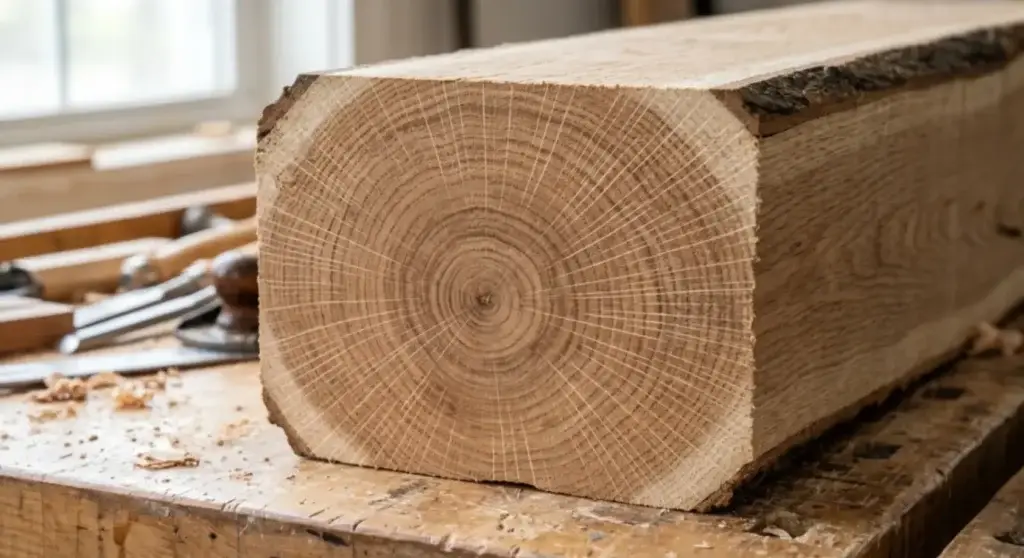
The visual character, tactile depth, and structural stability of wood grain kitchen cabinets are governed entirely by the geometric angle of the saw blade relative to the log’s annual growth rings. Understanding the yield-to-stability ratio is essential for budgeting and risk mitigation.
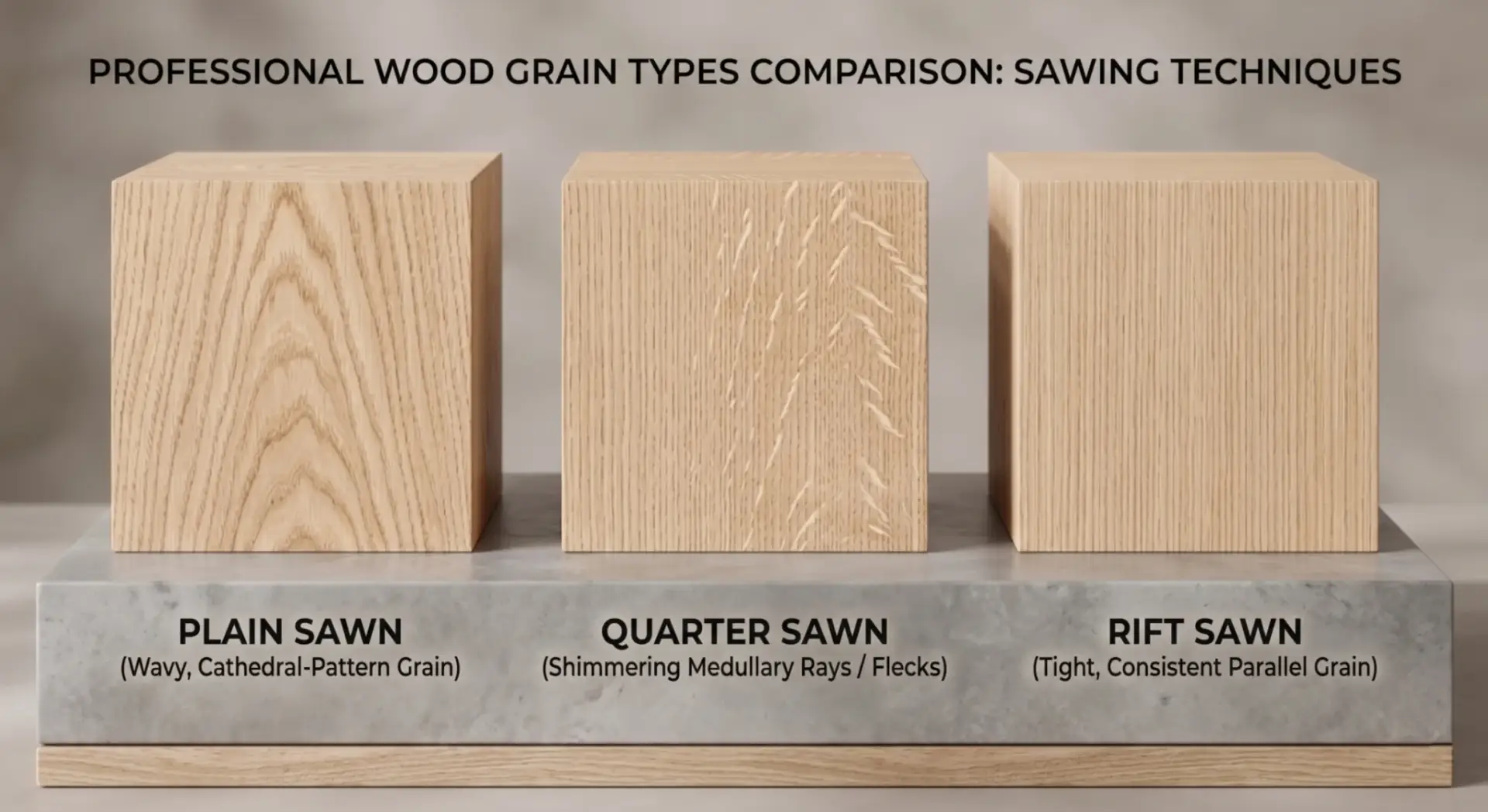
Plain Sawn (0°–30°): The Cathedral Grain
Plain sawn white oak cabinets are milled tangentially across the log, producing broad, looping “cathedral” arches.
Visuals: Traditional, highly figured organic patterns with prominent light and dark contrast.
The Technical Risk: Plain sawn lumber exhibits the highest tangential shrinkage ratio (T/R≈ 2:1). As seasons change, plain sawn boards expand and contract significantly across their width, making them unsuitable for wide single-piece slab doors or tall full-overlay runs where door edges can bind against adjacent units.
Quarter Sawn (60°–90°): The Stability Specialist
Quarter sawn white oak cabinets are cut radially from the center of the log, yielding exceptional structural discipline.
Visuals: Features shimmering ribbons crossing the vertical grain lines, known as “Ray Flecks” or Medullary Rays.
The Physics: Because growth rings run perpendicular to the board face, quarter sawn timber expands in thickness rather than width. It provides double the dimensional stability of plain sawn stock, making it the premier choice for coastal estates and high-humidity climates.
Rift Sawn (30°–60°): The Architectural Standard
Rift sawn white oak cabinets represent the absolute benchmark for contemporary minimalist, transitional, and European organic architecture.
Visuals: A clean, hyper-linear vertical grain pattern with zero cathedral arches and minimal ray flecking.
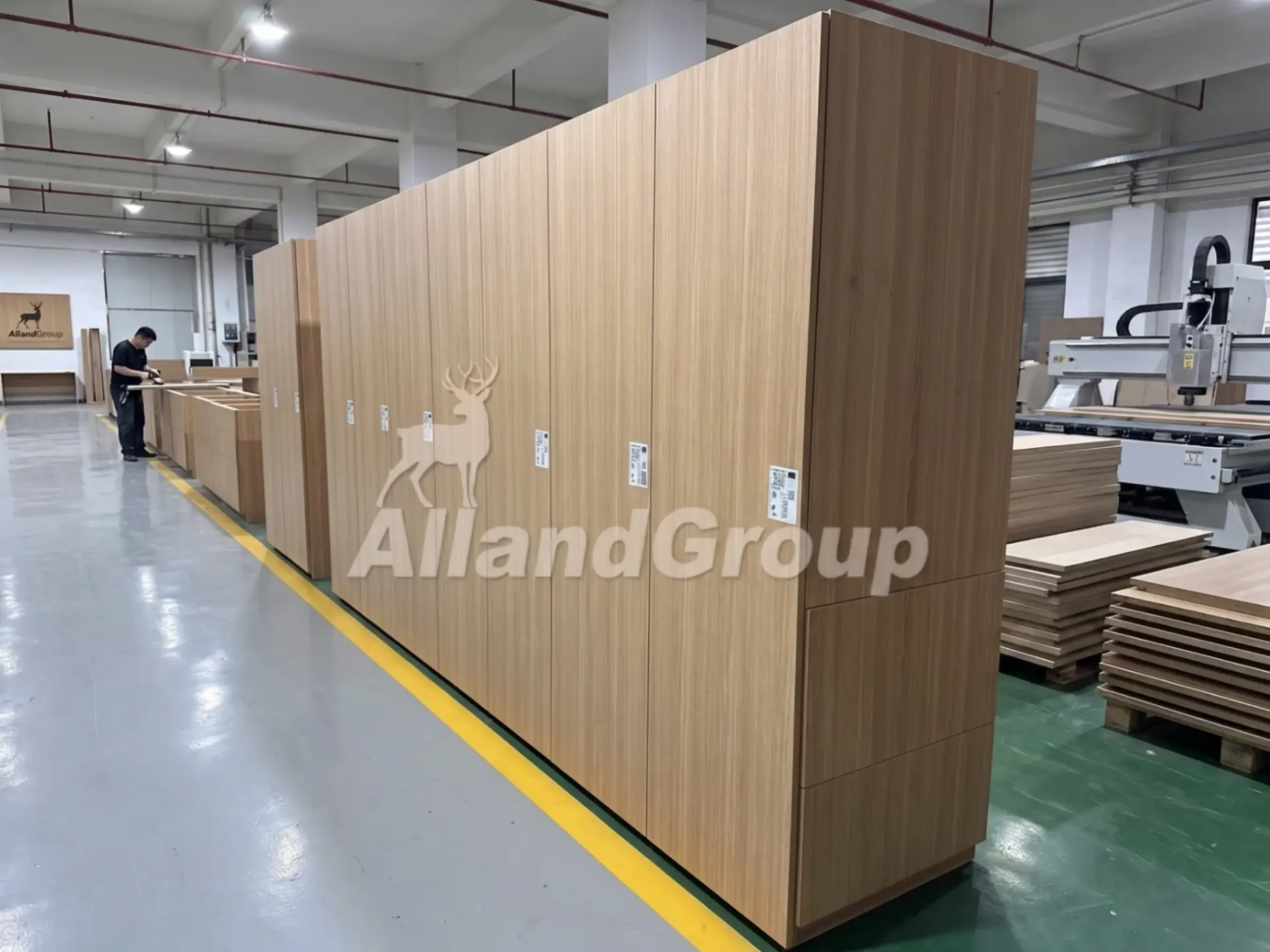
The B2B Engineering Reality: Rift sawing requires angling the saw to isolate 45° growth rings, resulting in high milling waste (lowest log yield) and commanding a 20% to 30% cost premium. However, this cut offers perfectly uniform internal stress distribution. For 8-foot to 10-foot floor-to-ceiling pantry doors and integrated refrigeration panels featured in our custom cabinet doors guide, Rift Sawn White Oak is the only cut guaranteed to resist bowing or cupping over time.
3. Surface Chemistry: Achieving the "Invisible" Matte Finish on Natural Oak Cabinets
The most frequent complaint from high-net-worth homeowners regarding natural oak cabinets is that they prematurely amber into an unnatural yellow or feel coated in a thick, artificial plastic film. This is not a failure of the timber—it is a failure of finishing chemistry and surface preparation.
Managing Tannin Pull and UV Ambering
White Oak is loaded with naturally occurring tannic acid (8% to 10% by weight). When standard waterborne clear topcoats are sprayed without an engineered barrier, the water activates water-soluble tannins, pulling them to the surface in an uneven, blotchy mustard-yellow hue known as “Tannin Bleed.”
The ALLAND Multi-Stage Finish Protocol
Isolating Tannin Blockers: We apply an automated, industrial-grade neutralizing wash primer that chemically chelates free tannic acid inside the wood pores, permanently locking the timber in its raw, organic “Wheat” or “Sand” architectural state.
Ultra-Matte 5° Sheen Polyurethane: Traditional polyurethanes create an artificial glossy plastic film that obscures the wood’s organic character. ALLAND applies an imported European 2K catalyzed polyurethane topcoat calibrated to a 5% dead-matte sheen. It delivers an untreated, raw-wood visual aesthetic while providing an impervious, KCMA-certified barrier against red wine, cooking grease, and hot kitchen oils.
Preserving Open-Pore Tactility: Our automated sanding and spraying lines avoid flooding the natural grain valley, leaving the tactile micro-texture of the wood grain exposed to the fingertips.
4. Sequence Grain Matching and Precision Splicing
For multi-unit developers, general contractors, and luxury estate builders, sourcing custom millwork from local boutique shops often results in production bottlenecks, erratic lead times, and uncontrolled grain variance. ALLAND operates at the intersection of artisanal architectural craft and high-volume industrial automation.
Sequential Flitch Matching (Zero "Grain Jump")
One of the most visible failures in large custom kitchens is “Grain Jump”—where adjoining doors or drawer faces display jarring differences in grain density, color tone, or angle.
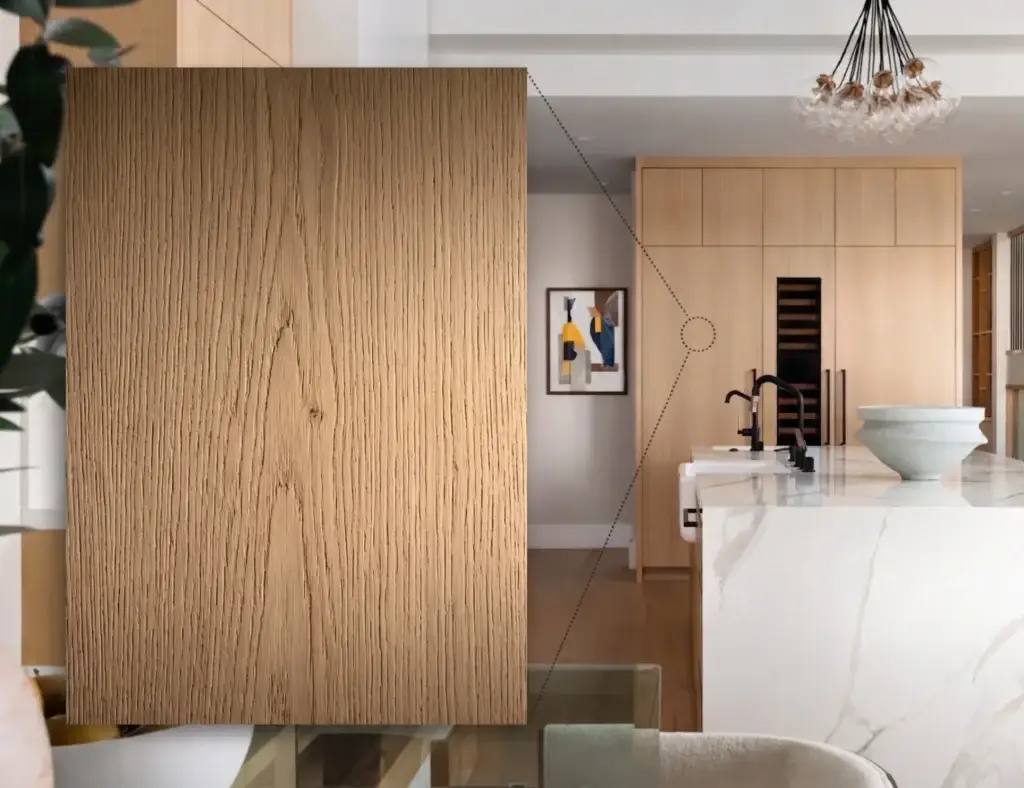
Our Process: For premium Rift and Quarter Sawn projects, ALLAND utilizes Sequential Flitch Matching. We pull natural wood veneers sliced sequentially from the exact same log flitch, numbered in chronological production order.
Architectural Harmony: When your custom cabinetry is installed, the vertical wood grain flows unbroken across adjacent tall pantry towers, built-in appliance doors, and base drawer stacks, creating a continuous architectural tapestry across the entire wall elevation.
Precision Engineering for Seamless Jobsite Fit
Cabinetry is a game of millimeters. Delivering successful millwork across diverse climatic zones requires rigorous factory quality control:
Appliance Integration Precision: Sub-Zero, Thermador, and Miele panel-ready specifications are audited in our CAD department before cutting, maintaining tight 1/8″ (3mm) continuous reveal lines.
100% Horizontal Factory Dry-Fit Inspection: All custom white oak runs, islands, and tall appliance columns are pre-assembled horizontally in our factory prior to export crating, verified via 4K video inspection sign-offs.
Operating as a direct-to-trade custom cabinetry factory, we bridge architectural design with predictable factory pricing and on-schedule containerized delivery.
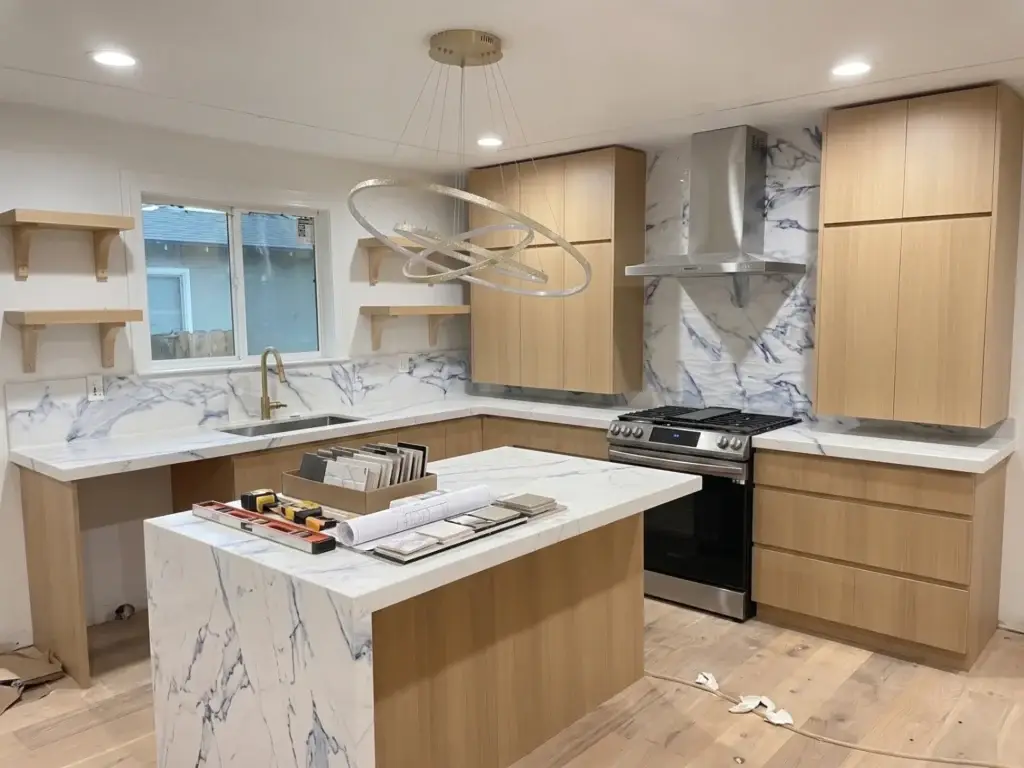
Architectural Case Study: California Transitional Estate
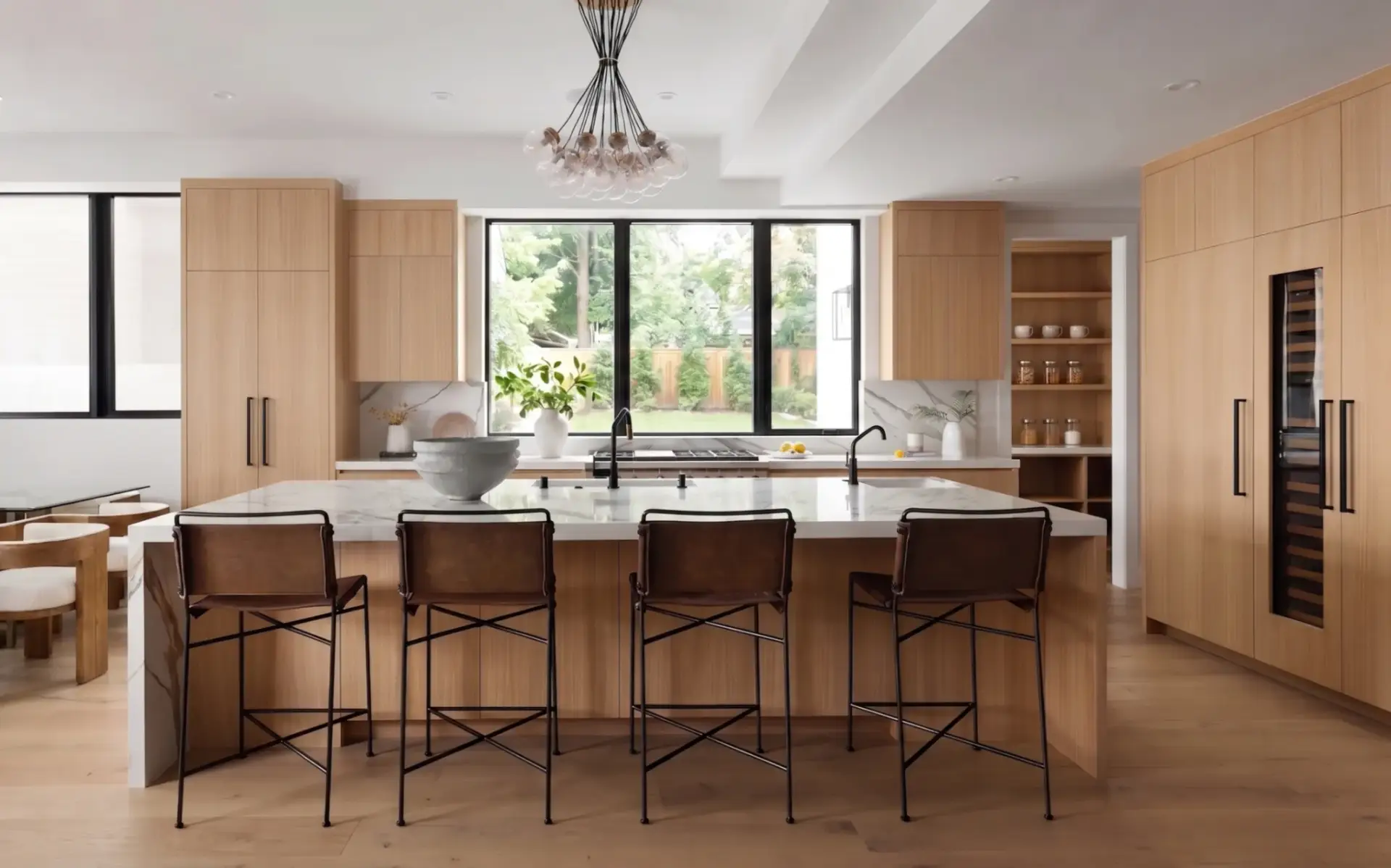
In this luxury residential kitchen in California, the architectural brief called for a warm, organic modern palette pairing custom white oak cabinets kitchen runs with dramatic natural stone veining.
Material Harmony: Rift Sawn White Oak wall and base cabinets finished in our 5° ultra-matte 2K protective sealer provide a calm, linear contrast to the bold blue-grey veining of the Calacatta quartzite countertops and full-height backsplash.
Floating Open Shelving Integration: Solid white oak floating shelves with internal heavy-duty steel mounting rods flank the range hood, adding open display space while maintaining continuous grain alignment with lower drawer runs.
Bring Your White Oak Vision to Life with Factory Precision
Planning a custom White Oak kitchen build, luxury estate casework run, or multi-family residential package? Upload your architectural floor plans, cabinet schedules, or CAD drawings (.pdf / .dwg). ALLAND’s engineering desk will review your grain specifications, calculate yield requirements, and deliver an itemized direct-from-factory cabinetry package estimate within 24 to 48 hours.
📐 Ready to start your custom white oak cabinetry build?