
2026 Oak Cabinets Kitchen Ideas for Modern Custom Homes
In luxury residential design and architectural property development, the conversation surrounding oak cabinets kitchen ideas has shifted from nostalgic rustic styling to a disciplined standard of organic modernism. High-net-worth homeowners, architects, and custom builders are bypassing sterile, high-gloss white surfaces in favor of the tactile warmth, acoustic softness, and structural permanence of natural oak millwork.
However, incorporating oak casework into contemporary construction involves nuanced material mechanics. Unlike uniform synthetic substrates, natural oak species—predominantly American White Oak (Quercus alba) and Northern Red Oak (Quercus rubra)—respond dynamically to indoor environmental shifts. Without precise log sawing specifications, moisture barrier chemistry, and balanced core construction, solid wood faces and wide veneer panels face jobsite risks of tangential swelling, joint cracking, and uneven amber discoloration.
Successfully executing custom oak kitchens requires balancing visual finish tones—from pale Nordic tones to deep wire-brushed charcoal—with stable joinery engineering. Here is the definitive specification guide for high-end custom kitchen cabinetry packages.
Light Oak Kitchen Cabinets and Modern Minimalist Luxury
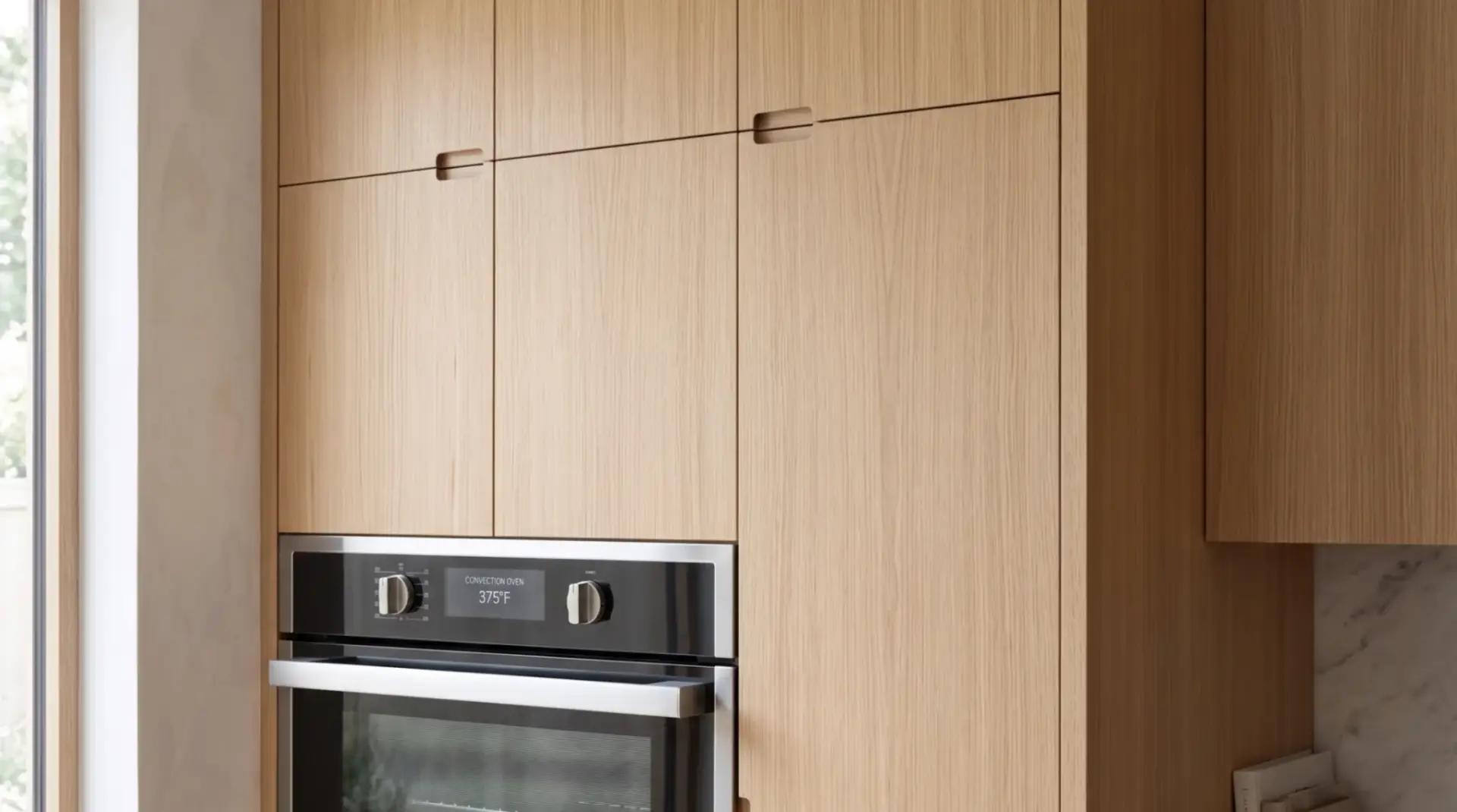
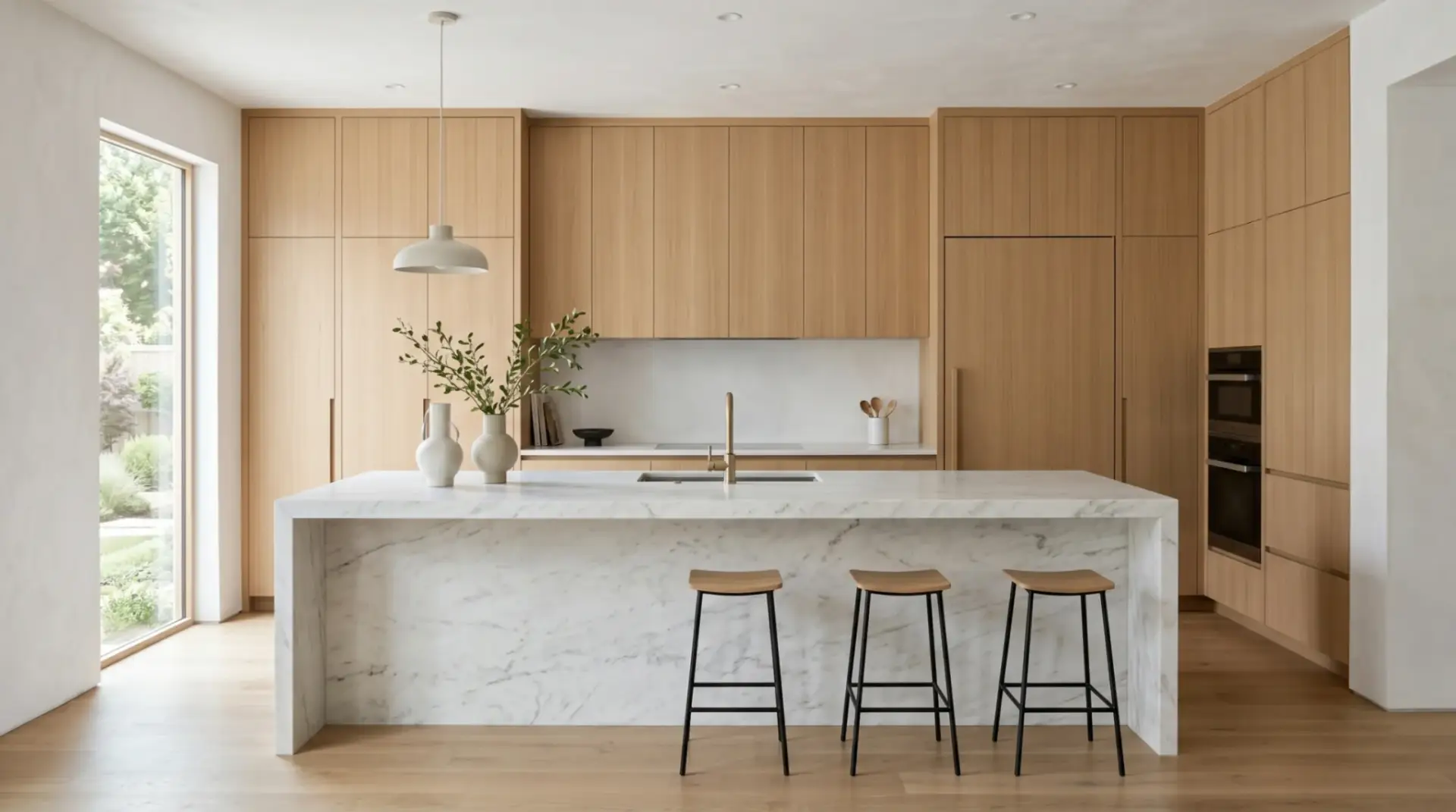
When specifying light oak kitchen cabinets for open-concept floor plans, the architectural goal is creating an expansive, luminous interior without washing out natural timber character. Light oak provides a neutral architectural baseline that pairs cleanly with cast concrete, honed limestone, and minimalist stainless steel.
Grain Control: The Power of Rift Sawn Milling
The visual refinement of pale oak depends directly on saw blade orientation. Standard plain-sawn (flat-sawn) boards display prominent, looping “cathedral” arches that can overwhelm minimalist spaces.
For high-end architectural millwork, specifying rift sawn white oak cabinets isolates a tight, perpendicular 45-degree grain orientation. This yields vertical linear striping that visually raises ceiling lines and allows integrated panel-ready refrigeration towers to align with adjacent runs.
Formulating the Anti-Yellowing Clear Barrier
The primary risk with pale timber cabinetry is photo-oxidation. Traditional nitrocellulose or solvent-borne clear coats react with ambient ultraviolet light, turning pale oak into an unwanted brassy yellow. Professional finishing schedules require:
Tannin-Passivating Primers: Chemically chelating free surface tannic acid to prevent water-activated “tannin bleed.”
UV-Absorbing 2K Topcoats: Applying non-yellowing acrylic-polyurethane protective coatings calibrated to a 5% dead-matte sheen, preserving raw wood aesthetics while resisting kitchen oils and cleaning chemicals.
Honey Oak Kitchen Cabinets with Contemporary Sophistication
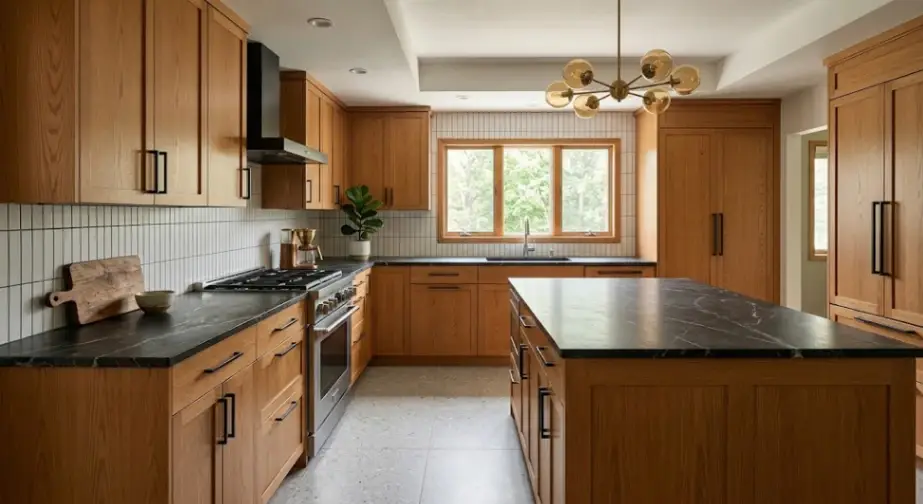
Mentioning honey oak kitchen cabinets often brings to mind the heavy, orange-varnished, raised-panel cabinets of the late 20th century. In modern interior architecture, however, honey oak has been re-engineered into a warm, caramel-infused palette that anchors transitional and mid-century modern spaces.
Modern Detailing for Warm Wood Tones
Executing a sophisticated honey oak kitchen requires clean geometry to balance rich wood tones:
Slim-Profile Door Architecture: Replace chunky raised profiles with narrow-rail Slim Shaker doors or precision-veneered flat slab doors.
High-Contrast Material Pairing: Pair warm caramel oak tones with dark soapstone, leathered granite, or charcoal quartz countertops. The dark stone balances golden wood undertones, transforming warmth into intentional historic luxury.
Concealed Full-Overlay Fit: Eliminate visible face-frames in favor of full-access European frameless construction with tight 1/8″ (3mm) cabinet reveals.
Dark Oak Kitchen Cabinets: High-Contrast Moody Elegance
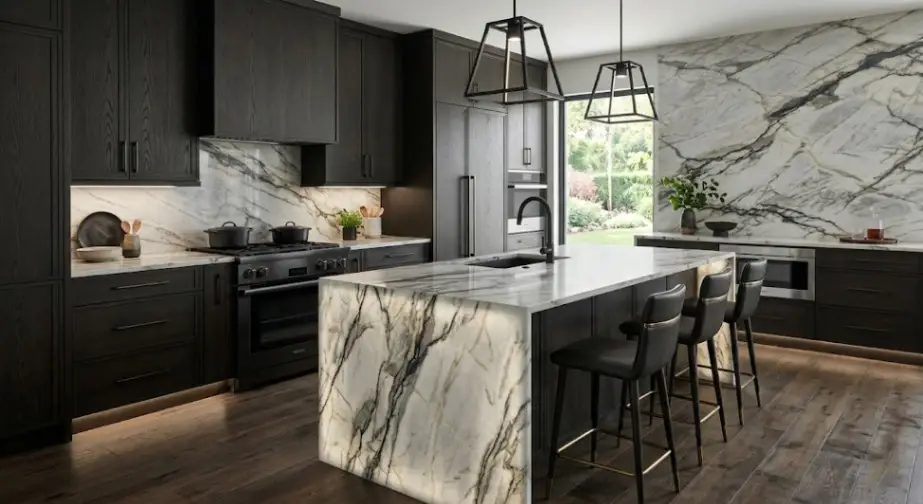
For luxury urban brownstones, penthouses, and executive estates, dark oak kitchen cabinets have emerged as an alternative to flat painted black cabinetry. Unlike painted surfaces that can feel opaque and sterile, dark-stained oak retains visible tactile grain relief, creating depth beneath dramatic architectural lighting.
Depth Through Wire-Brushing and Hand-Wiping
Creating high-end dark oak requires preserving wood cellular topography rather than covering it under thick opaque lacquers:
Mechanical Wire-Brushing: Soft earlywood cells are mechanically brushed away, leaving the dense latewood ridges raised and distinct.
Hand-Wiped Pigment Application: Deep espresso, charcoal, or obsidian wood dyes are hand-wiped into open pore valleys. Wiping clear the top ridges leaves dark pigment embedded deep within the wood grain, creating optical dimension under task lighting.
Dead-Matte Sealing: Applying an ultra-matte 3% sheen protective finish eliminates distracting glare while protecting dark surfaces from visible fingerprint oils.
Painting Oak Kitchen Cabinets: Open-Grain Textural Architecture
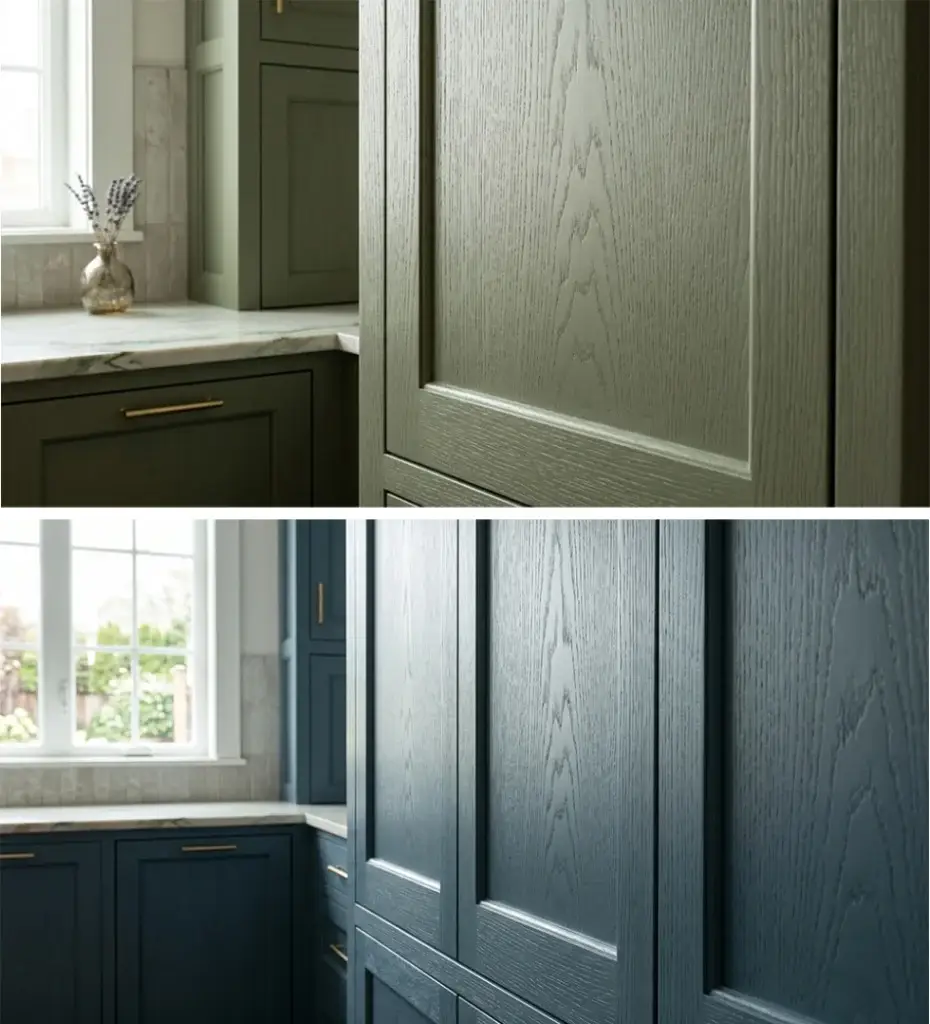
A common misconception is that oak is unsuitable for painted finishes due to its prominent wood pores. In modern high-end casework, painting oak kitchen cabinets has become a deliberate architectural technique to achieve an organic, textile-like surface on sage greens, deep navies, and warm charcoals.
Engineering Stability: Solving the "Joint Crack" Problem
Applying paint over solid wood frames introduces structural risks from seasonal humidity changes. When traditional solid wood panels expand or contract across the grain, the paint film bridges across the stiles and rails will crack along hairline glue seams.
To deliver painted oak cabinetry for high-humidity coastal and seasonal climates, factory engineering utilizes an advanced hybrid specification:
Engineered Composite Center Cores: Center panels are fabricated using high-density, moisture-resistant engineered cores laminated with thick genuine oak veneers on both sides. This ensures zero panel expansion while displaying open-pore wood texture.
Flexible 2K Polyurethane Lacquers: Utilizing elastic catalyzed polyurethanes allows the cured paint film to stretch slightly with ambient thermal movement, preventing spider-web cracking at 90-degree frame joints.
Natural White Oak Cabinets Kitchen Architecture: Sequence Flitch Matching
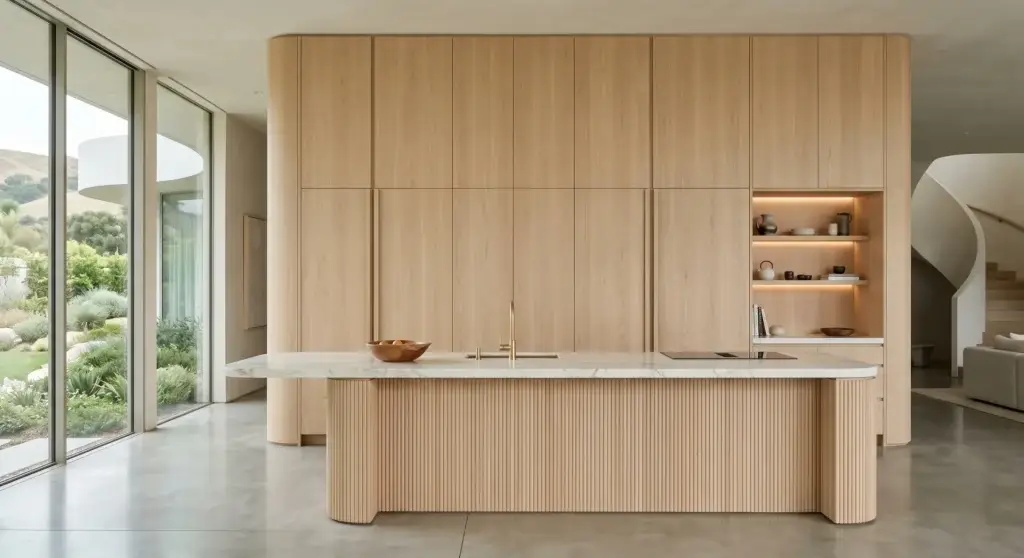
At the apex of residential millwork is the natural white oak cabinets kitchen specification. White Oak (Quercus alba) contains microscopic Tyloses that biologically plug its cellular vascular tubes, making it naturally resistant to water absorption and rot compared to red oak.
Eliminating "Grain Jump" in Full-Height Millwork
A common defect in large residential kitchens is “grain jump”—where adjoining doors show mismatched grain angles, varying densities, or clashing undertones.
Sequential Flitch Slicing: Premium white oak veneers are sliced sequentially from the exact same log flitch and numbered in order.
Architectural Wall Alignment: As casework is installed, vertical grain patterns flow continuously across adjacent tall pantry runs, integrated appliance panels, and lower drawer banks, creating an unbroken natural elevation.
Manufacturing Standards for Large-Scale Oak Cabinetry Projects
Delivering extensive oak kitchen packages across North American climate zones requires strict factory-floor quality gates. Sourcing casework directly from an export-focused custom cabinetry factory ensures millwork is engineered for jobsite stability before loading into containers:
Target Moisture Content Control: All natural oak lumber and veneer substrates are conditioned in climate-controlled kilns to maintain a strict 6% to 8% equilibrium moisture content (EMC), preventing joint shrinkage during dry winter heating seasons.
Heavy-Duty Plywood Carcass Chassis: Box carcasses utilize 3/4″ (18mm) CARB-2 / TSCA Title VI certified multi-ply birch plywood joined with precision dowel and confirmat screw engineering.
100% Factory Horizontal Dry-Fit Inspection: Complete custom cabinetry runs, integrated appliance panels, and complex curved islands undergo full pre-assembly on the factory floor to verify reveals and grain continuity via 4K video inspection before crating.