Inspiring Blue Kitchen Cabinets Ideas for Modern Custom Homes
Rich blue cabinetry brings timeless character, tactile warmth, and architectural permanence to modern luxury residences. Curated by our custom cabinetry engineering team, here are six definitive blue design schemes to inspire your upcoming project.
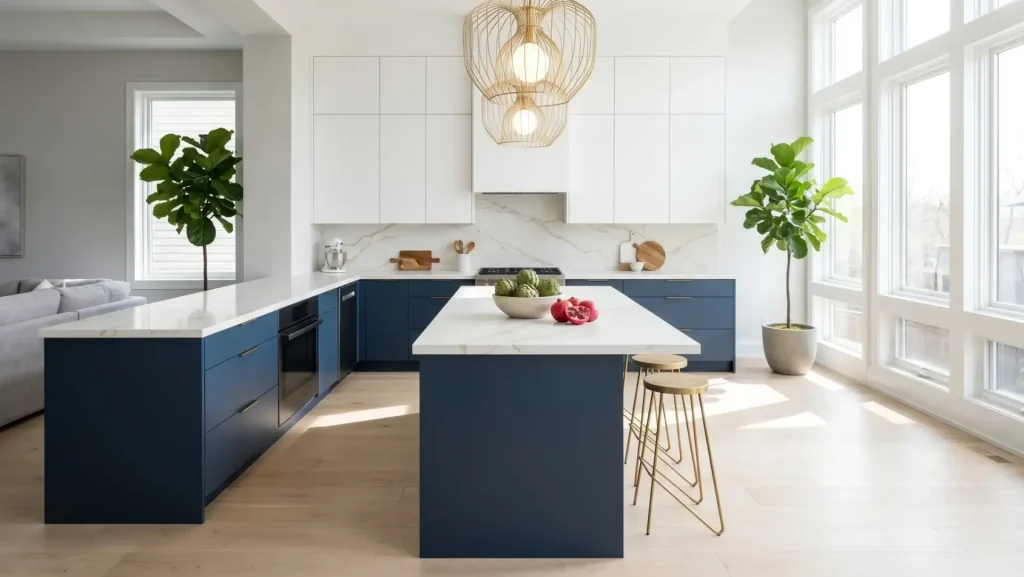
The High-Albedo Horizon — Modern Blue Kitchen Cabinets with Crisp White Surfaces
For homeowners who love dramatic color yet crave an airy, sun-drenched culinary environment, the two-tone “High-Albedo” scheme is an ideal solution. This design utilizes deep blue along the lower horizontal plane to anchor the footprint, while keeping the upper vertical elevation luminous and open.
Designing a Kitchen with Blue Cabinets and White Countertops
Curating the White Tone: When pairing modern blue kitchen cabinets with white elements, avoid stark, icy cold whites that can read clinical. Instead, specify softer tones with warm mineral undertones (such as Sherwin-Williams Alabaster or Benjamin Moore Simply White). This subtle warmth ensures the white surfaces reflect abundant daylight without clashing against the blue base units.
Continuous Horizon Island Tops: A seamless island waterfall countertop in engineered quartz with soft gold veining bridges the gap between the dark blue base structure and the light-filled ceiling, creating an inviting centerpiece for both prep work and morning entertaining.
Organic Synthesis — Deep Navy Blue Cabinets Paired with Rift White Oak
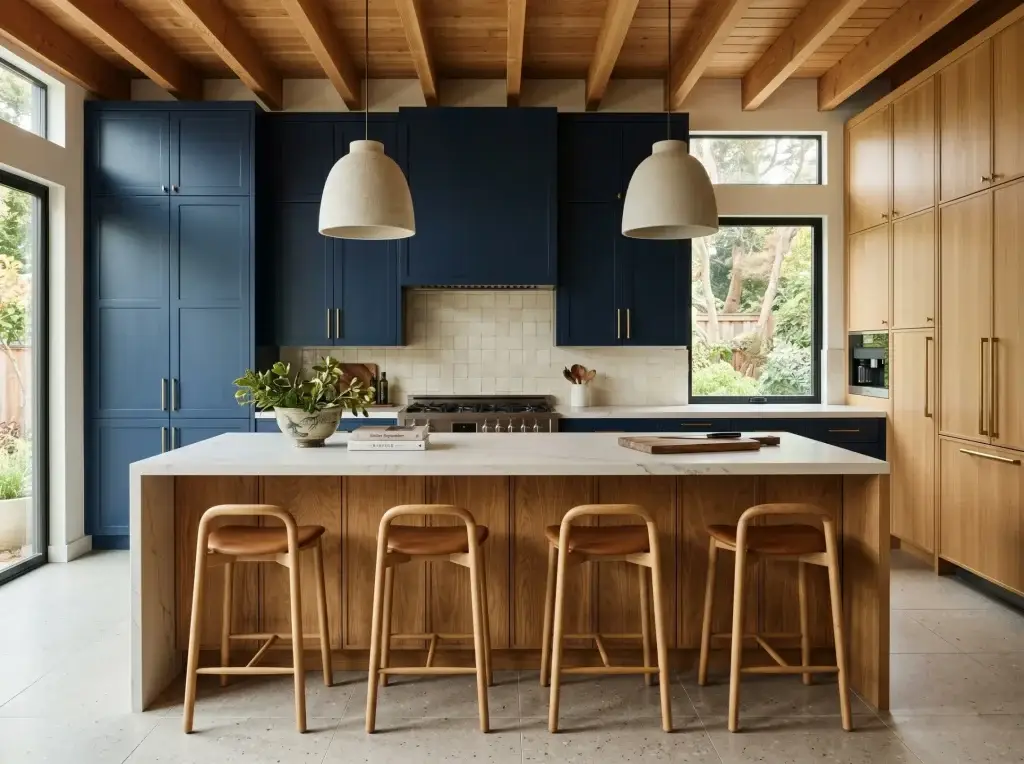
As luxury residential design trends heavily toward “Modern Heritage” and warm biophilic aesthetics, designers are celebrating the organic contrast of saturated navy blue kitchen cabinets paired directly with raw, linear timber.
Blending Saturated Color with Architectural Timber
Tactile Rift-Sawn Precision: Rather than rustic flat-sawn oak with prominent flame cathedrals, modern luxury spaces specify vertical Rift Sawn White Oak for the central island. The pinstripe-clean vertical wood grain introduces soothing tactile depth, grounding the cool navy perimeter with golden, honey-toned organic warmth.
Balanced Material Transition: Incorporating open floating wood shelving along the navy walls allows everyday ceramic dishware to be displayed beautifully, weaving the natural timber identity across the entire kitchen elevation.
The Monarch Statement — Blue Shaker Cabinets with PVD Brushed Gold Accents
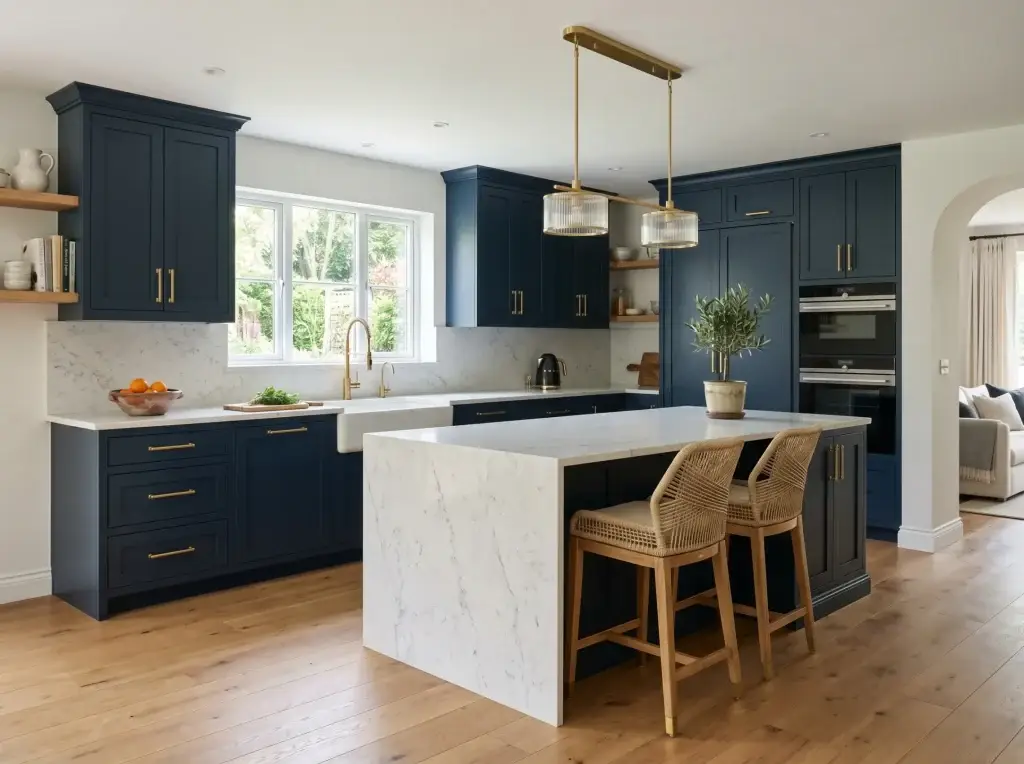
For transitional manors, historic brownstone renovations, and custom estate residences, blue shaker cabinets represent the perfect bridge between classic millwork detailing and modern tailoring. Working with deep navy tones, hardware transforms from functional utility into the literal jewelry of the kitchen.
Styling Blue Cabinets with Gold Hardware
The Jewel Effect of Satin Finishes: Highly reflective yellow brass can feel overly glossy against saturated blues. The refined modern choice is blue cabinets with gold hardware finished in brushed satin or champagne gold. These soft, non-reflective warm metals glow gently under ambient light, creating a tailored focal point against the recessed panel shadowlines.
Modern Slim Shaker Profiles: Contemporary interpretations feature a tailored slim shaker frame (stiles as slim as 1/2″ to 3/4″). This provides dimensional depth and shadow transitions without the heavy, traditional dust-catching crevices of antique millwork.
The Coastal Earth-Tone — Blue Green Kitchen Cabinets in Ultra-Matte Finishes
For modern lakeside estates, coastal villas, and open-plan lofts, designers are moving beyond single primary blues in favor of dynamic, earth-inspired blue green kitchen cabinets. These sophisticated slate-teal, eucalyptus, and misty fjord pigments respond dynamically to changing daylight—reading crisp ocean blue under bright midday sun and softening into a peaceful sage-green under evening lighting.
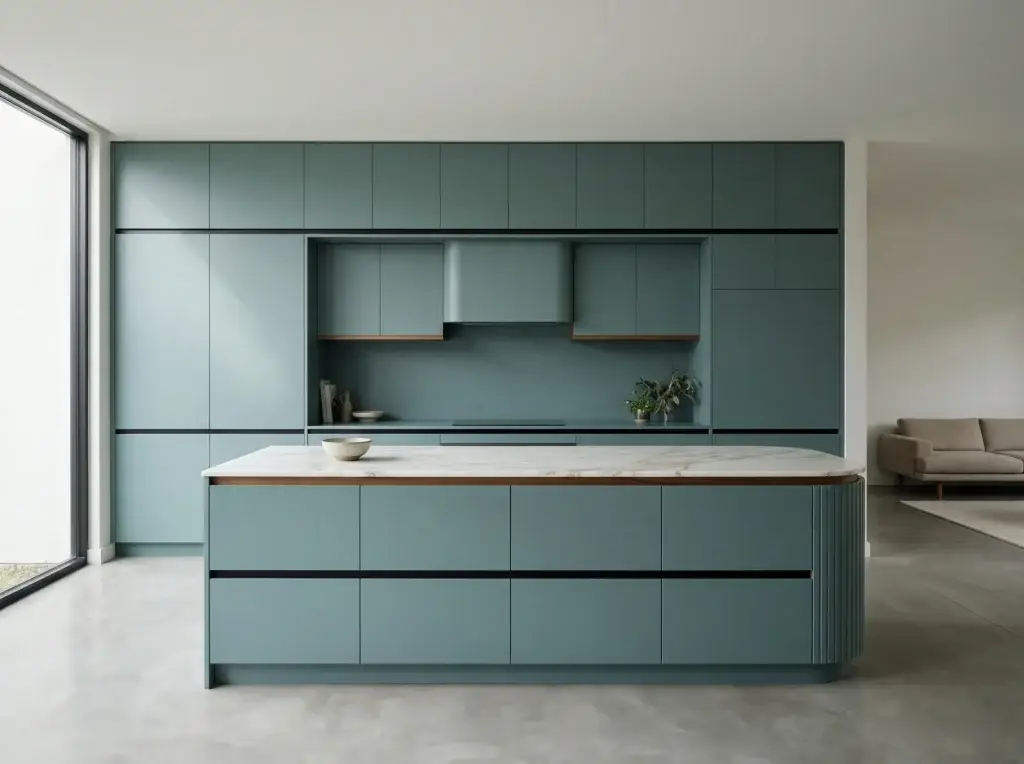
The Minimalist Appeal of Flat-Slab Profiles
Integrated Handleless Recessed Channels: In contemporary open spaces, surface-mounted handles can visually clutter complex pigments. We recommend pairing muted blue-green finishes with frameless slab doors and concealed horizontal J-pull or C-channel profiles, creating clean, uninterrupted planes of color.
Earthy Material Harmonies: Blue-green tones blend effortlessly with raw architectural textures—such as fluted travertine islands, micro-cement flooring, and matte black lighting elements—preventing minimalist spaces from feeling cold or uninviting.
Entertaining in Style — The Custom Blue Bar Cabinet and Butler’s Pantry
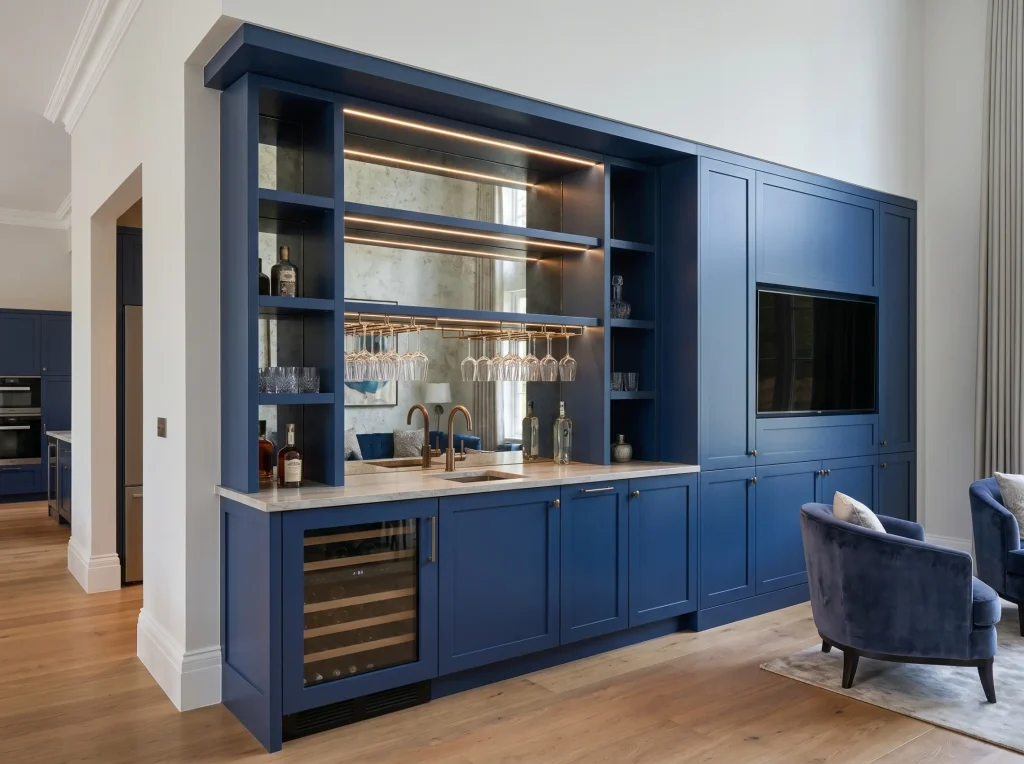
A hallmark of a curated luxury estate is carrying signature design language from the primary kitchen into secondary social zones. Customizing a matching blue bar cabinet or wine display for a dedicated dining wing, entertainment lounge, or executive library unifies the home’s interior design architecture.
Creating an Intimate Lounge Atmosphere
Smoked Bronze Mirror Backings: In an entertainment area, standard clear mirrors can feel commercial. Selecting an antiqued or smoked bronze mirror back panel behind open shelving softly reflects glassware while establishing an inviting, moody atmosphere.
Integrated Beverage & Wine Preservation: Under-counter dual-zone wine coolers and clear ice machines are seamlessly integrated behind matching blue millwork frames, ensuring the hospitality zone functions effortlessly during evening gatherings.
Monolithic Serenity — Midnight Blue Appliance Towers with Pocket Doors
For open-concept luxury residences, the pinnacle of contemporary luxury is visual peace: concealing small prep appliances, coffee bars, and breakfast prep areas behind clean, monolithic panels when not in use. Saturated midnight blue provides a calm, sculptural wall that allows the central island to shine.
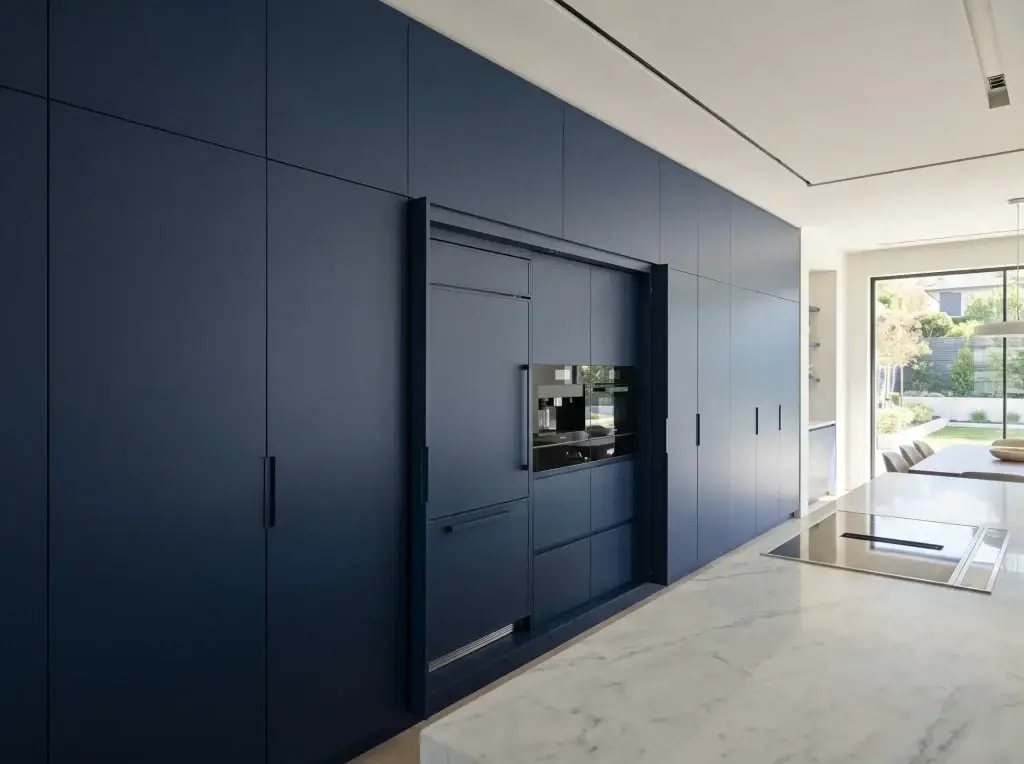
The Magic of Disappearing Doors
Concealed Pocket Door Engineering: Utilizing specialized slide-in pocket door hardware, tall midnight blue cabinet doors pivot open and slide smoothly into hidden side pockets alongside the cabinet carcass. This grants full, unhindered access to an espresso station or steam oven while prepping.
Instant Visual Serenity: Once morning coffee is finished, the doors slide out and close completely flush with the surrounding cabinetry, instantly transforming a busy prep counter into a peaceful, continuous blue architectural wall.
Material & Finish Specifications for Saturated Blue Casework
Translating deep blue concepts into enduring residential millwork requires balancing visual richness with daily practicality. Dark architectural pigments absorb ambient light differently than neutrals, meaning the tactile quality of the finish and the structural integrity behind the panels determine the longevity of the installation.
The Softness of 5° Dead-Matte Finishes: High-gloss lacquers create harsh reflections on dark blue, while cheap satin formulas tend to show oily fingerprint smudges. An ultra-low 5-degree dead-matte finish provides a velvety, warm texture that diffuses ambient daylight softly across wide cabinet elevations.
Flawless Multi-Pass Coating Application: Deep colors like navy and indigo immediately reveal surface imperfections. Architectural casework relies on multi-stage polyurethane coatings applied in climate-controlled, dust-free environments to achieve uniform depth and color saturation from edge to edge.
Rigid Carcass Substructures: Blue perimeter bases often carry heavy waterfall islands or thick engineered stone slabs. Specifying full 3/4″ (18mm) multi-ply birch plywood carcasses ensures the underlying millwork supports large stone runs without frame deflection over time.