
Built-In Microwave Cabinet Specification & Engineering Guide
In high-end architectural millwork, luxury is defined by structural discipline and the complete removal of small appliance clutter from prime food-preparation surfaces. For general contractors, custom home builders, and interior designers, leaving a microwave loosely situated on a kitchen counter degrades the perceived value of a premium property, interrupts visual symmetry, and consumes high-value real estate on the stone deck.
However, integrating a high-performance built in microwave cabinet into a custom kitchen layout introduces complex technical challenges. Unlike generic modular cabinetry that treats appliances as an afterthought, true custom appliance integration requires precise management of spatial dimensions, thermal load dissipation, and electrical accessibility. Failing to plan for these engineering variables leads to expensive field retrofits, damaged finishes, and cabinet carcass warpage.
As an architectural millwork and custom cabinetry manufacturer, ALLAND provides the mechanical blueprint and factory-direct CNC fabrication for engineering seamless, built-in kitchen layouts that integrate luxury appliances while preserving structural integrity.
The Ergonomic Scale: NKBA Safety Heights vs. Jobsite Liability
When designing a bespoke kitchen microwave cabinet, ergonomics and user safety must dictate the initial layout. The National Kitchen & Bath Association (NKBA) enforces strict placement standards to protect homeowners from hot spills and unstable handling of heated vessels.
The baseline NKBA standard dictates that the operational floor of a microwave cavity must sit no higher than 54 inches (1,372 mm) above the finished floor (AFF). For universal accessibility (ADA compliance) and family safety, undercounter microwave drawer configurations positioned between 30 inches and 36 inches AFF provide optimal top-down loading ergonomics.
📐 Appliance Cutout & Clearance Verification (48 Hours)
Specifying high-end built-in microwave drawers or speed ovens from Wolf, Sharp, Bosch, Thermador, or Miele? Send us your appliance cut sheets. ALLAND’s engineering team will precision CNC-machine exact appliance openings, integrate hidden rear ventilation chutes, and verify structural load support directly at the factory level.
Vertical Symphony: The Tall Appliance Tower Stack
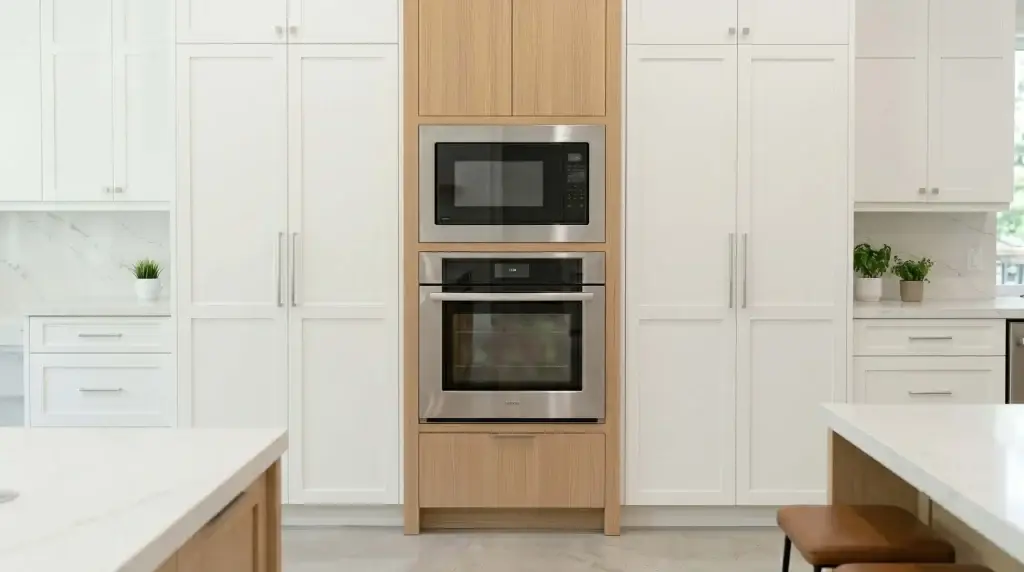
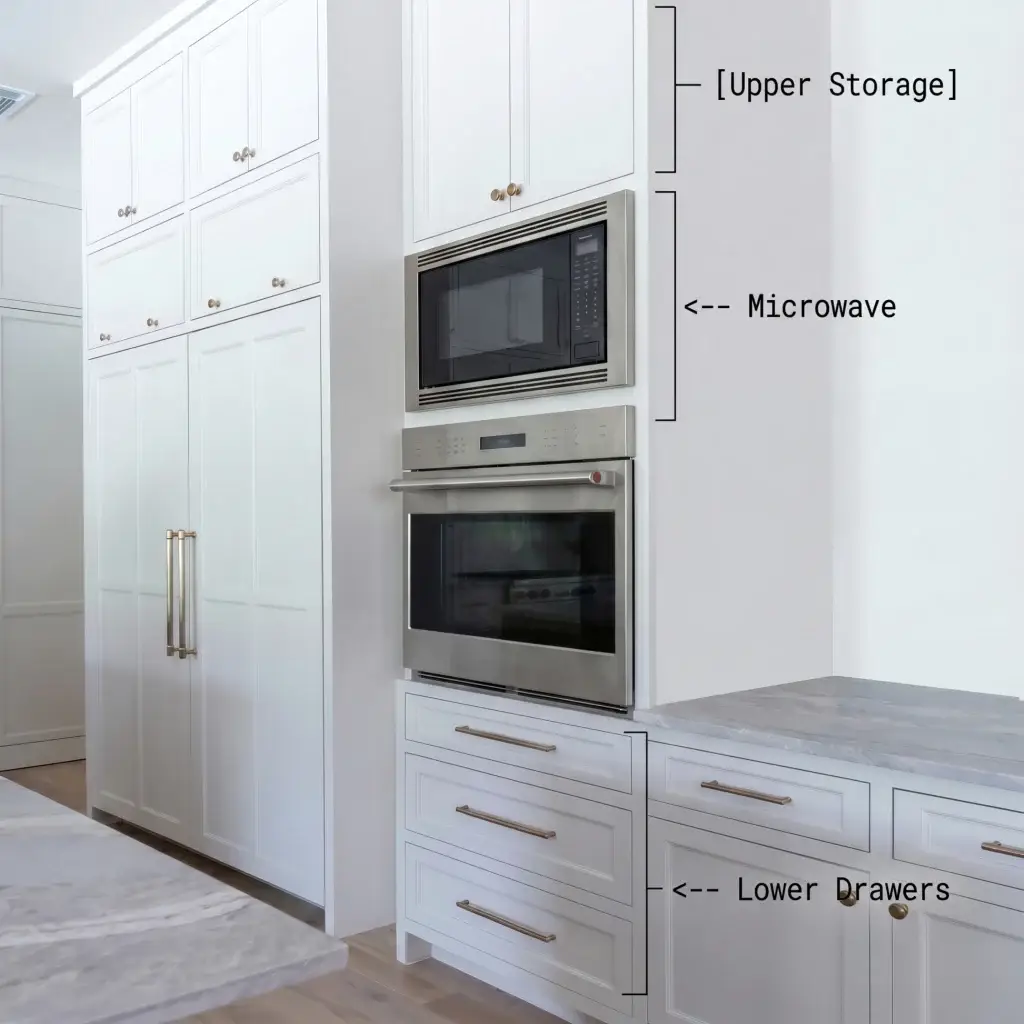
The most requested custom kitchen layout for open-concept homes is the vertical appliance tower. Integrating a microwave oven storage cabinet directly into a floor-to-ceiling millwork stack groups thermal appliances into a single zone, maximizing continuous countertop runs elsewhere.
Maximizing vertical space through appliance stacking is a practical approach, but it requires careful integration within your overall kitchen footprint. For a deeper understanding of how appliance zones, work triangles, and traffic flow interact in various kitchen layouts, refer to our complete guide to custom kitchen layout types.
Managing Thermal Load and Passive Ventilation
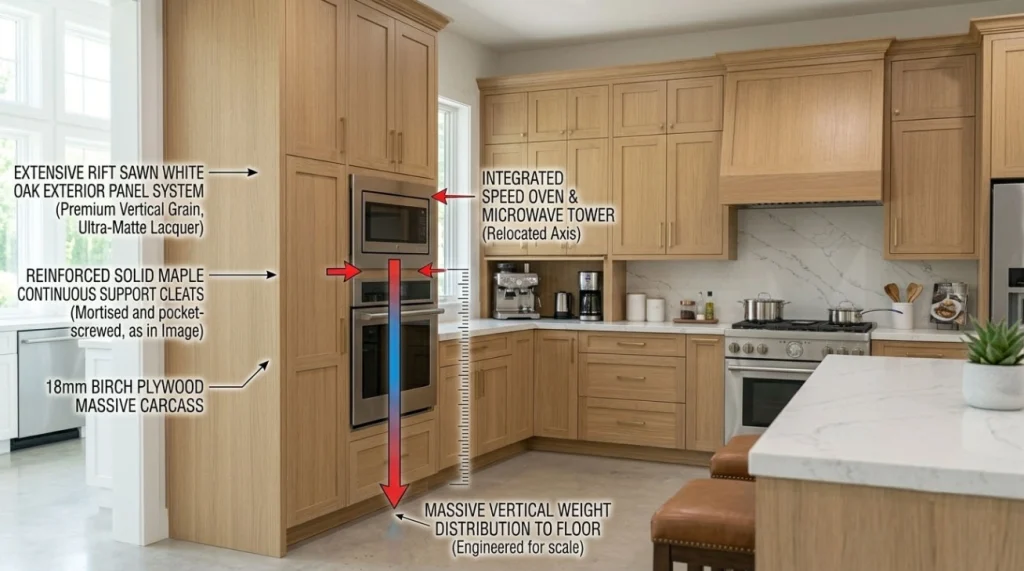
A major engineering challenge with built-in configurations is heat management. High-end microwaves and combination speed ovens generate continuous moisture vapor and heat that must vent away from the cabinet box. Without proper airflow, trapped heat will dry out surrounding substrates, causing delamination of veneers, finish checking, and joints to split.
To address this, ALLAND fabricates tall appliance columns using 3/4″ (18mm) high-density plywood core boxes finished with a 2K polyurethane chemical-resistant barrier. Our factory submittals detail a 2-inch rear air-gap bypass channel behind the cabinet box. This allows warm air to rise uninhibited behind the utility envelope and vent out safely over the upper soffit line.
Trim Kit Margin Alignment
Achieving a flush, integrated appearance requires precise coordination with the appliance manufacturer’s specification sheets. Every high-end microwave requires a specialized Trim Kit to bridge the structural opening between the metal appliance housing and the cabinet face panel. The depth of the cabinet box is critical; a standard 24-inch cabinet depth microwave pocket must accommodate both the physical depth of the machine and the rear-mounted 120V electrical plug without kinking the cord.
ALLAND processes these openings using multi-axis CNC routing equipment, maintaining a dimensional tolerance within 0.5 mm. This clean margins profile ensures a flush fit with no unsightly gaps or binding face-frame joints.
🛠️ Need exact cutout specs for your project’s appliance package?
Under-Counter Minimalism: Microwave Drawers in Base Cabinets & Islands
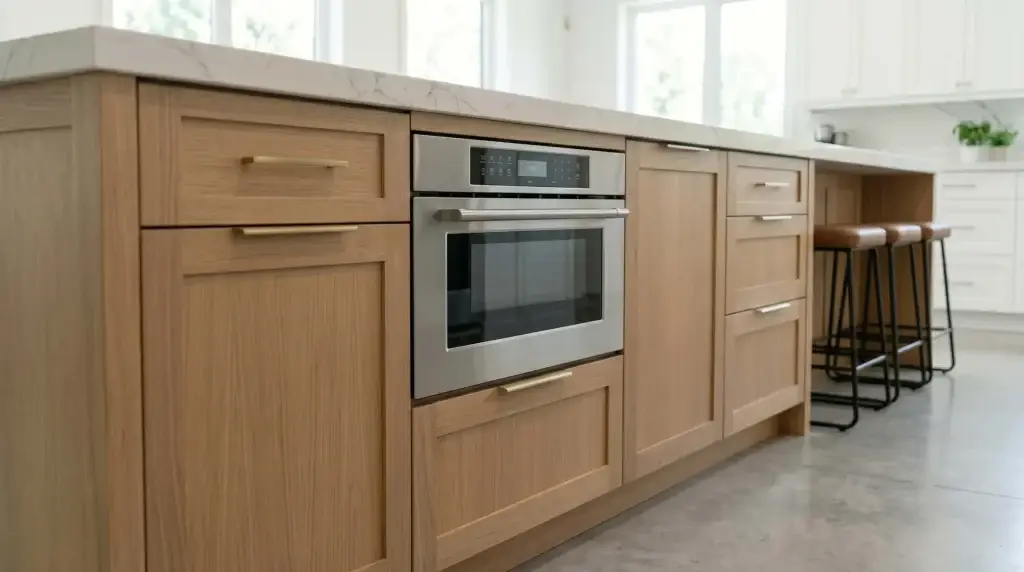
Modern interior designers increasingly position cooking appliances below the eye line. This design shift has driven the popularity of installing a microwave in base cabinet boxes or positioning a heavy microwave in kitchen island units, preserving unobstructed upper wall space while enhancing top-down loading ergonomics.
Engineering for Mechanical Shock and Vibration
Unlike traditional drop-down door models, a microwave drawer slides horizontally out from the cabinet face on heavy-duty motorized glides. The repetitive mechanical motion, combined with the weight of food, introduces dynamic lateral forces that can cause lower-grade cabinet boxes to shift out of alignment over time.
To counteract this movement, ALLAND reinforces below-counter microwave stations with an internal structural bracket frame. We use solid maple mechanical cleats pocket-screwed behind the face stiles to transfer the kinetic energy of the moving drawer directly down to the structural plinth of the island. This keeps the cabinet doors aligned across the entire run.
Beyond Standard Prefabricated Shelves
In mass-produced home construction, projects are often restricted to a standard cabinet for microwave 24” shelf component, which limits design flexibility. High-end custom residential architecture rarely conforms to prefabricated dimensions.
When configuring a luxury microwave dimensions cabinet, ALLAND analyzes the exact appliance specifications—whether it is a 24-inch luxury drawer or a wider 30-inch speed oven. We customize the internal clear span and finish the interior box surfaces to match the exterior drawer fronts, avoiding the unfinished look common with generic, off-the-shelf cabinets.
🛠️ Customizing island casework or non-standard appliance openings?
Alternative Configurations: Handling Specialized Layout Risks
When lateral wall runs or island space is restricted, designers sometimes consider alternative placements, such as installing a microwave wall cabinet or using a corner microwave cabinet setup to optimize space.
The Elimination of Over-The-Range (OTR) Combinations
Premium residential builders generally avoid Over-The-Range (OTR) microwave-hood combinations due to poor ventilation performance and an outdated appearance. An OTR unit crowds the cooktop area and lacks the extraction power (CFM) needed for heavy-duty gas ranges.
Instead, ALLAND recommends placing specialized wall units in secondary zones, such as a butler’s pantry, a breakfast nook, or an auxiliary beverage bar. This configuration separates quick reheating tasks from the main cooking area, preventing foot-traffic congestion around the range.
Custom Upper-Cabinet Depths
A standard upper wall cabinet has an interior depth of 12 inches. However, even a compact built-in microwave requires an interior clearance depth of at least 15 to 18 inches to accommodate the chassis and wire connections.
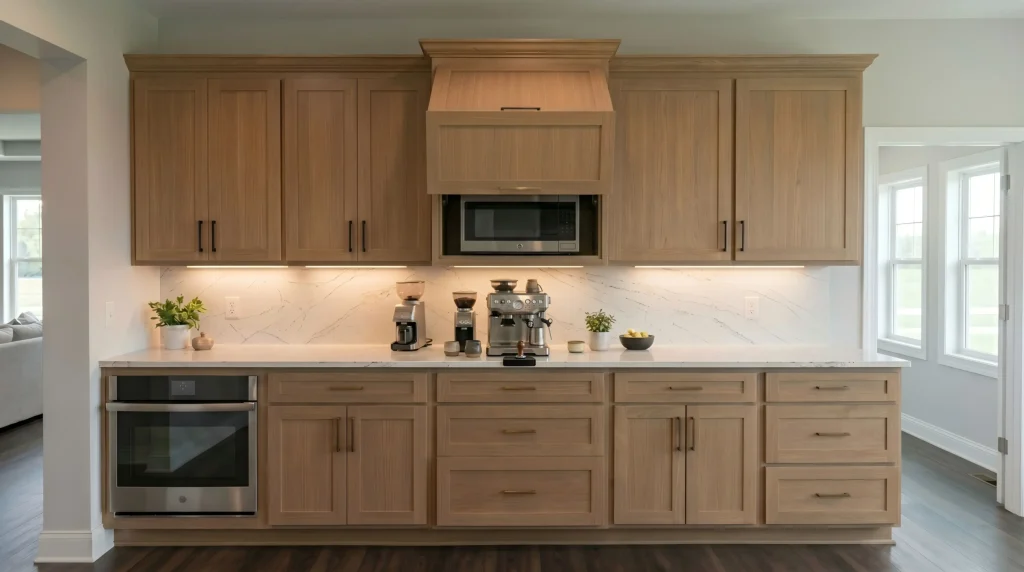
To overcome this layout conflict, ALLAND manufactures extended-depth upper boxes that step-out from the surrounding wall run. By extending the box depth and adding custom matching side gable panels, we provide the necessary room for a seamless microwave inside cabinet setup while maintaining a cohesive look across the kitchen.
Value Engineering for Elite Build Execution
For high-volume multi-family developments and custom estates, true value engineering focuses on minimizing jobsite labor and eliminating future warranty liabilities. Leaving appliance openings to be field-cut by trim carpenters often leads to raw, unsealed edges that absorb moisture and compromise the finish.
ALLAND addresses this by utilizing precise digital factory manufacturing:
CNC Pre-Milled Wire Portals: All access channels for electrical lines and ventilation bypass routes are cut prior to assembly using CNC machinery, featuring clean, edge-banded seals that block vapor transmission.
Structural Core Backing: We construct our appliance back panels using 3/4″ (18mm) solid core panels rather than thin hardboard backing, completely preventing box bowing or structural settling under the weight of heavy professional speed ovens.
Integrated Wire Tracks: Specialized, isolated wiring pathways keep high-voltage appliance cords separate from moving drawer glides, ensuring long-term code compliance and smooth mechanical operation.