
Kitchen Sink Cabinet Engineering: Structural Clearances & Zero Failure Specs
In high-end architectural residential builds, the kitchen sink cabinet represents the single highest zone of liability for structural failure, stone fractures, and long-term water damage warranty claims. For general contractors, custom home builders, and estate developers, specifying this critical base unit is not merely an aesthetic cabinet choice—it is a complex exercise in clearance engineering, dynamic dead-load distribution, and vapor control.
When a $15,000 mitered-edge quartz perimeter cracks at the cutout, or an expensive cast-iron fixture sags after handover, the blame rarely lies with the stone supplier or the plumber. It falls squarely on the structural failure of the cabinet box beneath it.
Every custom project manager knows the late-night anxieties of improper plumbing integration:
The Field-Notching Catastrophe: A field trim carpenter forced to scoop or saw through the structural top rails and side gables of a cabinet because the specified sink basin was too wide for the box opening—voiding warranties and destabilizing adjoining carcass runs.
The Undermount Sag and Stone Fracture: A heavy 200-pound dual-basin undermount sink flexing against standard particleboard box sides, shearing through cheap field mounting clips, pulling the perimeter silicone seal away, and snapping expensive stone decks.
The Hidden Mold Time-Bomb: Slow micro-condensation along cold plumbing lines dripping into porous, unfinished cabinet bottoms, breeding hidden toxic black rot inside a luxury estate.
As an export-driven custom cabinetry factory, ALLAND details the exact physical mechanics required to match kitchen sink sizes with custom structural millwork boxes—protecting project margins and ensuring lifetime residential durability.
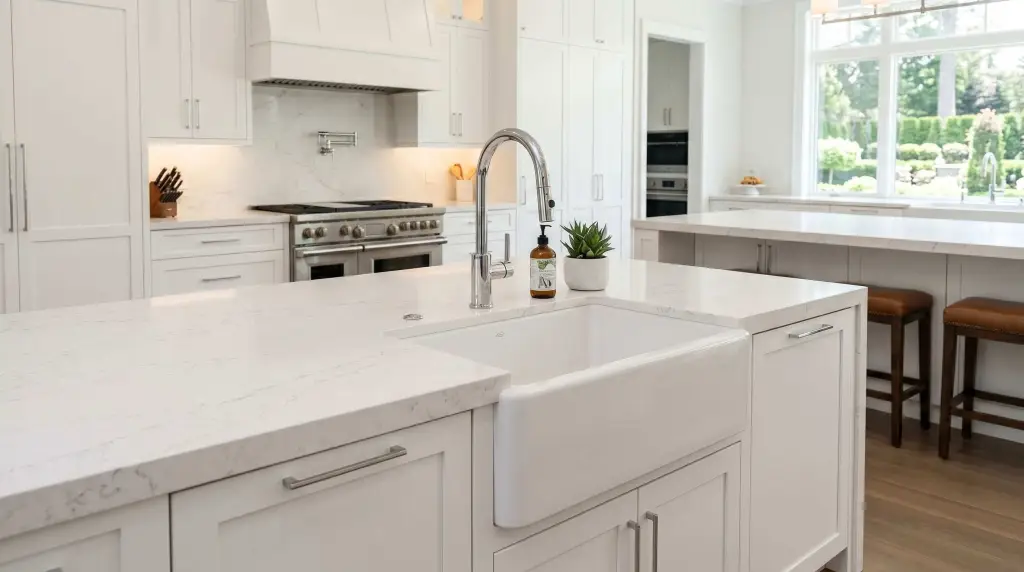
Dimensional Geometry: Aligning Kitchen Sink Sizes with Cabinet Box Clearances
The most prevalent error across custom residential job sites is the systematic misunderstanding of kitchen sink cabinet measurements versus the physical outer lip dimensions of the specified basin fixture. Architects frequently specify a 33-inch basin into a nominal 33-inch cabinet base, assuming a 1:1 translation. In reality, this mistake compromises structural cabinet flanks, requiring expensive on-site rework.
Critical Sink-to-Cabinet Dimensional Ratios
24″ to 25″ Bar / Prep Fixtures: Requires a 27″ minimum cabinet base. Provides 1-1/2″ clear margin per flank for mechanical mounting clips and plumbing drops.
30″ Standard Single Basin: Requires a 33″ minimum cabinet base. Accommodates standard undermount bracket assemblies and top drop-rails.
33″ Architectural Double Basin: Requires a 36″ minimum cabinet base (Industry Standard). Provides the mandatory perimeter zone for structural vertical support cleats.
36″ Estate Farmhouse Apron Fixtures: Requires a 39″ to 42″ reinforced cabinet base. Accommodates heavy cradle framing and lateral side carriers.
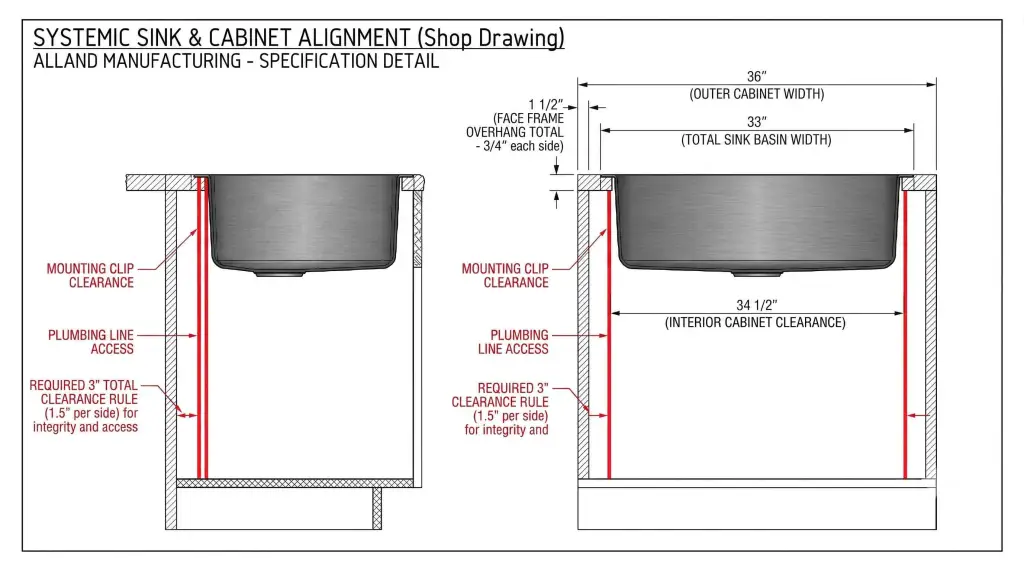
The Mandatory “Three-Inch Clearance Rule”
To ensure uncompromising structural integrity, the exterior width of a kitchen sink cabinet must be at least 3 inches wider than the absolute outer rim of the basin (providing a minimum 1-1/2″ internal margin per flank):
Lip Seating & Mechanical Cleats: Mechanical stone undermount clips, perimeter silicone beads, and internal vertical carrier stretchers require an uninhibited clearance envelope. Restricting this zone prevents mechanics from torquing undermount anchor bolts properly.
Eliminating Flank Compromise: Forcing an oversized fixture into an undersized box forces installers to notch the top load-bearing plywood stretchers. When these horizontal rails are notched on site, the cabinet box loses up to 60% of its diagonal torsional rigidity, leading to out-of-square drawer alignment across adjoining carcasses.
Mechanical Loading: Structural Physics of the Kitchen Sink Undermount Installation
Modern architectural specifications overwhelmingly mandate a kitchen sink undermount detail. Flush undermount transitions eliminate visual rims and simplify counter wipe-down, but suspending a massive double-basin fixture beneath a 3cm quartz counter introduces severe vertical down-draft tension vectors that standard millwork cannot sustain.
Dynamic System Load Calculation
Cast-Iron Double Basin: 110 to 130 lbs (Dry fixture dead-weight).
Water Volume (10 Gallons Capacity): 83.4 lbs (Calculated at 8.34 lbs per gallon).
1-HP Heavy-Duty Garbage Disposal: 18 to 22 lbs (Cantilevered vibration and motor torque).
Heavy Cookware Set: 25 to 35 lbs (Peak shock impact loading).
Total Combined System Load: 236 to 270 lbs. When subjected to continuous disposal vibration, standard cam-lock particleboard boxes flex, pull away from stone silicone seals, and fail.
The Engineering Solution: Integrated Hardwood Cleats
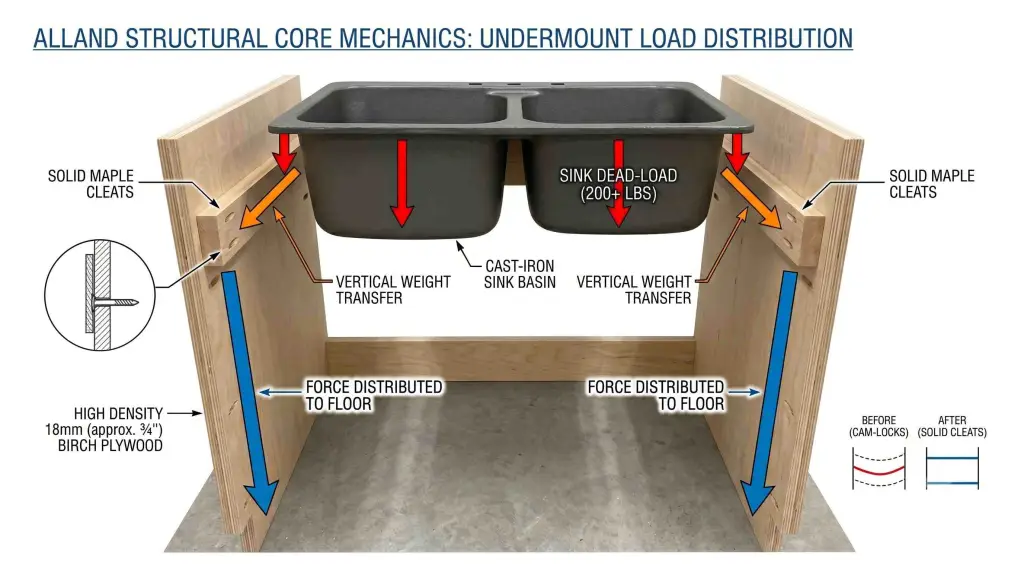
Cheap modular cabinets rely on plastic corner brackets or standard field clips bonded directly to the stone underside. Over time, motor vibration from the garbage disposal fatigues the chemical bond, shearing the clips.
Continuous Load-Bearing Hardwood Cleats: In every kitchen double sink cabinet build, we reject field clips. Our factory mortises two continuous 3/4″ x 2″ solid maple support cleats directly into the 18mm multi-ply birch carcass side panels.
Direct-to-Floor Force Vector Transfer: The entire weight of the sink basin is structurally transferred away from the stone adhesive layer down through the vertical core plywood gables directly to the architectural subfloor. The stone countertop carries zero tensile hanging load, eliminating hairline quartz fracture callbacks forever.
Material Aesthetics: Managing the White Kitchen with Farmhouse Sink Trend
The architectural demand for a white kitchen with farmhouse sink remains a cornerstone of high-end transitional and modern heritage estates. However, incorporating an exposed fireclay or hammered copper apron-front fixture introduces unique structural tolerances and severe capillary water vulnerabilities.
Material Aesthetics: Managing the White Kitchen with Farmhouse Sink Trend
For high-net-worth residential projects, the timeless aesthetic of a white kitchen with farmhouse sink remains a premier design choice. However, an apron-front fixture requires a completely distinct cabinet facade architecture and precise material defense systems to prevent premature aging and moisture rot.
Factory Apron-Front vs. Field Modification Standards
Precision CNC Cradle Routing: Standard field carpentry relies on handheld jigsaws, leaving jagged, unsealed edges prone to water uptake. ALLAND 5-axis CNC machines the apron cradle directly from manufacturer CAD cut-sheets, preserving a strict 1/8″ shadowline reveal around the curved ceramic basin.
Core Substrate Stability: Traditional solid wood front rails crack when exposed to persistent apron rim splashing. We engineer high-density moisture-resistant (MR) MDF cores framing the cutout, providing zero lateral expansion and preventing paint checking along joint lines.
Pre-Machined Capillary Drip Relief: A flat stone overhang allows water droplets to track backward into painted millwork. Our shop drawings detail a 2mm angled relief chamfer beneath the countertop overhang, breaking surface tension so water drips straight down safely away from the cabinet face.
Centralized Focus: Structural Integration of Kitchen Island Sinks
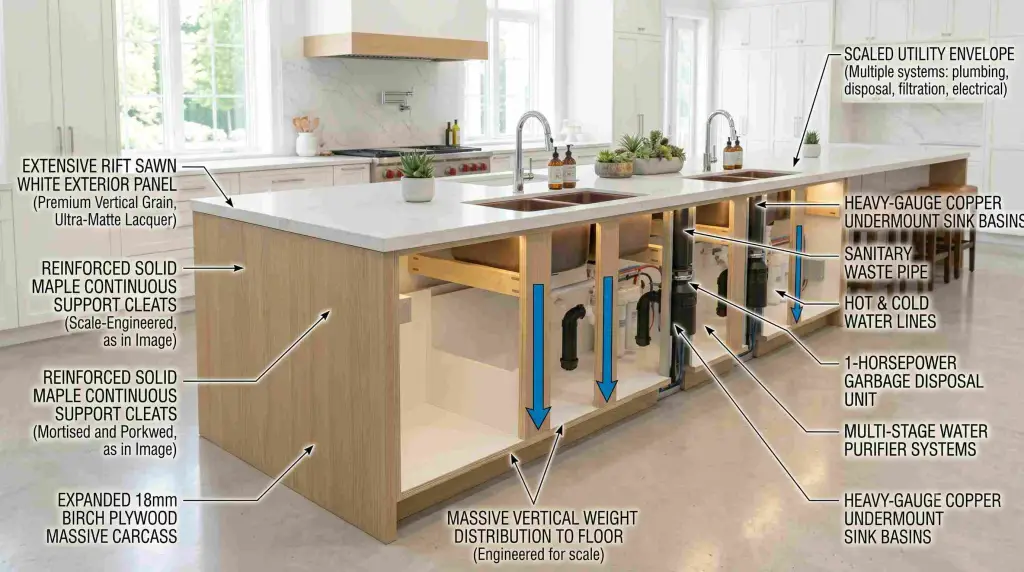
Placing kitchen island sinks into open-concept living layouts shifts the sink cabinet from an isolated wall unit into an exposed architectural centerpiece visible from 360 degrees. Island plumbing lacks wall cavities for venting and drainage, requiring specialized casework architecture.
Navigating the 360-Degree Finished Carcass
When a sink is placed inside a central island, the rear panel of the kitchen sink cabinet is completely exposed to the open-concept living area. Standard perimeter boxes utilize unfinished raw backs; island sink boxes demand premium structural integration.
The Strategy: ALLAND constructs island sink basements utilizing multi-layered side and rear cladding panels that match your custom face profiles (e.g., matching the linear rhythm of your main Rift Sawn White Oak run). The backing panels are integrated directly into the structural frame, completely obscuring utility pathways while providing a continuous architectural facade.
Perimeter Sink Bases vs. Island Sink Enclosures
Finished Carcass Architecture: Standard perimeter bases utilize 1/4″ unfinished raw backs hidden against drywall studs. Architectural island sink bases require 3/4″ (18mm) full-thickness structural panels clad in sequence-matched wood veneer or ultra-matte 2K lacquer.
Plumbing Rough-In Isolation: Perimeter bases vent directly into wall studs. Island sink bases require a dedicated 4-inch internal utility envelope, safely housing island loop vents, water filtration units, and shut-off manifolds.
Electrical Chase Routing: Garbage disposals and air switches require isolated power pathways. Factory-routed raceways keep high-voltage circuits protected from condensation, eliminating jobsite floor coring.
The Dedicated Rear Utility Envelope
360-Degree Finished Cladding: Perimeter sink bases rely on unfinished backs hidden by drywall. For island configurations, we construct integrated structural rear panels matched to your primary facade—such as sequence-matched Rift Sawn White Oak or 2K polyurethane panels.
Internal Mechanical Raceways: Installers often ruin island bottom decks by cutting massive holes to run P-traps, loop vents, and reverse-osmosis water lines. We detail a dedicated 4-inch deep utility envelope at the rear base of the cabinet box. Plumbing and electrical trades execute rough-ins cleanly through pre-machined pathways without compromising the floor plinth’s load-bearing integrity.
Factory Moisture Defense: Aluminum Liners & Pre-Machined Port Seals
The space directly beneath an architectural kitchen sink is a hostile micro-environment characterized by condensation spikes, plumbing connection drips, and heat cycling from adjacent dishwashers. Exporting turnkey millwork from a professional custom cabinetry factory eliminates water damage through factory-integrated materials.
Three-Tier Under-Sink Moisture Infrastructure
Marine-Grade Hardwood Substrate: Built using 3/4″ (18mm) multi-ply birch plywood bonded with Class 1 exterior water-resistant phenolic resins. Completely eliminates particleboard core swelling during plumbing mishaps.
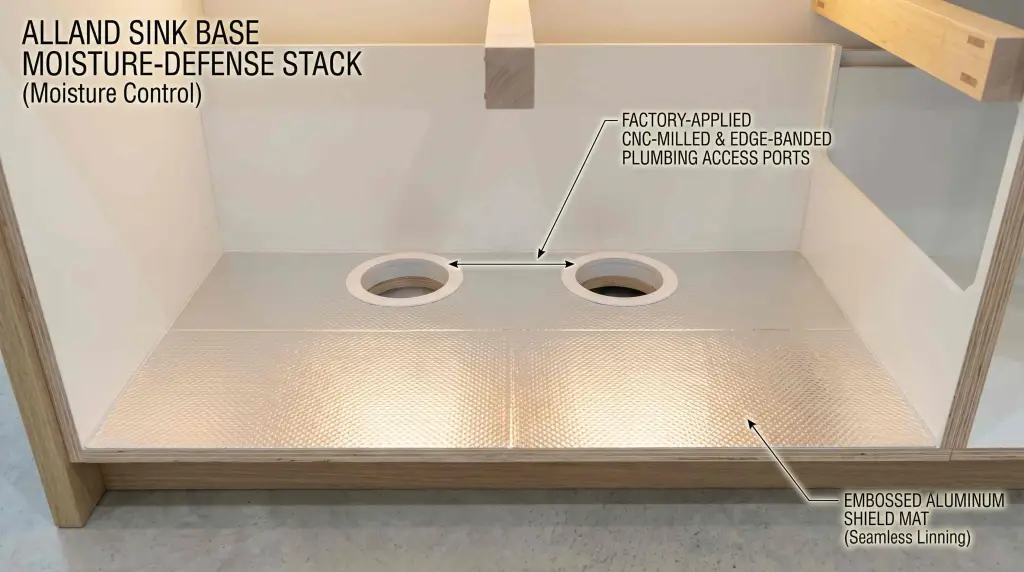
Embossed Aluminum Catch Deck: The cabinet floor is factory-lined with a heavy-gauge embossed aluminum shield. Folded upward 1 inch along all interior perimeter flanks, it forms a seamless catch basin capable of holding up to 2 gallons of slow pipe drips safely away from raw wood.
Factory CNC Pre-Machined Passages: All water inlet and waste drain portals are CNC-milled and edge-banded with waterproof PUR adhesives before crating, ensuring bare wood fibers are never left exposed inside the cabinet.
Zero-Field-Cutting Plumbing Protocols
Seamless Embossed Aluminum Tray Deck: Every ALLAND sink unit features an integrated heavy-gauge embossed aluminum deck liner. Turned up 1 inch along all three interior vertical faces, this non-corrosive shield creates a liquid containment tray that holds standing pipe leaks safely away from core wood fibers.
Factory CNC Port Pre-Machining: In multi-unit developments and custom luxury builds, field-drilled plumbing holes leave jagged, porous timber edges that absorb moisture like a sponge. By mapping your submittal schedules into our CAD/CAM production lines, our CNC routers cut, edge-band, and seal all internal access portals at the factory. Field installation time drops from 90 minutes per sink base to under 15 minutes.
Engineer Failure-Free Kitchen Sink Cabinets for Your Next Project
Eliminate field-notched cabinet gables, sagged undermount basins, and moisture warranty call-backs. Whether detailing a bespoke private residence or procuring an entire multi-family casework package, send us your architectural plans (.pdf / .dwg) or appliance cut sheets. ALLAND’s engineering desk delivers a comprehensive CAD clearance audit, load-bearing shop drawings, and factory-direct quotation within 48 hours.
📐 Ready to specify fail-proof custom kitchen cabinetry?

Frequently Asked Questions: The Sink Base Engineering Q&A
Q: Can I install a 33-inch undermount sink into a 33-inch kitchen sink cabinet base?
A: No, not without compromising structural integrity. A 33-inch basin requires a minimum 36-inch cabinet box. The additional 3-inch margin provides necessary 1-1/2″ internal clearances on both flanks to seat undermount clips, apply waterproof structural silicone beads, and maintain intact, unnotched 18mm load-bearing side gables.
Q: How do you prevent a heavy cast-iron double sink from sagging over time?
A: Eliminate field-glued undermount clips. We mortise continuous 3/4″ x 2″ solid maple support cleats directly into the 18mm birch plywood side panels. The combined 250-pound weight of the filled basin and garbage disposal transfers downward into the vertical cabinet flanks and floor, placing zero tensile strain on the quartz countertop.
Q: What is the best cabinet carcass material beneath a kitchen sink?
A: Marine-grade CARB-2 certified 3/4″ (18mm) multi-ply birch plywood protected with an embossed aluminum floor liner. Particleboard or standard MDF swells rapidly when exposed to slow plumbing leaks. Multi-ply birch retains dimensional rigidity even under continuous high-humidity environments.