
Tariffs on Kitchen Cabinets from China Import Guide
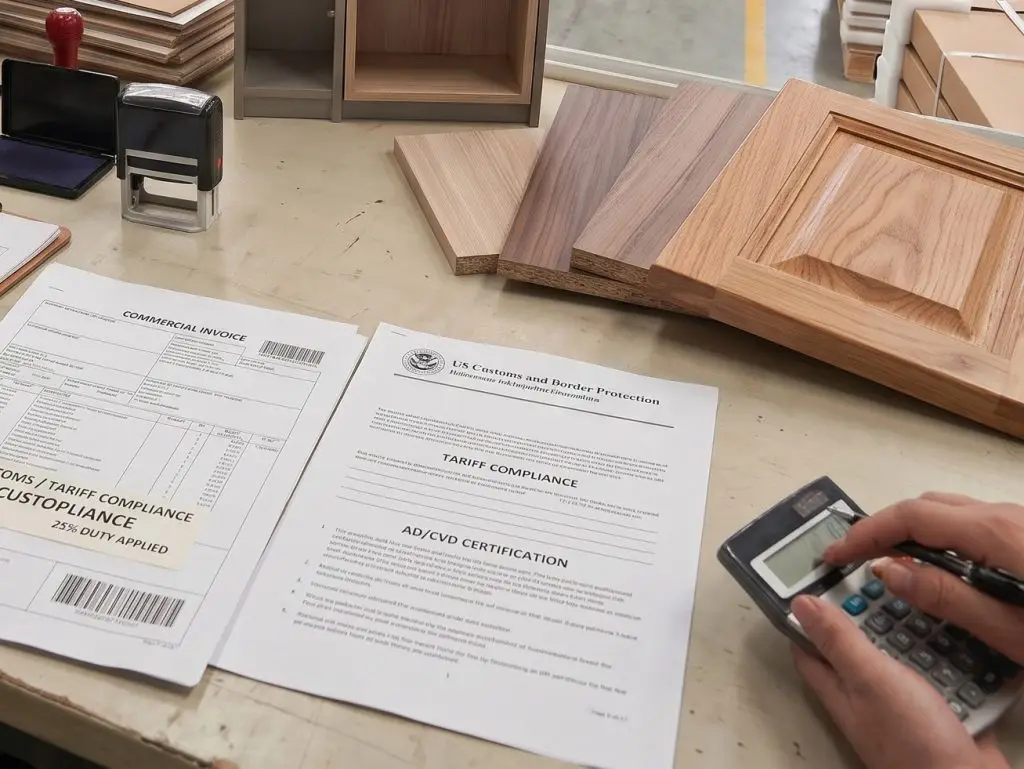
Sourcing custom cabinetry directly from China offers significant cost efficiency for multi-family residential developments, custom residential runs, and commercial interior fit-outs. However, many overseas contractors, builders, and developers hesitate when facing customs duties and international logistics.
If you are planning an overseas casework order, you likely have three straightforward questions: Will I have to pay tariff on kitchen cabinets from China? Are kitchen cabinets made in China subject to tariff rules that wipe out my project savings? And ultimately, where to buy kitchen cabinets made in China without risking container delays or compliance surprises? This guide breaks down current tariff frameworks, container logistics economics, hidden destination expenses, and direct factory procurement models to keep your project fully protected.
Stained Bathroom Vanity
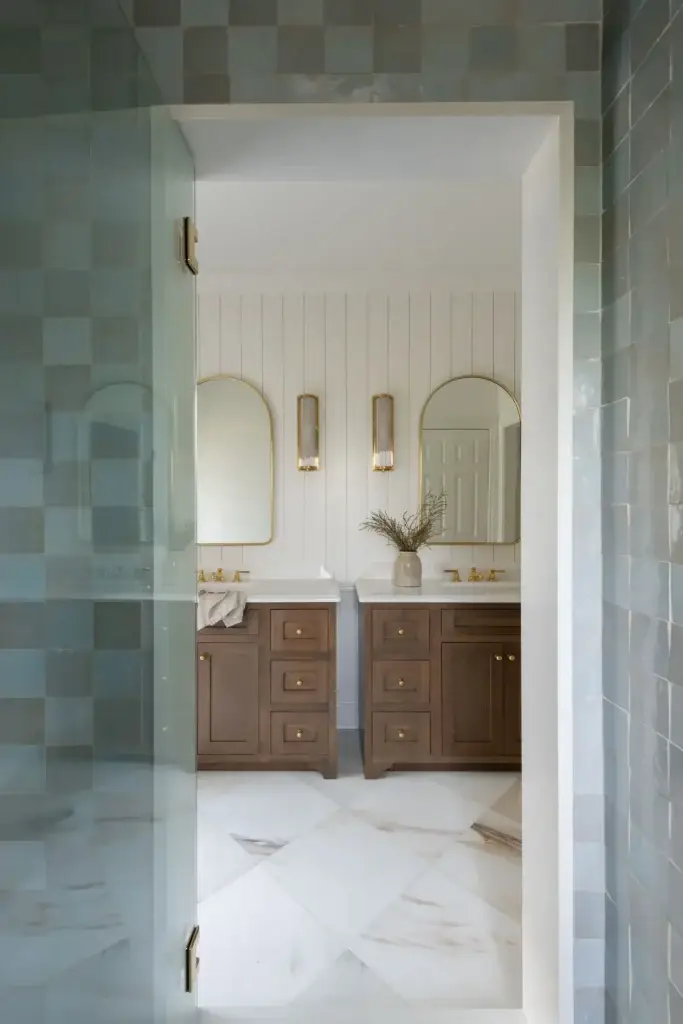
Specifying an authentic stained bathroom vanity requires balancing fine furniture detailing with high-performance moisture resistance. This primary ensuite showcase presents an elegant oak double vanity layout, utilizing solid white oak and flush face-frame joinery engineered for luxury residential estates.
Departing from standard mass-produced consoles, these transitional bathroom vanity cabinets feature stepped-profile shaker doors, split symmetrical sink stations, and unlacquered brass appointments that ground the bath in timeless English country warmth.
bathroom black vanity
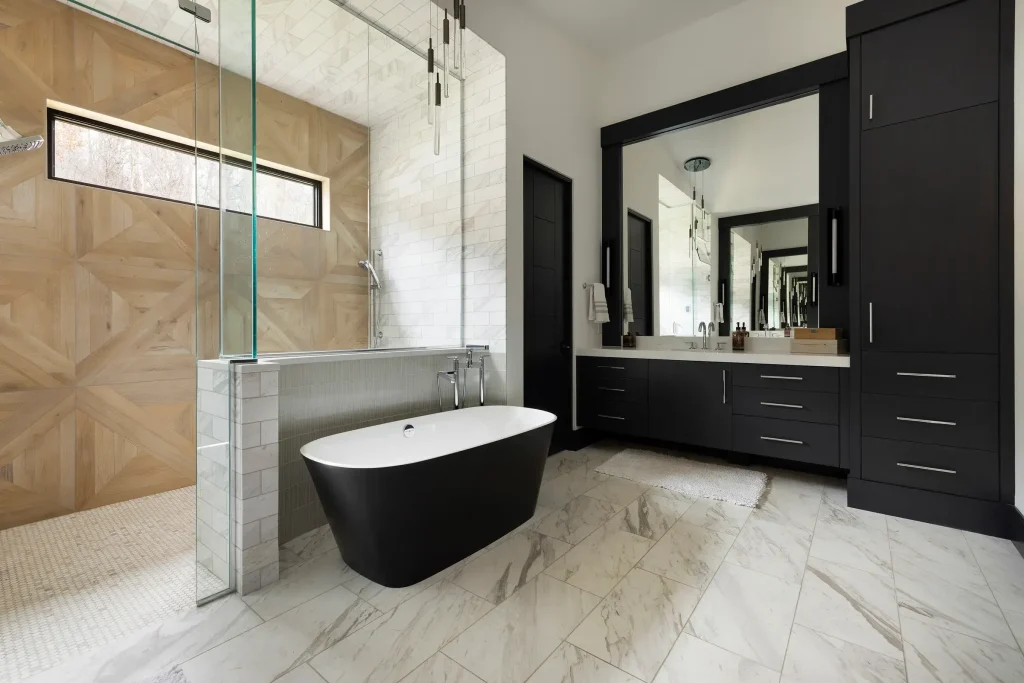
Developing luxury residential washrooms requires functional layouts that merge architectural scale with moisture-resistant joinery. This custom bath casework suite presents comprehensive bathroom ideas with black vanity configurations, spanning minimalist powder room consoles to symmetrical primary bathroom layouts.
Engineered with dark-stained oak veneers and full-access box construction, these black bathroom cabinets deliver high-contrast focal points against natural marble slabs and custom glass enclosures across diverse floor plans.
Contemporary Kitchen Ideas
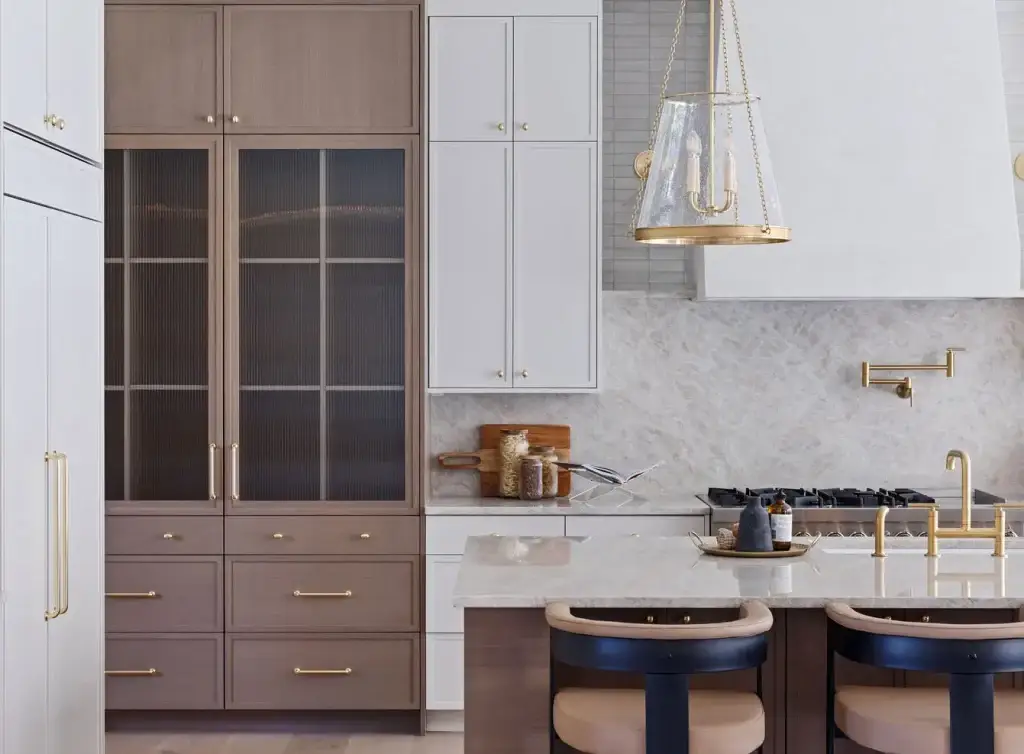
Exploring contemporary kitchen ideas requires balancing clean architectural silhouettes with organic wood textures. This open-concept residential showcase features high-performance frameless cabinet design, combining matte painted perimeters with natural rift white oak millwork tailored for modern luxury living. Departing from conventional box cabinetry, these two-tone painted kitchen cabinet ideas unite ultra-narrow frame profiles, bespoke appliance housing, and integrated island work zones that create a seamless flow into adjacent dining and living spaces.
Stained Kitchen Cabinet Ideas
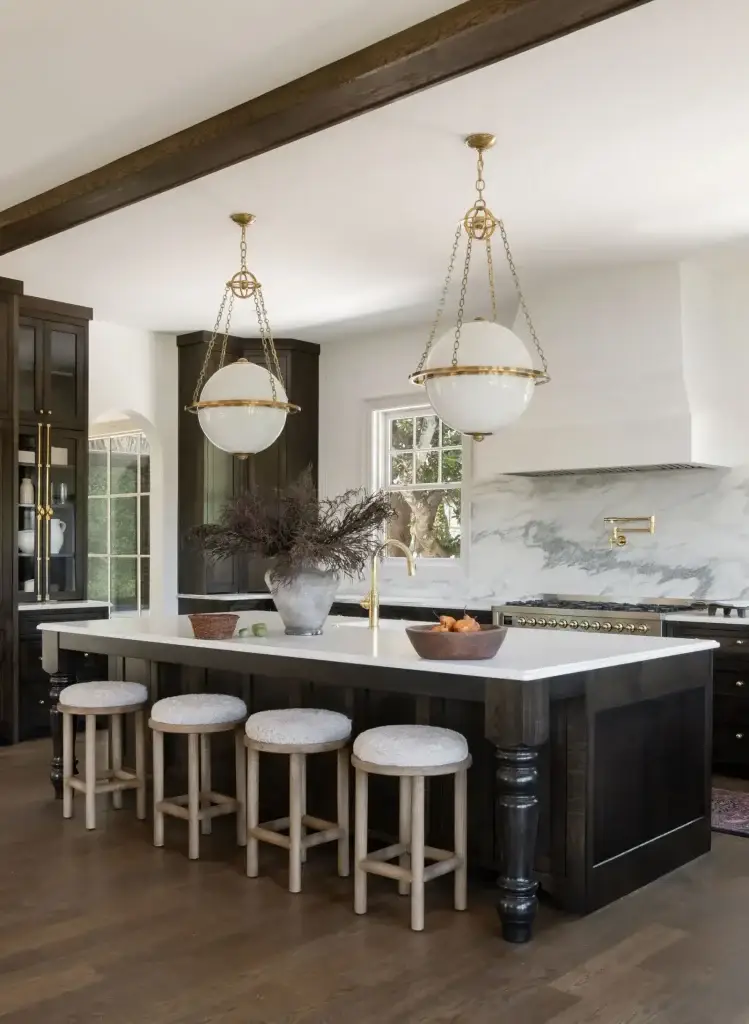
Searching for refined dark wood kitchen cabinet ideas requires balancing rich, historic stain depths with clean transitional architectural lines. This custom estate showcase highlights the warmth of cerused white oak, pairing natural wood grain with flush inset casework engineered specifically for luxury residential projects. Departing from standard stock boxes, these contemporary dark wood kitchen cabinets integrate tailored perimeter runs, stepped drawer profiles, and artisanal brass hardware that elevate functional culinary zones into heirloom furniture.
Inset Beaded Cabinets
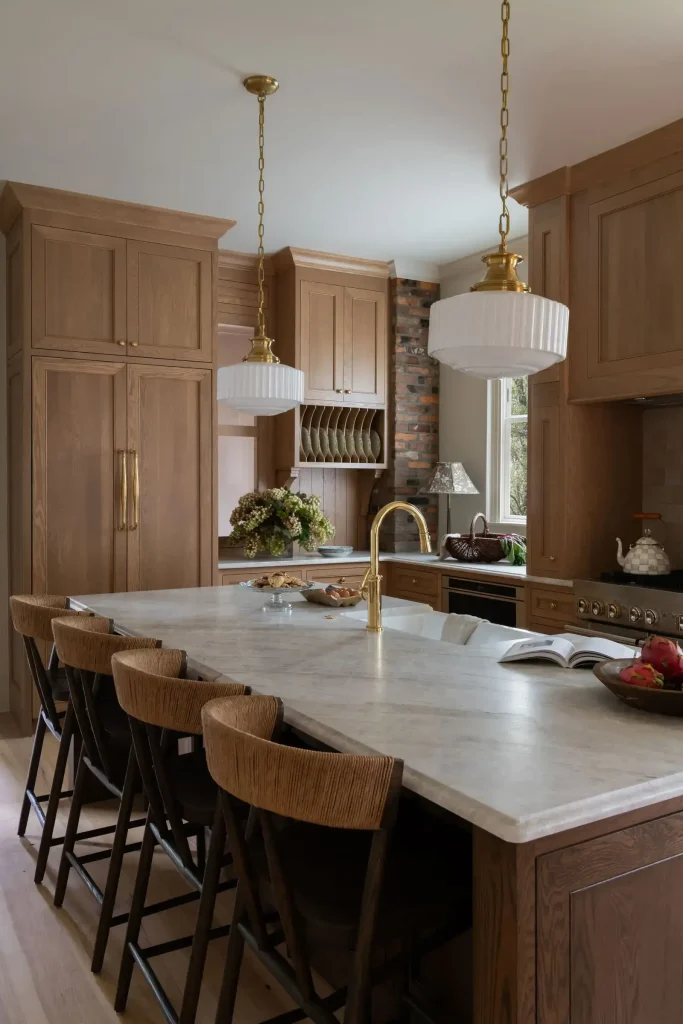
This custom kitchen combines classic American kitchen design with refined English cottage craftsmanship, utilizing high-grade white oak plain sawn lumber to establish an organic, architectural focal point for custom residential estates. Engineered with tight 3/32-inch reveals, these inset beaded cabinets feature flush face frames, authentic beaded edge cabinet doors, and integrated millwork elements that provide a timeless foundation for discerning home builders and architects.
How to Buy Kitchen Cabinets from China

When general contractors, custom home builders, and design-build firms consider direct sourcing, one question comes up repeatedly: how to buy kitchen cabinets from China without running into catastrophic job-site delays or costly dimensional errors? For years, the traditional supply chain has conditioned buyers to pay 40% to 60% markups to domestic distributors just to avoid the perceived risks of imported casework.
The issue has never been geographic manufacturing capabilities; it has always been communication protocols, engineering standards, and lack of visual accountability. When working through an established architectural millwork manufacturer, buying direct gives you full access to bespoke wood veneers, true 3/4″ multi-ply plywood boxes, and authentic European hardware at wholesale trade pricing. Here is your actionable, step-by-step technical guide to navigating the entire custom cabinetry procurement process with total confidence.
Are Kitchen Cabinets from China Safe

When North American builders, architects, and discerning homeowners investigate direct sourcing, two questions invariably surface: Are kitchen cabinets made in china safe? and Are kitchen cabinets from china good quality?
These are fair questions. For decades, outdated impressions painted imported cabinetry as synonymous with flat-packed, disposable flatware. Yet industry insiders recognize a fundamentally different reality: China has quietly evolved into the manufacturing backbone of the world’s highest-end custom millwork. The casework showcased in multimillion-dollar estates, five-star hospitality suites, and luxury multi-family developments across Los Angeles, New York, and Vancouver frequently traces its origin to advanced custom facilities in China.
Quality is not a matter of geography; it is a matter of strict engineering protocols and precise fabrication control. When built by established architectural mills like ALLAND Cabinet, bespoke Chinese millwork delivers exceptional material integrity, non-toxic environmental safety, and millimeter-level joinery tolerances that routinely outperform local retail stock box lines. Here is the technical breakdown of how premium custom casework is built and why it stands among the safest, most durable architectural investments on the market today.
San Diego Coastal Custom Home
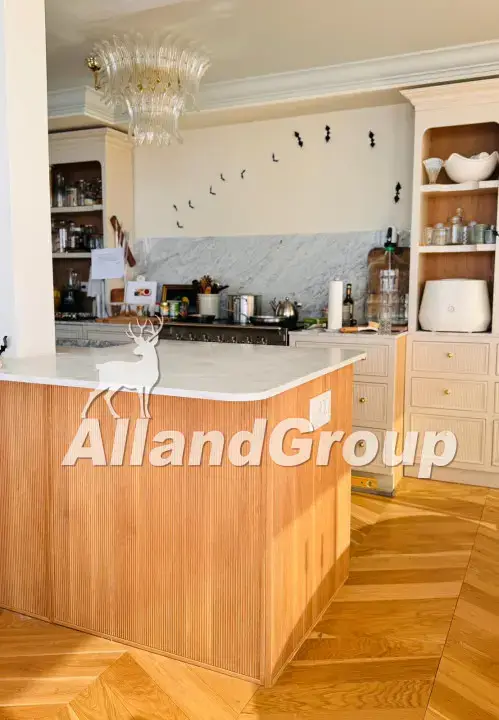
For this private coastal residence in San Diego, the homeowner requested a bespoke architectural millwork package centered on our artisan fluted white oak cabinets. Combining classic American flush inset face frames with delicate vertical reed profiling, the project seamlessly integrates solid white oak joinery, soft-painted storage, and custom hand-carved stone features.
Canada Modern Minimalist Villa
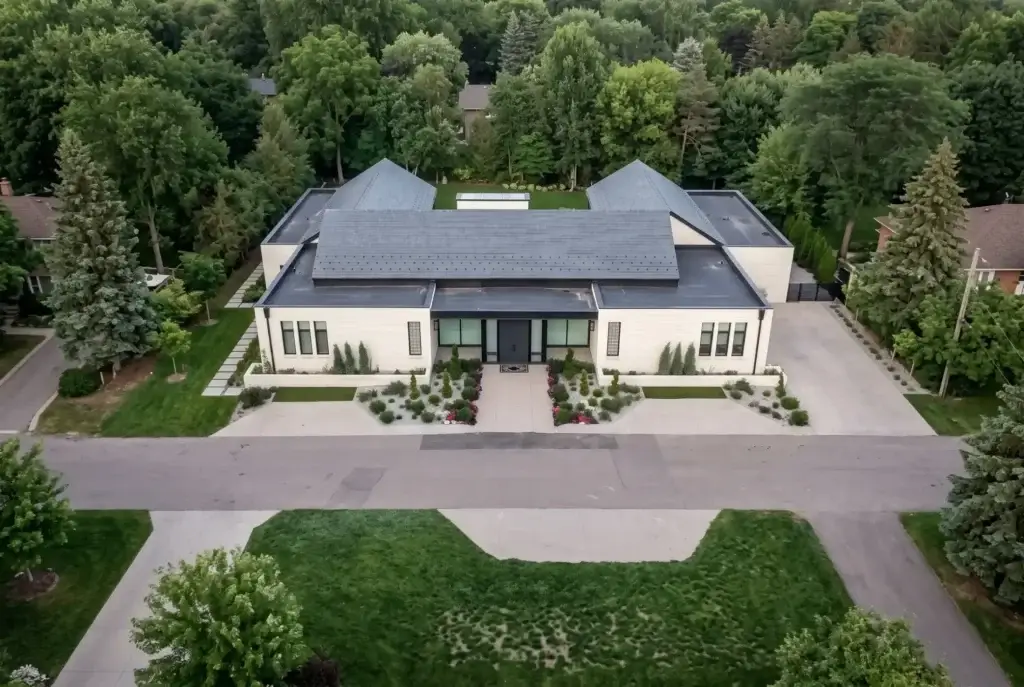
For this private residence in Canada, the client selected a full custom millwork package anchored by our dark wood veneer kitchen cabinet collection. From the initial shop drawing review to factory pre-assembly and final jobsite fit-out, the project delivers clean modern lines, seamless grain matching, and custom architectural casework throughout.
Modern Walnut Kitchen Cabinets: Two-Tone & Joinery Guide
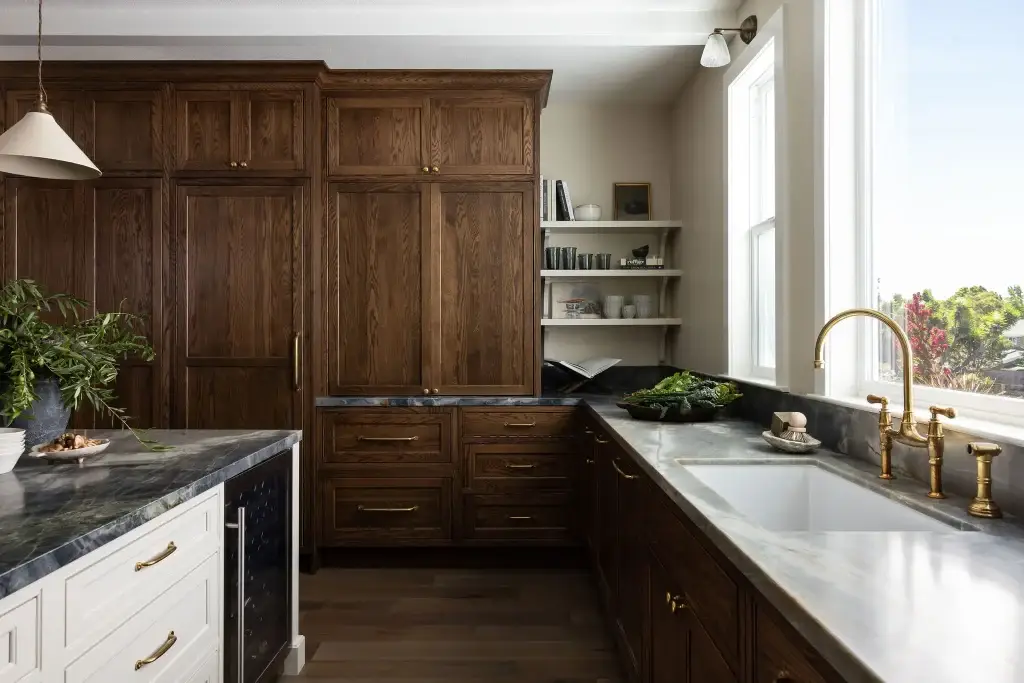
An architectural guide to modern walnut kitchen cabinets. Discover how to balance two-tone layouts with warm white casework, specify 1/2″ slim shaker joinery, and eliminate on-site installation risks with full workshop dry-fit pre-assembly.
Mid Century Modern Bathroom Vanity
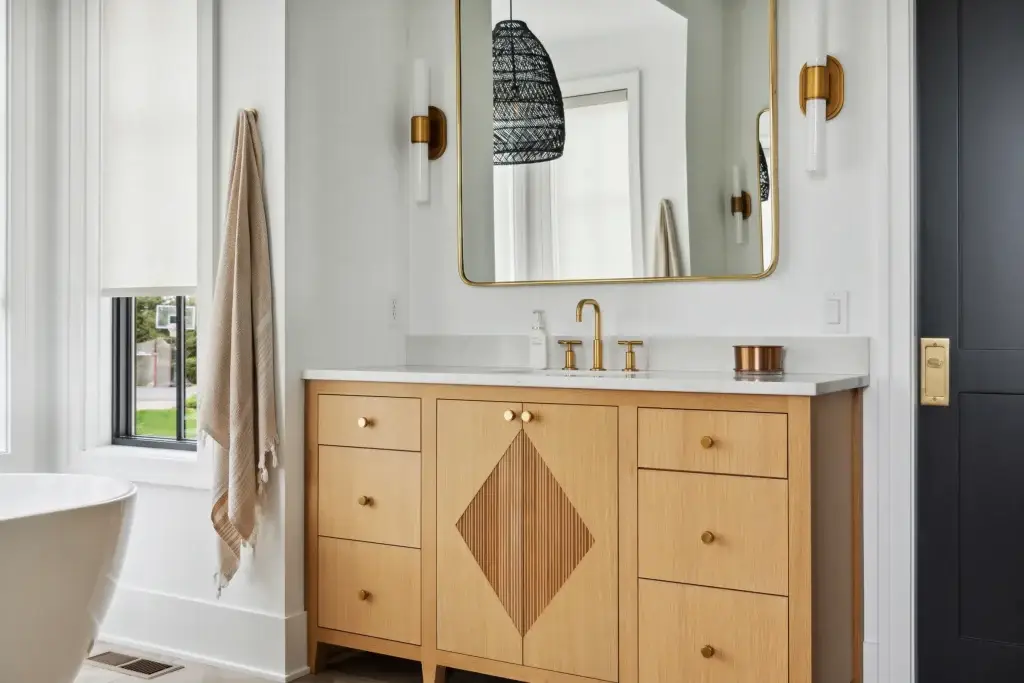
Engineered for precision residential millwork specifications, this mid century modern bathroom vanity package delivers furniture-grade casework tailored to exact architectural shop drawings. The 60-inch freestanding chassis integrates rift-cut white oak veneers, solid timber tapered legs, and factory-machined brass hardware bore margins.
The carcass is constructed from 3/4-inch marine-grade plywood boxes sealed with an automated conversion varnish to withstand interior humidity. ALLAND translates architectural schematics into detailed CAD submittals, locking in perimeter plumbing cutouts, structural leg mortises, and stone countertop load paths prior to factory production.
His and Hers Bathroom Vanity White Oak Millwork Suite | ALLAND
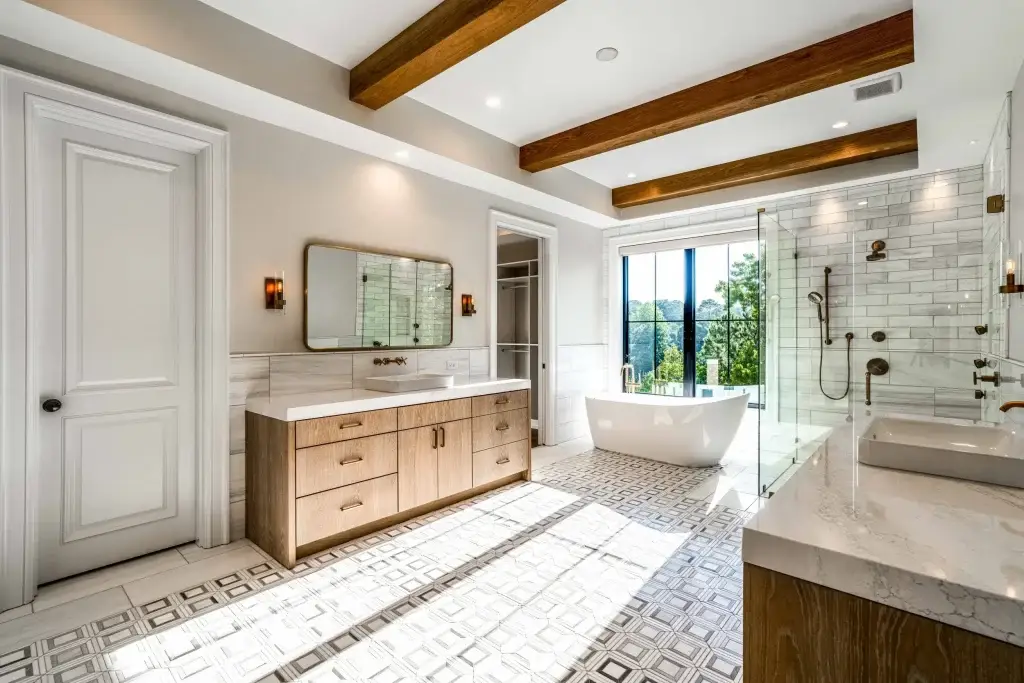
Installed in an organic modern master ensuite, this his and hers bathroom vanity package breaks away from conventional linear layouts by deploying dual opposing casework runs. Flanked by floor-to-ceiling iron-frame windows, exposed structural timber beams, and a focal freestanding soaking tub, the symmetrical casework balances natural warmth with clean architectural mass. Each base cabinet is fabricated using commercial-grade waterproof plywood boxes faced with vertical-grain white oak veneers. ALLAND links the entire ensuite scope into a coordinated shop drawing submittal, ensuring dead-level countertop heights, centered wall-mount plumbing drop zones, and precise wall scribes across opposing partitions.
Bathroom Vanity with Double Sink Marble Top Casework
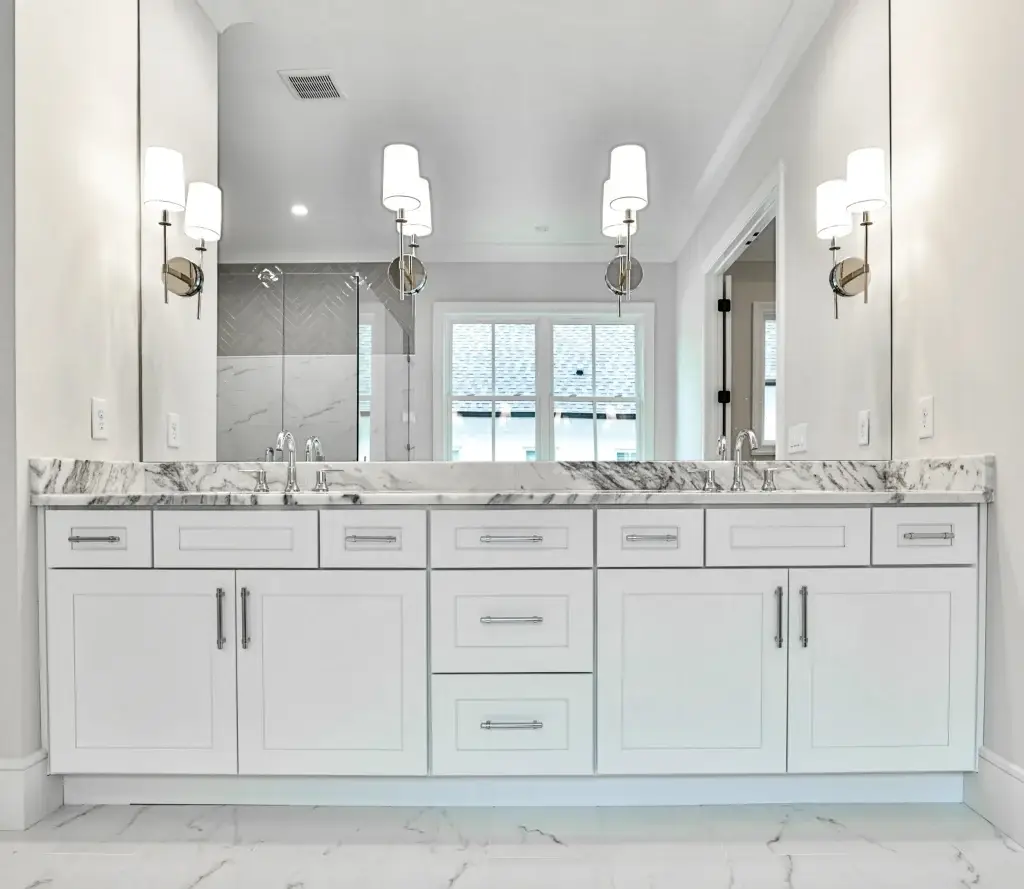
Installed in a high-ceiling primary ensuite, this custom bathroom vanity with double sink program pairs symmetrical dual-basin millwork with a matching guest bath installation. The casework run establishes a balanced architectural axis between full-height mirrors, natural marble slabs, and custom polished chrome hardware.
Fabricated on exterior-grade moisture-resistant plywood boxes with catalyzed polyurethane coatings, the cabinetry withstands daily steam and humidity cycles without edge degradation. Precise CAD shop drawing submittals align base plumbing drop zones, center drawer stacks, and perimeter wall scribes prior to crating and jobsite delivery.
Alcove Bathroom Vanity: Custom Light Oak Millwork
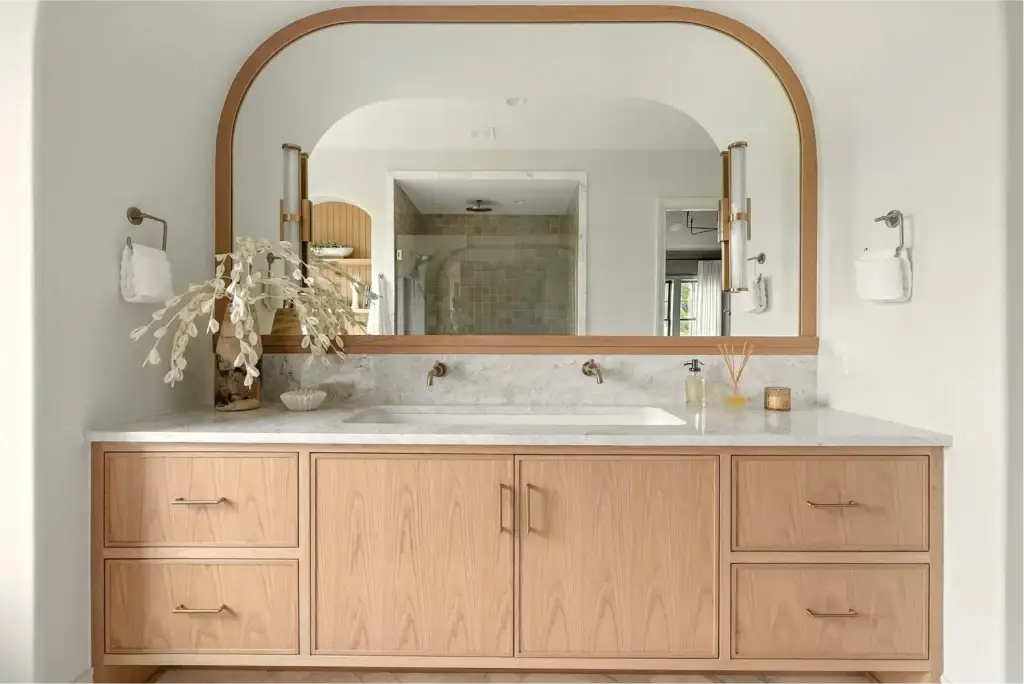
This custom alcove bathroom vanity is built to fit an arched drywalled recess, aligning a flush base chassis with a matching radius-crowned oak mirror frame. The installation pairs wide-format stone detailing with warm architectural millwork, framed by high ceilings and natural daylit surroundings. Built on exterior-grade plywood cores and finished with a low-sheen clear conversion coat, the cabinetry maintains reliable stability across humid master bath cycles. Factory shop drawings link the base dimensions, wall-mount plumbing rough-ins, and arched trim margins into a single unified submittal.
Custom White Bathroom Vanity
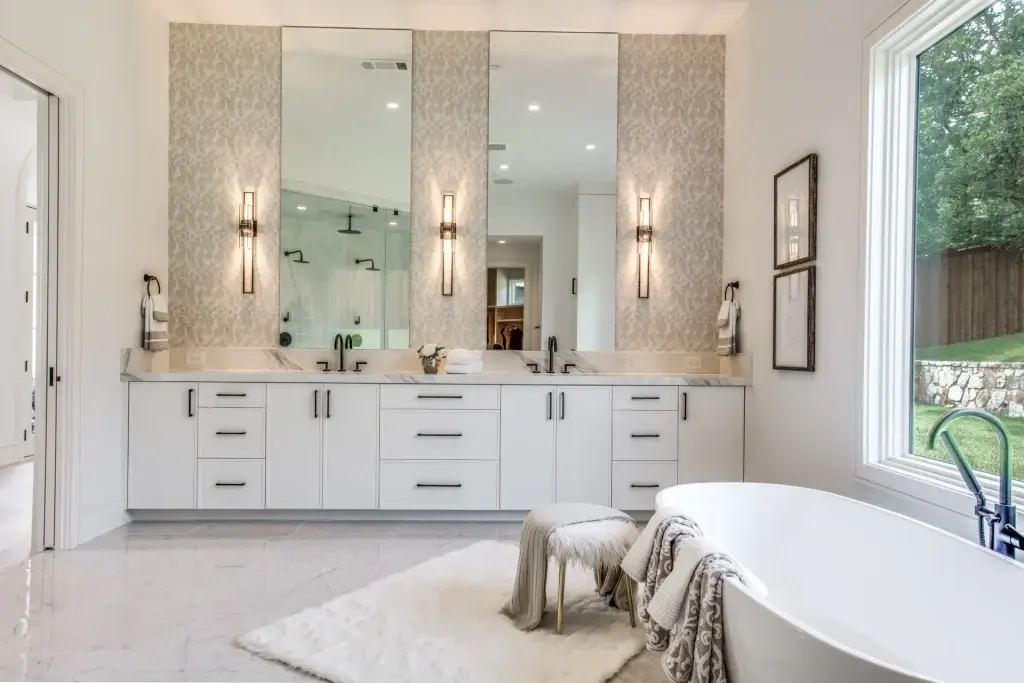
Engineered for luxury residential estates, this custom white bathroom vanity program reflects a refined balance of transitional architecture and high-performance cabinetry engineering. Factory-controlled CAD shop drawings guide every casework dimension, achieving seamless structural alignment across primary ensuites and secondary bath elevations.
The cabinetry combines classic mortise-and-tenon construction with modern multi-stage polyurethane conversion coatings. Built on high-density moisture-resistant core panels and paired with pre-machined quartz countertop assemblies, each module guarantees lasting dimensional stability against high-humidity bathroom environments.
Custom White Oak Bathroom Vanity
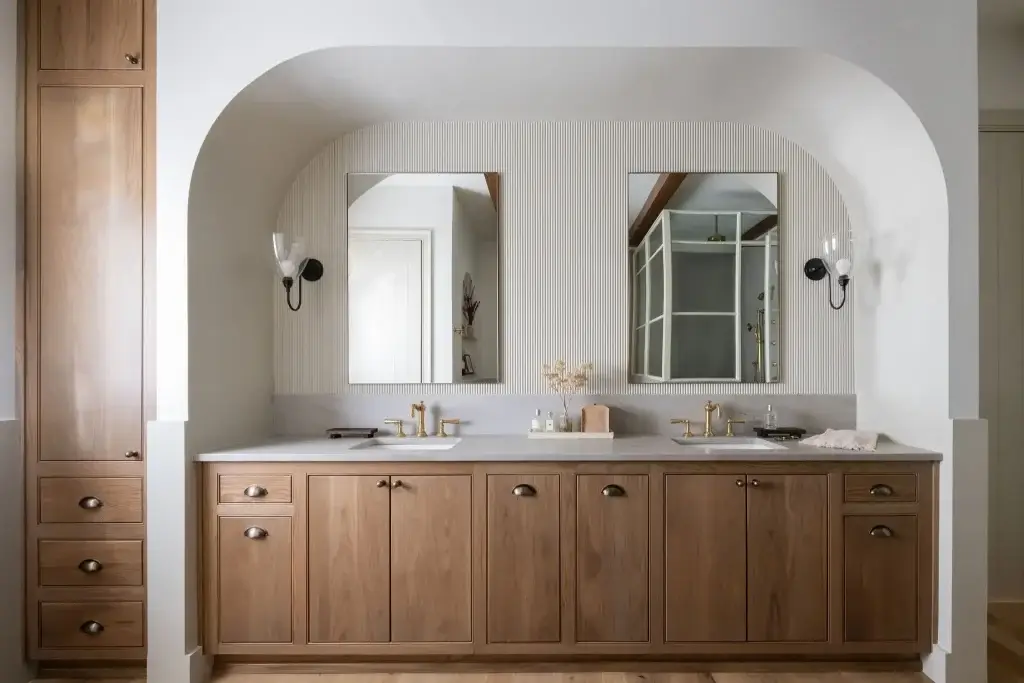
Engineered for luxury estate residences, this custom white oak bathroom vanity program demonstrates seamless architectural integration within structural wall alcoves. Factory-direct CAD shop drawings ensure zero-tolerance alignments between the dual vanity chassis, tall linen towers, and recessed arched ceiling profiles.
The project pairs refined traditional joinery with modern moisture-barrier composite engineering. Featuring marine-grade core substrates, natural rift-cut veneers, and factory-machined stone countertop interfaces, each module delivers enduring dimensional stability in high-humidity master ensuite environments.
Wood Veneer vs Solid Wood Cabinets: Which Is Better?
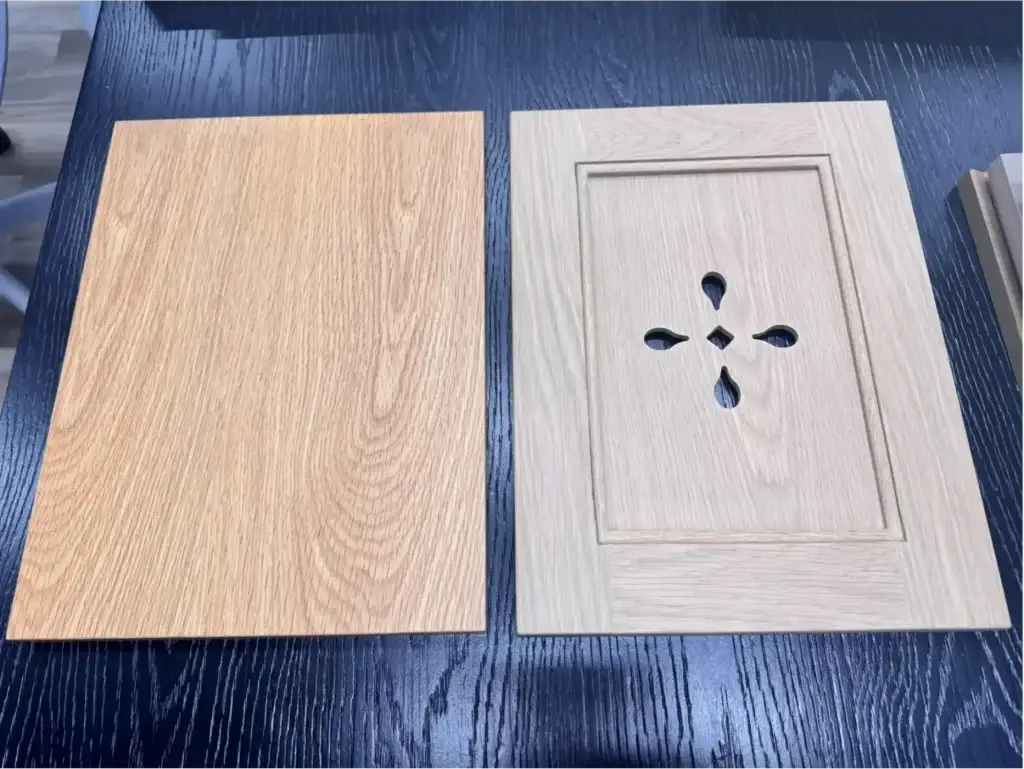
Compare veneer vs solid wood cabinets for North American projects. Explore how solid hardwood kitchen cabinets perform against engineered wood veneer panels across modern slab cabinets, solid wood shaker cabinet doors, and dovetail drawer construction. Learn how to specify the right materials based on climate, cost, and door profiles.
Wood Veneer vs. Laminate Cabinets
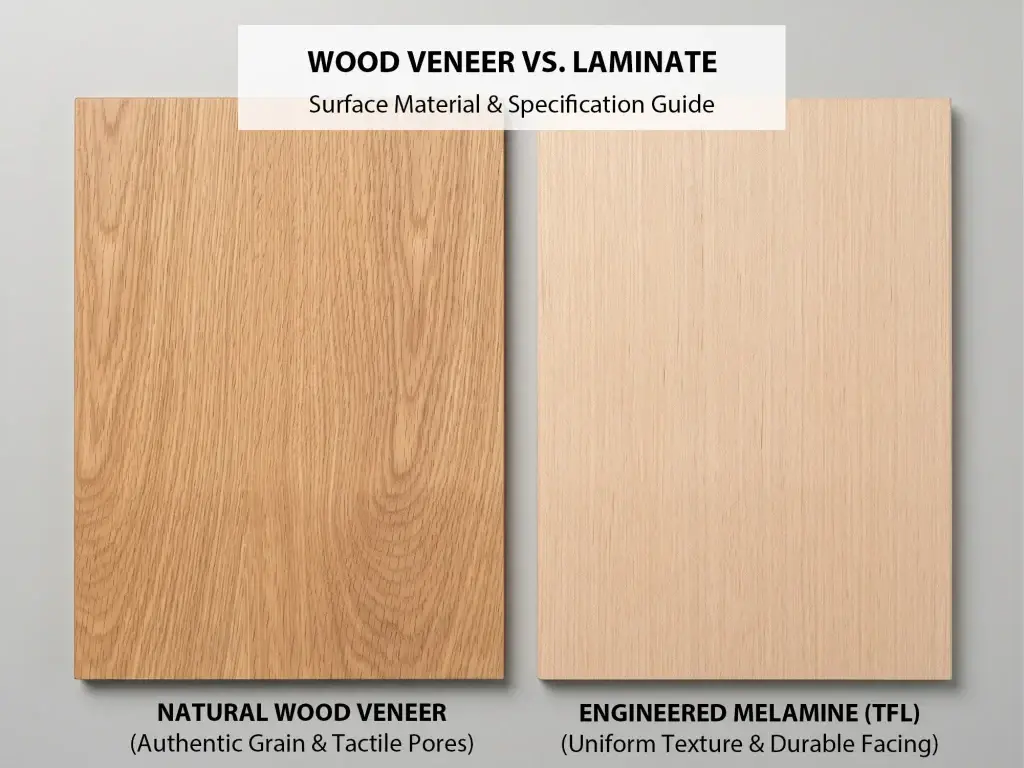
In modern residential architecture and commercial developments, flat-panel millwork has largely replaced traditional raised-panel profiles. When builders and architects specify modern flat panel kitchen cabinets, the visual identity of the entire room comes down to the surface finish. While solid timber was once the default choice for bespoke casework, wide planks across broad, unsupported spans remain dimensionally unpredictable. Solid hardwood moves with seasonal humidity, cupping, bowing, and developing surface checks over time. Because of this, engineered surfaces applied over balanced composite cores have become the North American casework standard.
When project teams weigh wood veneer vs laminate cabinets, the conversation is often clouded by outdated impressions. Many clients assume laminate is thin, peel-prone plastic from decades past, or that wood veneer is far too delicate for an active home kitchen. In precision casework manufacturing, neither holds up. Choosing between laminate vs veneer cabinets comes down to balancing authentic grain depth against mechanical impact, continuous flitch matching across wide elevations, moisture defense in wet zones, and your production budget.
Framed vs Frameless Cabinets
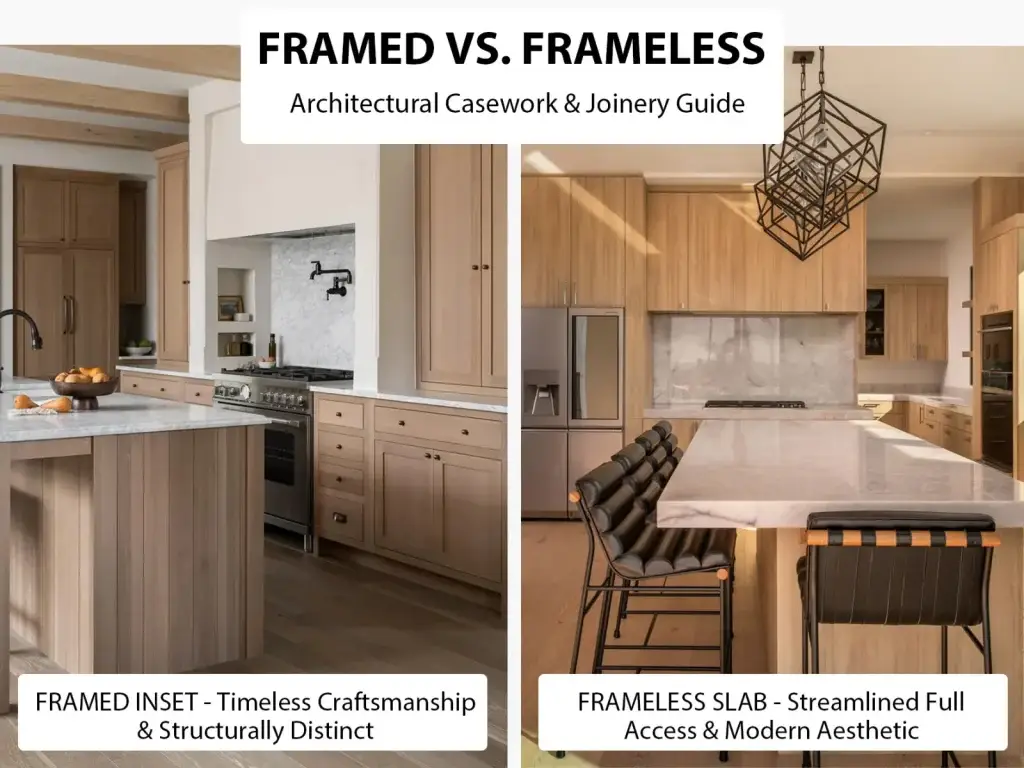
In American residential millwork, the face frame cabinet is the legacy build. It treats casework like freestanding furniture, stiffening the box with a perimeter of solid lumber that gives the elevation classic depth and gives trim carpenters plenty of meat to scribe against. Across modern developments, frameless casework—European full-access boxes built around edge-banded panels and tight reveals—has carved out equal ground for anyone chasing dead-flat slab doors and clean shadow lines.
Comparing framed vs frameless cabinets is not an argument over which system is objectively superior. Neither box is a universal fix. A coastal shingle-style kitchen often demands the architectural shadow lines of a face frame, while a multi-unit contemporary floor plan leans on the raw cubic storage and modular layout of a frameless carcass.
For builders, architects, and homeowners, making the call comes down to four trade realities: elevation aesthetics, net drawer clearance, long-term hardware retention, and what your trim crew has to fight on the jobsite walls.
White Oak vs Maple Cabinets: How to Choose
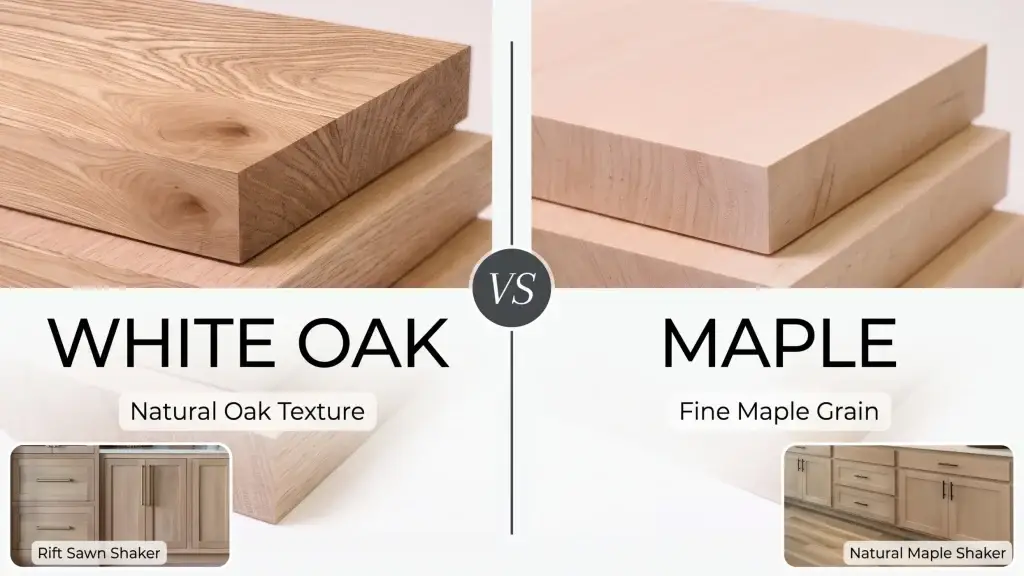
When evaluating premium domestic hardwoods for high-end residential millwork, project architects, general contractors, and builders frequently compare white oak vs maple cabinets. In custom North American construction, selecting between these two premier hardwoods is not merely an aesthetic choice between organic tactile grain and smooth planes; it is an engineering decision dictated by cellular pore anatomy, moisture-driven expansion thresholds, and finishing chemistry. Both species deliver exceptional structural longevity, yet they serve fundamentally different architectural roles. Hard maple represents the industrial gold standard for glass-smooth painted cabinetry, fine perimeter frames, and solid dovetail cabinet drawers. Conversely, white oak—particularly quarter-sawn and rift-cut selections—serves as the definitive benchmark for natural tactile grain and contemporary minimalist casework. Understanding their mechanical behavior, door profile construction dynamics, and budget yield variables ensures that specifying custom cabinets for kitchen projects delivers lasting dimensional stability without unexpected budget inflation.
Two Tone Modern Kitchen Cabinets
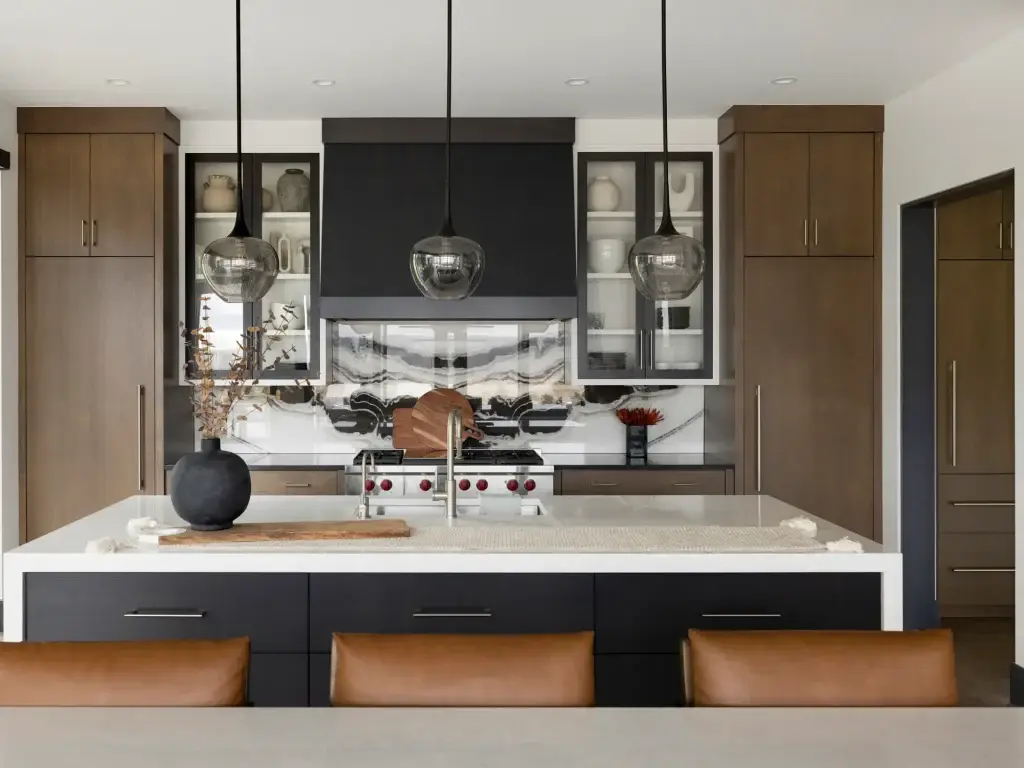
Specifying two tone modern kitchen cabinets allows custom home builders, residential developers, and interior architects to anchor expansive open-concept layouts with deliberate architectural contrast. In modern estate pavilions featuring exposed black steel I-beams and vaulted ceiling spans, balancing organic timber textures against deep charcoal surfaces creates a grounded culinary environment.
Executing multi-tone casework at this scale demands rigorous manufacturing discipline across substrate selection, veneer sequencing, and edge-banding precision. Standard commercial boxes frequently suffer from uneven field staining, poor joinery tolerances, and visible edge lines that compromise high-end interiors. ALLAND eliminates these installation bottlenecks through precision CNC-milled frameless box assemblies, balanced multi-ply cores, and controlled factory-applied conversion finishes built to custom architectural specifications.
Scandinavian Kitchen Design
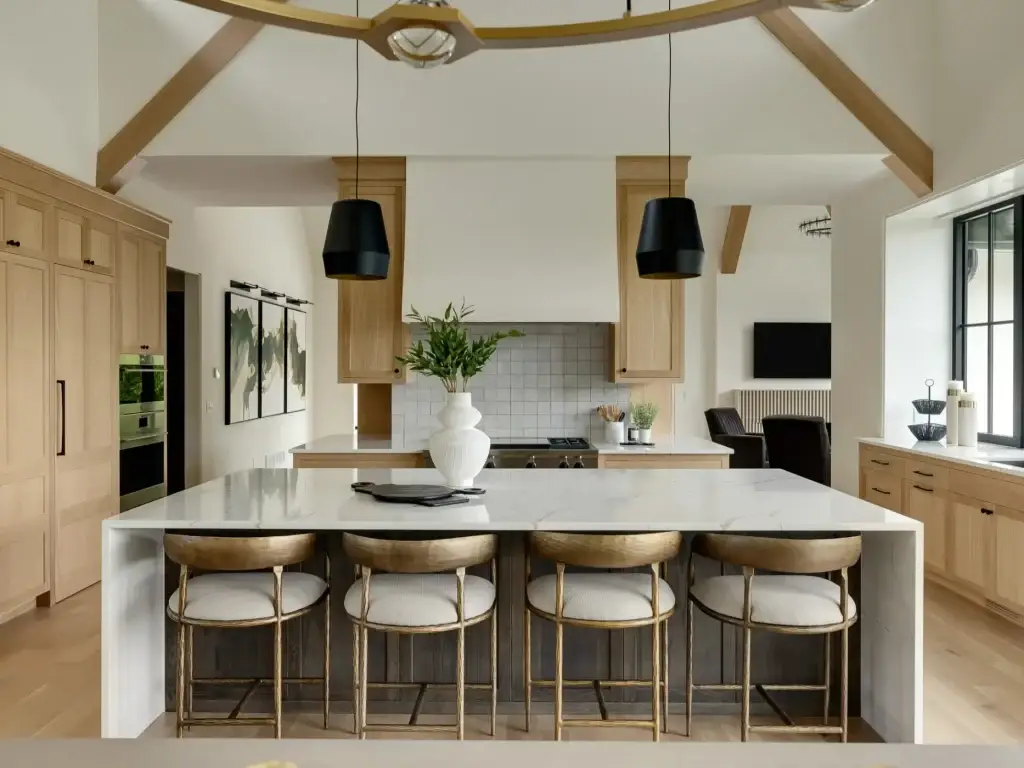
Executing an architectural scandinavian kitchen design requires an authentic balance between warm organic materiality, disciplined joinery, and expansive spatial daylighting. For custom home builders, architects, and interior designers, curating natural white oak alongside crisp white plaster elements and calibrated dark accents creates a serene, grounded atmosphere inside high-ceiling estates.
Expansive double-height open plans demand precise structural casework engineering to ensure flawless alignment across multi-functional zones. Low-grade commercial cabinetry often exhibits mismatched wood tones, unstable box assemblies, and sagging reveals across large stone spans. ALLAND eliminates these site risks by engineering bespoke hardwood millwork, multi-ply birch carcasses, and furniture-grade factory finishes built to exact architectural specifications.
Warm Kitchen Colors with Oak Cabinets | Inset Joinery Gallery
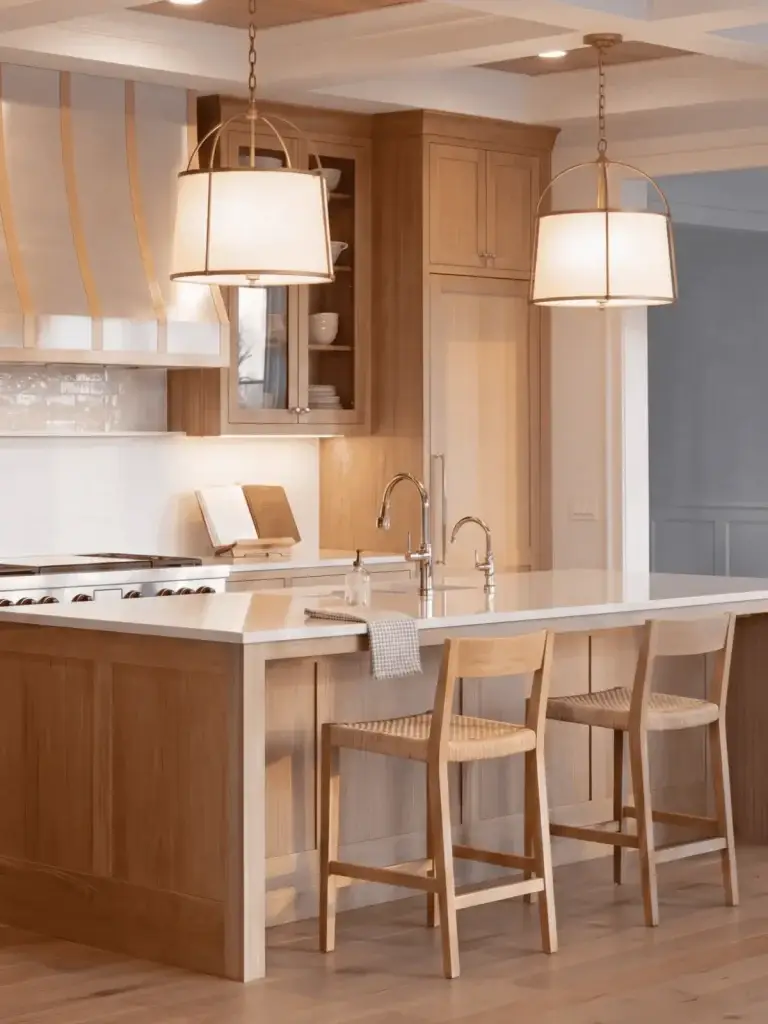
Curating an estate culinary palette around warm kitchen colors with oak cabinets combines organic material authenticity with timeless architectural proportion. For custom home builders, interior architects, and general contractors, specifying clear-finished white oak alongside soft white perimeter ceilings and honed quartzite counters establishes an airy, light-reflective baseline that feels both grounded and modern.
Large-scale estate residences require exceptional casework engineering to maintain alignment across open-concept layouts. Low-grade commercial boxes frequently rely on weak composite substrates, uneven field stains, and inconsistent reveals that compromise high-end interiors. Our factory resolves these bottlenecks through authentic solid hardwood face-frame construction, multi-ply plywood carcasses, and hand-inspected joinery built to rigid architectural shop standards.
Modern Italian Kitchen Cabinets: Engineering & Sourcing Guide
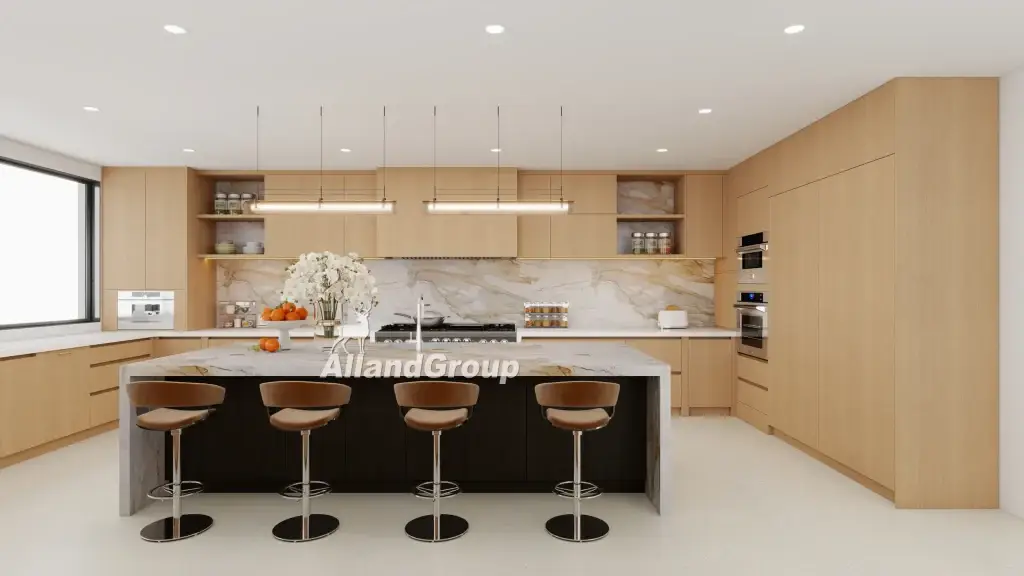
Specifying modern Italian kitchen cabinets for high-end North American residential projects frequently highlights a critical transition: translating curated design concepts into the physical realities of jobsite installation. While architectural design presentations naturally focus on visual minimalism, volumetric geometry, and spatial harmony, project architects, general contractors, and custom builders understand that modern casework is fundamentally a rigorous structural discipline. Achieving razor-thin reveals, monolithic planes, and hardware-free operation requires tighter dimensional tolerances, advanced substrate physics, and sophisticated mechanical engineering than traditional North American face-frame millwork typically involves.
Without comprehensive engineering submittals and synchronized production verification, modern casework can encounter unexpected challenges on site, such as deflection across wide-span drawer boxes, misaligned shadow lines, or extended lead times that impact overall construction schedules. Securing authentic architectural casework requires analyzing the engineering principles of European modern kitchen cabinets, material deflection thresholds, and direct manufacturing dynamics before releasing funds for production.
Custom Kitchen Cabinets Cost: New Construction Guide
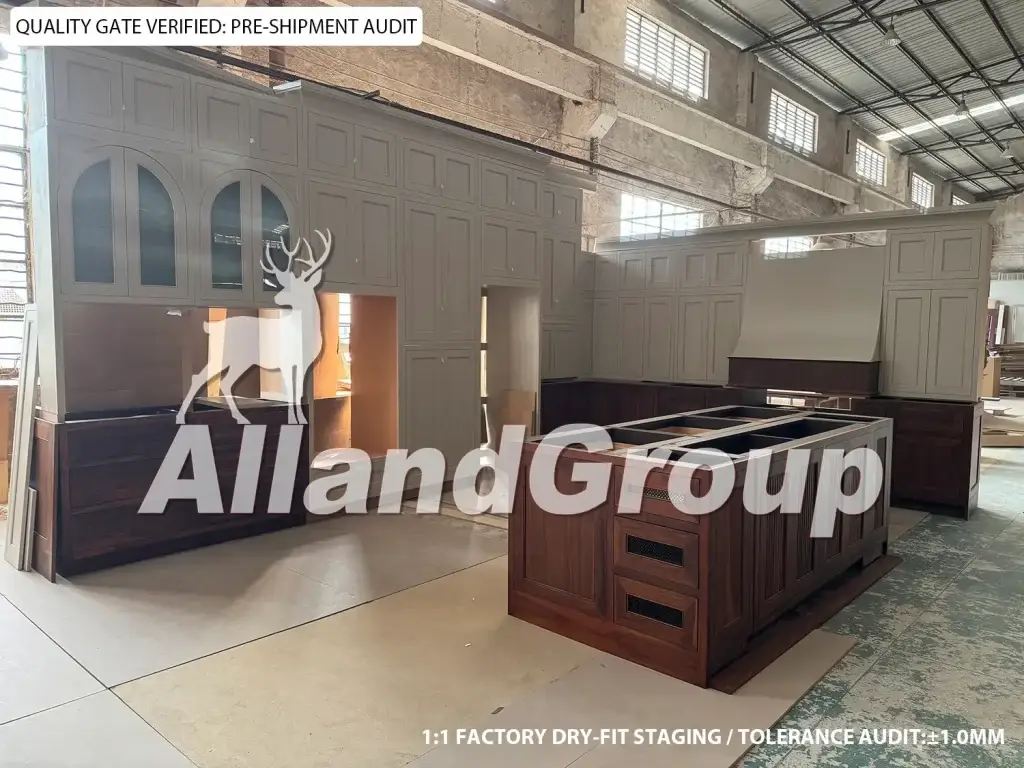
For a custom home builder balancing draw schedules, an architect protecting clean spatial sightlines, or a property owner self-managing a multi-million-dollar ground-up build, reviewing the initial finish bids is almost always an exercise in sticker shock. The drywall is hung, the subfloors are prepped, rough MEPs are signed off, and then the interior millwork estimates land on the desk.
In luxury residential construction across the United States—whether in the custom enclaves of Southern California, the coastal estates of Florida, or the mountainous tracts of the Mountain West—the custom kitchen cabinets cost consistently arrives as one of the most opaque, volatile line items on the entire budget spreadsheet.
Bids frequently swing wildly from $800 to well over $2,500 per linear foot, with total kitchen and scullery packages easily running from $80,000 to north of $250,000. Yet, when you dig past the computerized renderings to review the actual trade specification sheet, an uncomfortable question emerges: what are you actually paying for?
Too often, that six-figure total does not reflect structural integrity, furniture-grade multi-ply hardwood cores, or Austrian kinetic hardware. Instead, you are paying for high-rent design district leases, tiered sales commissions, administrative overhead, and the low-efficiency manual labor of small regional woodshops.
When project managers and owners ask how much are custom kitchen cabinets without tying that question to verified architectural drawings, spatial elevations, and strict material schedules, they are walking into a financial trap. Real custom architectural millwork is governed by three non-negotiable variables: gross linear footage, core substrate physics, and surface execution complexity.
This is why deciding to direct-source and import—specifically choosing 从中国采购 (sourcing from China)—has fundamentally shifted from an alternative option into a strategic priority for tier-one residential builders. Partnering with an engineering-led manufacturer like ALLAND定制橱柜 (ALLAND Custom Cabinetry) is no longer an exercise in settling for flat-pack compromises or sub-standard materials. For experienced builders, sourcing kitchen cabinets direct from manufacturer facilities represents a calculated supply-chain optimization: stripping out local design-firm commissions and showroom real estate overhead, and redirecting those savings directly into multi-ply structural casework, full-height mechanical stabilization, and sequence-matched architectural wood veneers.
Why Coastal Kitchen Cabinets Fail: The Oceanfront Millwork Guide
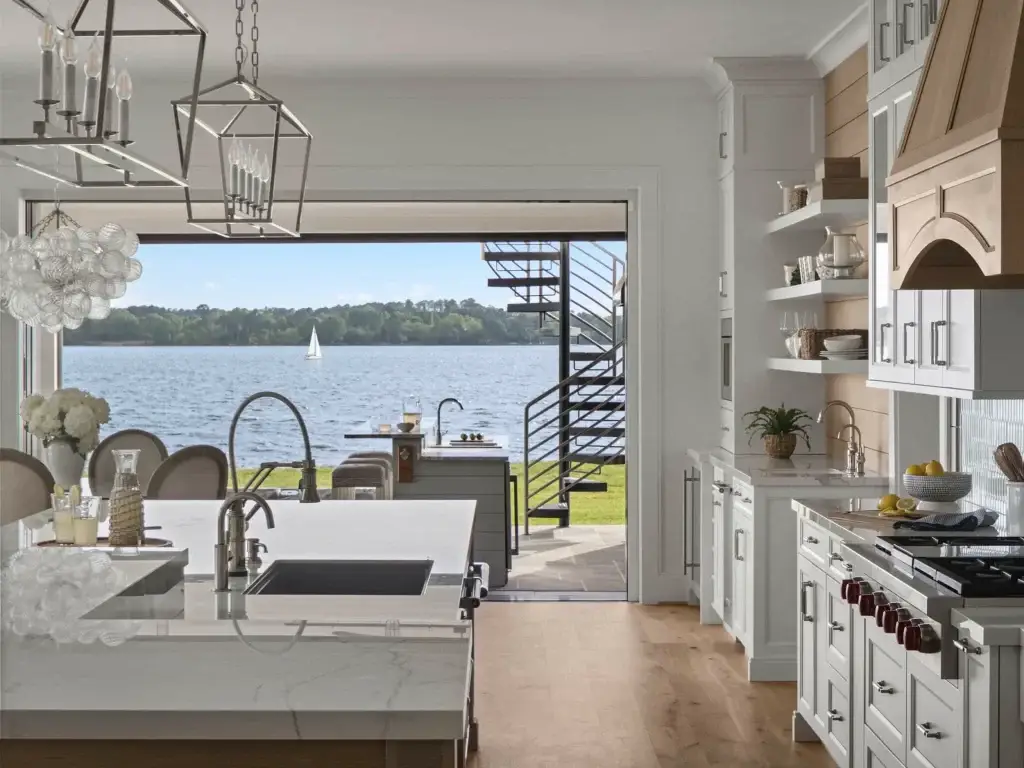
Living by the ocean comes with panoramic views and incredible natural light, but it is brutally hard on residential interiors. Most homeowners do not realize that standard luxury millwork is designed for controlled, inland air. When placed within a mile of the shoreline, standard cabinets begin to show distress surprisingly fast. Doors rub against frames, drawers stick in humid weather, hinges turn crusty and white, and cabinet bases under the sink can develop musty smells and swollen edges.
The marine environment creates a continuous assault on physical casework:
Relentless Humidity Swings: Daily ocean fog followed by dry, sun-drenched afternoons forces wood fibers to swell and contract constantly, placing intense shear stress on glued joints.
Airborne Salt Crystals: Fine sea salt travels inland on the breeze, landing on steel hinges, drawer glides, and fastener screws, causing premature chemical pitting and structural rust.
Intense Sunlight Exposure: Expansive coastal glass walls allow massive doses of UV radiation to heat cabinet surfaces, fading natural wood finishes and yellowing vulnerable synthetic resins.
Building dependable coastal kitchen cabinets is not about buying the most expensive showroom brand; it comes down to selecting the correct core materials, using wood cuts that naturally resist movement, and installing hardware engineered for marine environments.
Modern Luxury Kitchens: The Architecture of Hidden Kitchen Cabinets
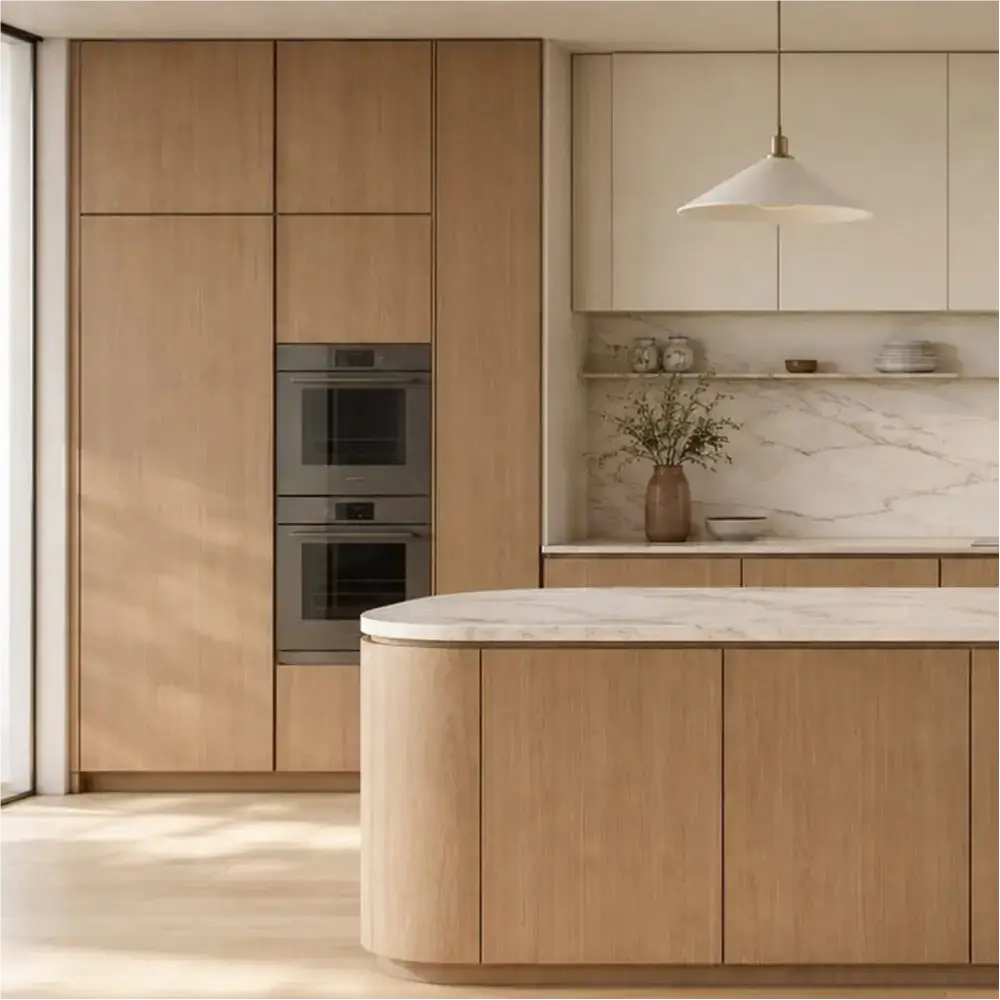
In modern open-plan architecture, the kitchen serves as the social centerpiece of the floor plan. However, this layout creates a persistent design challenge: the heavy operational mess of daily cooking is permanently on display. Unwashed prep dishes, active workstations, and countertop appliances disrupt the clean sightlines of a luxury estate.
Traditional exposed cabinetry often fails to satisfy clients demanding absolute aesthetic purity. This is why search interest in hidden kitchen cabinets continues to grow. Architects and designers look for real-world solutions that transform an active kitchen into a serene architectural backdrop. Designing a modern luxury kitchen requires hidden casework and specialized storage modules that maintain everyday functionality while concealing clutter.
Frameless Cabinets Kitchen
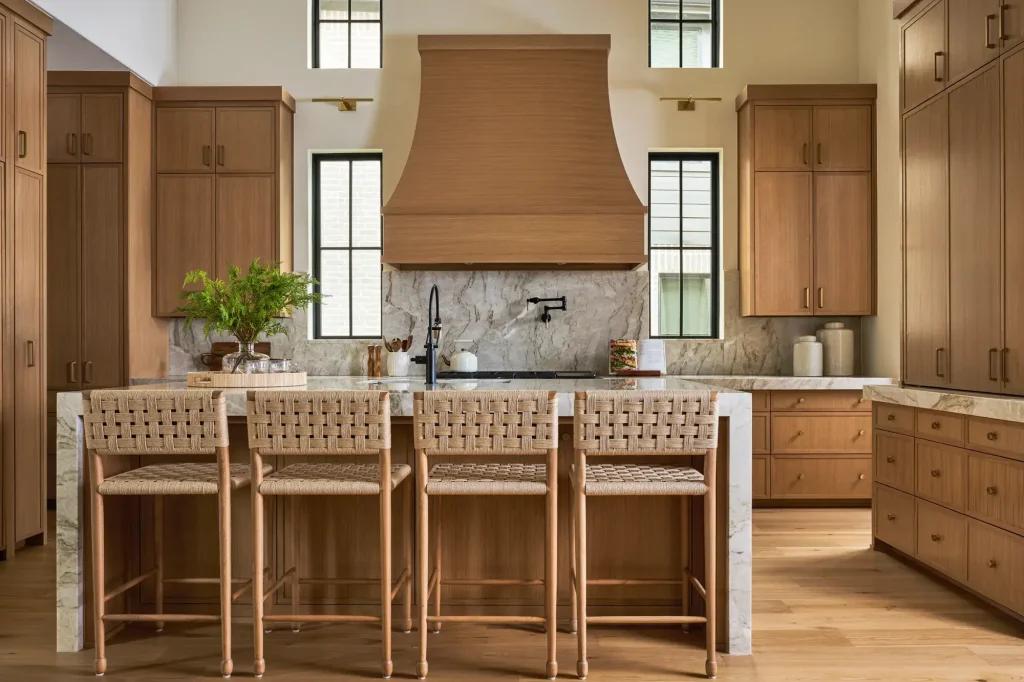
Specifying a custom frameless cabinets kitchen delivers a seamless fusion of architectural minimalism, organic warmth, and maximum interior storage capacity. For luxury custom home builders, architects, and general contractors, utilizing full-access European-style box joinery eliminates cumbersome face frames while framing continuous grain lines across high-ceiling culinary spaces.
Standard modular boxes frequently suffer from sagging top rails, uneven reveals, and structural joint failure when carrying heavy stone spans. Our direct-to-factory manufacturing lines fabricate every frameless carcass using 3/4-inch multi-ply hardwood plywood, full-depth dowel-and-cam lock engineering, and premium European concealed hardware to guarantee lasting stability beneath expansive natural quartzite countertops.
Greige Kitchen Cabinets with White Countertops
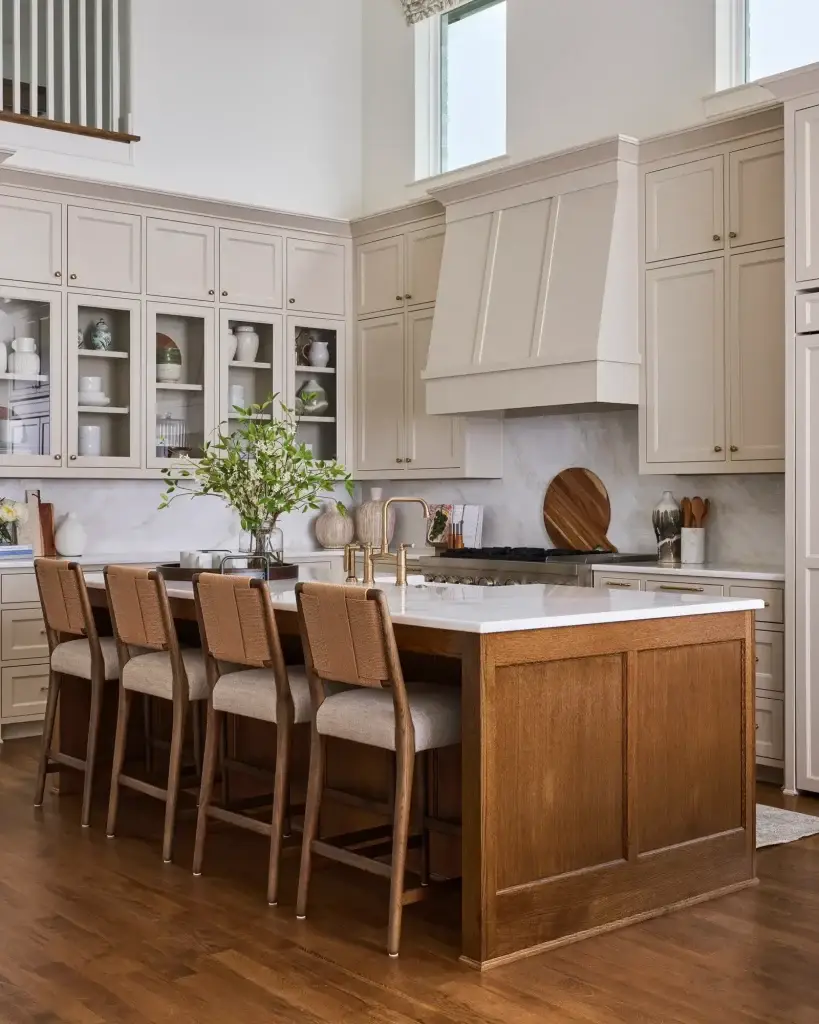
Pairing custom greige kitchen cabinets with white countertops establishes an earthy, light-reflective palette that merges Old World sophistication with contemporary living. For custom home builders, architects, and general contractors, specifying low-sheen mushroom tones over stark whites softens double-height architectural elevations while framing pristine Calacatta marble slab surfaces.
Standard modular units often lose structural integrity and alignment when attempting complex ceiling transitions beneath vaulted cathedral rafters. Our direct manufacturing facility engineers true flush inset face-frame assemblies on solid 3/4-inch multi-ply plywood boxes, utilizing factory-catalyzed conversion varnish finishes to guarantee uniform 3/32-inch margins, seamless stepped crown returns, and lifelong panel stability.
Kitchen with White Cabinets and White Countertops
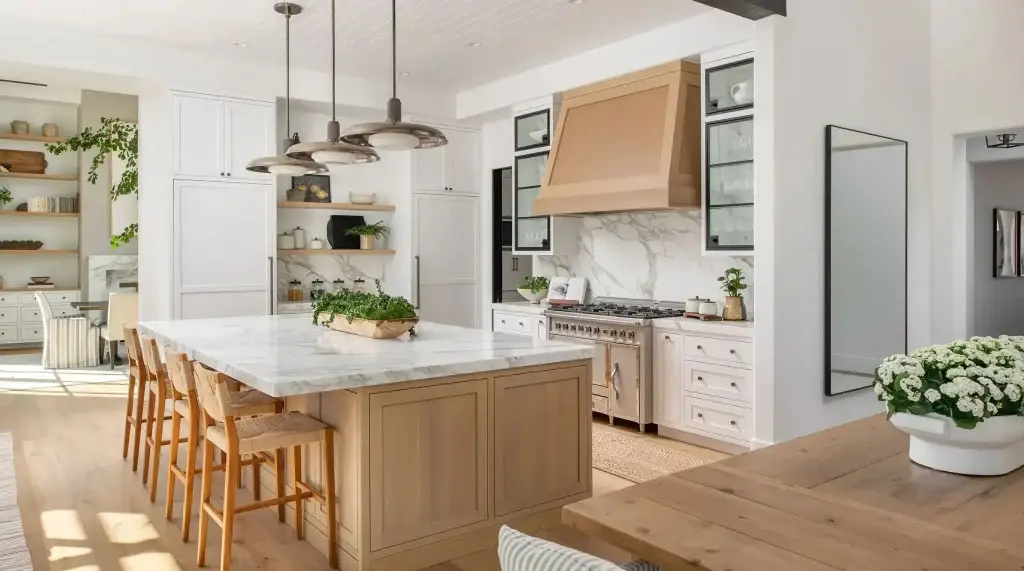
Executing a cohesive estate kitchen with white cabinets and white countertops requires balancing luminous monochromatic surfaces, authentic face-framed joinery, and organic architectural accents. For custom home builders, interior designers, and general contractors, specifying a white-on-white flush inset palette establishes an open, light-reflective baseline that integrates seamlessly with continuous full-height slab stone surfaces and architectural ceiling beams.
In large-scale luxury residences, basic modular white boxes often fail to maintain crisp alignment across expansive perimeter walls. Off-the-shelf overlay cabinetry frequently uses weak particleboard substrates that sag beneath heavy engineered stone, inconsistent field paint that discolors unevenly, and wide face frames that create visual clutter. Our manufacturing facility resolves these construction bottlenecks by engineering authentic flush inset face frames on 3/4-inch multi-ply plywood carcasses, factory-applied conversion varnish coatings, and precision flush reveals across all custom casework runs.
Minimalist Kitchen Ideas
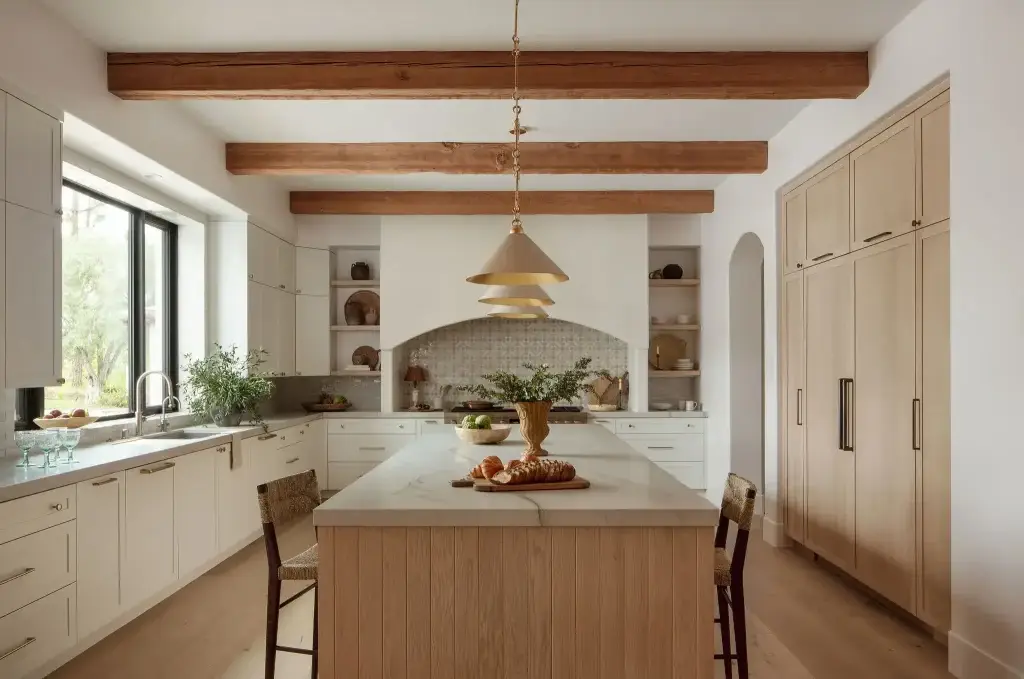
Executing high-end minimalist kitchen ideas in expansive estate residences requires balancing clean architectural discipline, concealed high-density storage, and natural organic textures. For custom home builders, interior designers, and general contractors, delivering a modern kitchen minimalist interior resolves a central spatial challenge: eliminating visual clutter while ensuring every working station remains highly ergonomic, tactile, and functionally durable.
Standard modular cabinetry frequently fails to execute seamless runs across large culinary envelopes. Builder-grade modular boxes often rely on fragile particleboard cores that sag under thick stone counters, misaligned face frames that break sightlines, and synthetic veneers that lack organic depth. Our direct-factory manufacturing facility resolves these construction hurdles through bespoke 3/4-inch multi-ply marine-grade plywood boxes, hand-selected timber flitches, and durable factory-applied conversion finishes.
Minimalist Kitchen Cabinets Design and Tall Unit Engineering
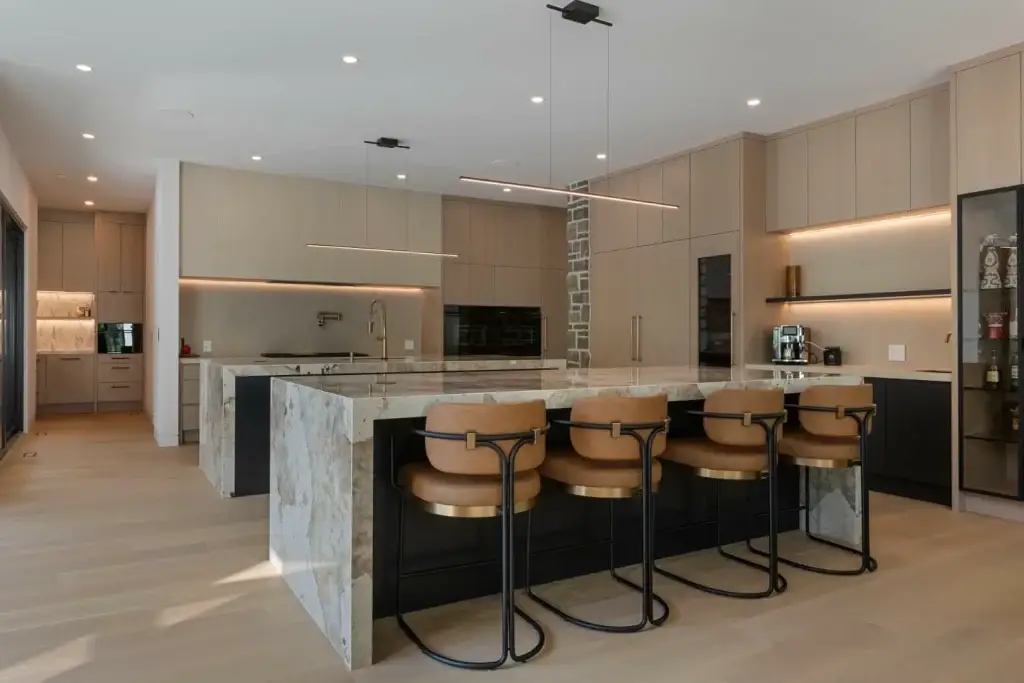
For general contractors, estate architects, and luxury home developers, designing and executing a high-end kitchen requires a careful balance between clean visual geometry and uncompromising physical execution. While the demand for minimalist interiors continues to dominate modern architectural briefs, translating these clean-lined concepts into a durable, built environment exposes the strict mechanical limits of standard millwork.
In luxury residential construction, precision is non-negotiable. A fraction-of-an-inch alignment error on a bank of drawers, an inconsistent shadow gap across an expansive wall of tall pantries, or a warped high-end wood veneer panel can instantly compromise an otherwise multi-million dollar interior. Achieving long-term structural stability while maintaining absolute visual purity demands a deep understanding of core cabinet mechanics, precise material engineering, and rigorous factory-direct quality control—especially when constructing floor-to-ceiling pantry units.
Sourcing Custom Kitchen Cabinets from China: The Ultimate Builder Guide
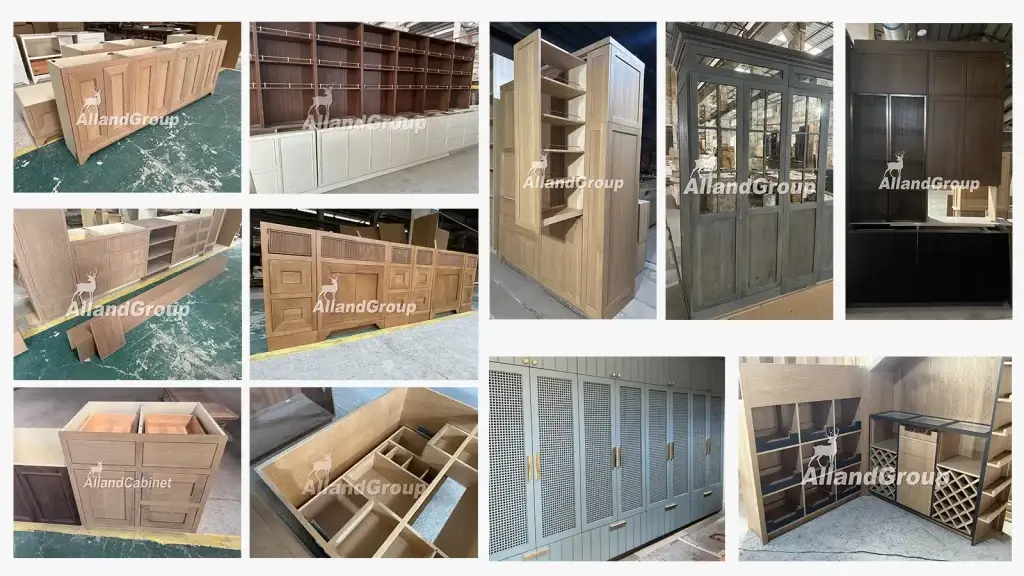
For North American general contractors, estate architects, and luxury home developers, deciding to source kitchen cabinets from china represents a high-leverage procurement strategy. When executed with precision, direct factory sourcing slashes millwork line-item budgets by 30% to 50% compared to domestic custom millwork shops, while providing access to multi-axis automated finishing lines and flexible architectural detailing. However, cross-border architectural millwork procurement carries severe financial liabilities if managed without rigorous risk mitigation. Thousands of miles away from the jobsite, project managers face specific late-night anxieties: The Blueprint and Dimension Disconnect, worrying whether an overseas factory truly understands imperial measurements (inches), appliance panel-ready tolerances, and American architectural notation, or if cabinets will arrive off-square and fail to fit the rough openings; The Substrate and Moisture Trap, receiving containers packed with cheap, porous particleboard cores that swell at the first sign of plumbing condensation, or finishes with lingering chemical odors that fail residential handover; and The Remote Quality Abyss, opening sealed shipping crates on site only to discover missing fillers, misdrilled hinge patterns, or scratched lacquer panels, forcing expensive finish carpenters to re-machine parts in the field. Sourcing successfully from a specialized factory for kitchen cabinets from china is not about chasing the lowest bottom-dollar catalog quote. It requires understanding engineering tolerances, insisting on zero-particleboard construction, and partnering with an industry leader backed by 18 years of manufacturing expertise and over 15,000 completed custom projects worldwide, perfectly exemplified by global manufacturers such as ALLAND.
Rift Cut White Oak Kitchen: The Modern Estate
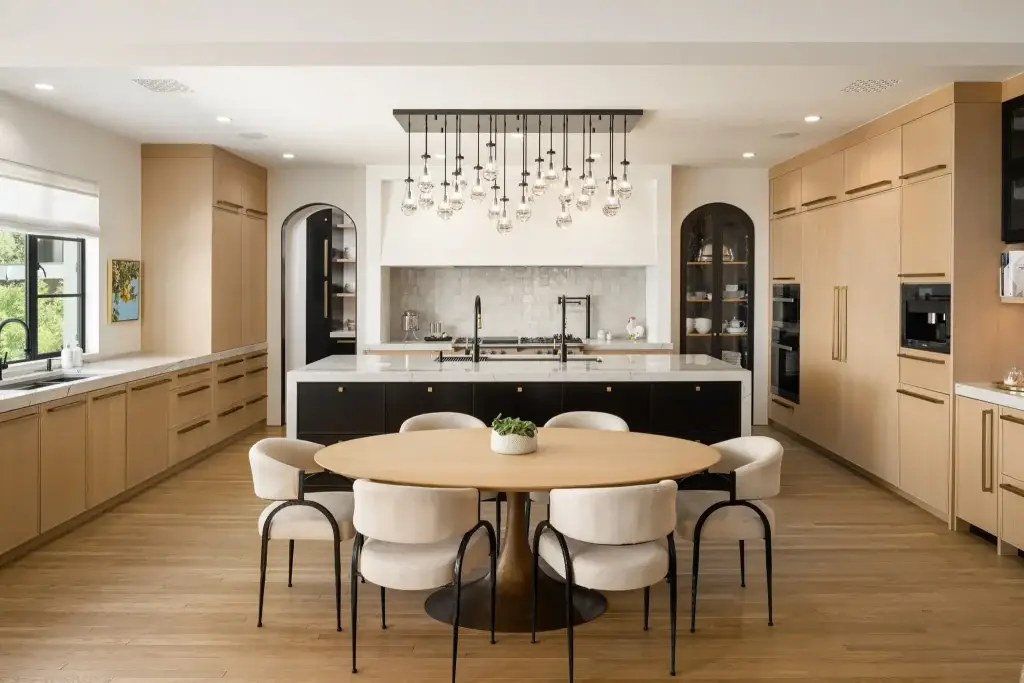
Engineering an expansive open-plan culinary space requires precision timber grain curation, high-contrast material palettes, and continuous architectural joinery. For custom home builders, interior designers, and general contractors, specifying rift cut white oak kitchen cabinets establishes clean vertical lines that celebrate pure linear wood grains while integrating modern high-density appliance storage.
In large-scale estate projects, standard modular cabinetry frequently fails to execute seamless runs across expansive perimeter walls. Factory stock boxes often rely on unstable particleboard cores that bow under heavy stone slabs, inconsistent stain penetrations that look muddy, and mismatched door veneers that disrupt horizontal sightlines. Our direct-factory manufacturing facility resolves these B2B pain points through bespoke 3/4-inch multi-ply marine plywood carcass construction, precision sequence-matched veneer layups, and factory-applied ultra-matte conversion varnish systems on all rift white oak kitchen cabinets.
Custom Slim Shaker White Oak Cabinets for Modern Architectural Residences
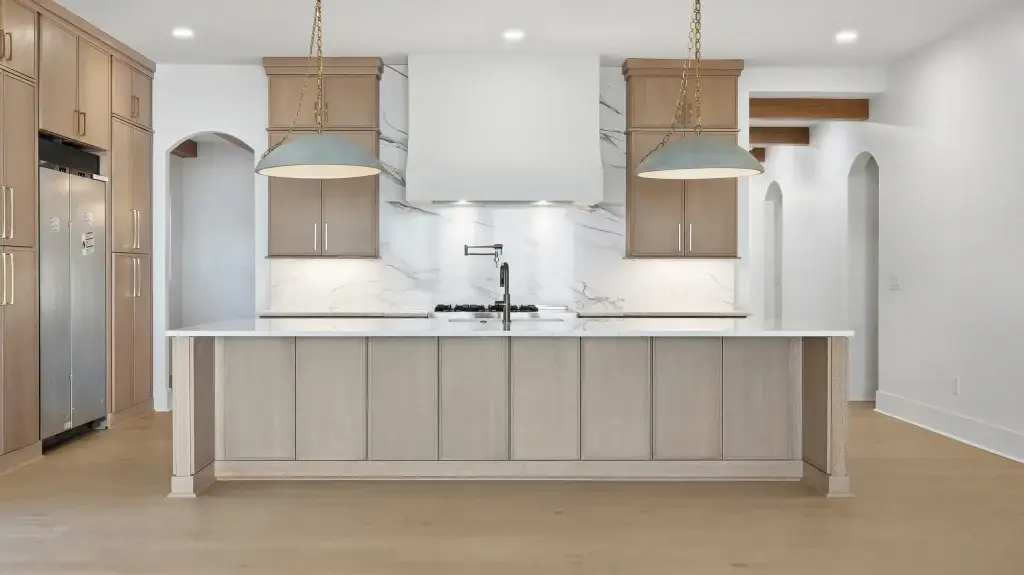
Executing an open-concept interior requires balancing organic wood warmth, clean architectural lines, and structural joinery precision. For custom home builders, interior designers, and general contractors, specifying slim shaker white oak cabinets resolves a common spatial challenge: achieving the delicate shadow lines of traditional five-piece millwork while maintaining the streamlined minimalism demanded by contemporary estates.
When sourcing whole-house millwork packages for high-end residential developments, standard mass-produced cabinets frequently fail to meet job-site structural standards. Builder-grade units often rely on particleboard carcass cores that sag under 3cm quartz slabs, unstable frame joinery that develops hairline fractures, and generic stains that turn muddy or orange. Our direct-factory manufacturing facility resolves these B2B pain points through bespoke 3/4-inch multi-ply marine plywood box construction, precision-milled micro-shaker profiles, and custom multi-step conversion varnish finishing.
The Complete Guide to Recessed Panel Door Cabinets
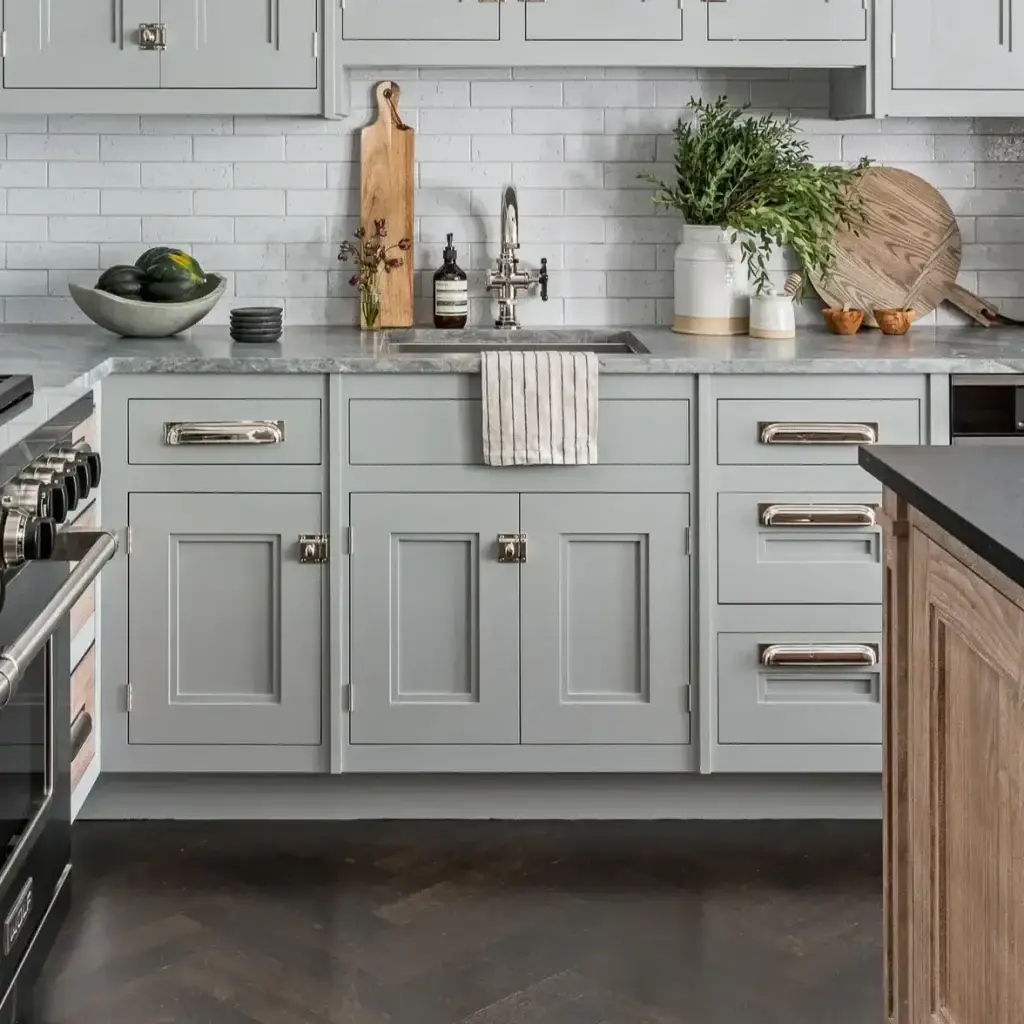
In North American architectural millwork, recessed panel door cabinets represent the structural foundation of transitional, modern farmhouse, and contemporary craftsman interior design. Defined by a flat, sunken center field framed by perimeter stiles and rails, recessed cabinet doors create an architectural balance between the crisp geometry of modern slab profiles and the classical depth of raised panels. For general contractors, luxury residential developers, and architects, specifying recessed doors delivers a versatile visual baseline that complements both urban multifamily developments and private custom estates.However, delivering complex recessed door schedules across North American climate zones involves subtle structural challenges. Millwork estimators frequently encounter serious field failures when relying on standard fabrication methods: 45° mitered frame corners that pull apart during seasonal humidity swings; multi-piece painted joints that crack along perimeter seams under indoor heating; thin 1/4″ (6 mm) center panels that vibrate and rattle hollowly during daily door closures; raw wood lines (the “halo effect”) appearing around stained panels as wood contracts in winter; and top shallow drawer pulls colliding with intricate inside-edge moldings. At ALLAND, we eliminate these jobsite liabilities through engineered joinery: factory pre-staining protocols, elastomeric compression cushions, heavy 3/8″ (9 mm) balanced core inserts, monolithic CNC moisture-resistant routing, and standardized drawer elevation schedules.
The Complete Guide to Custom Raised Panel Door Cabinets
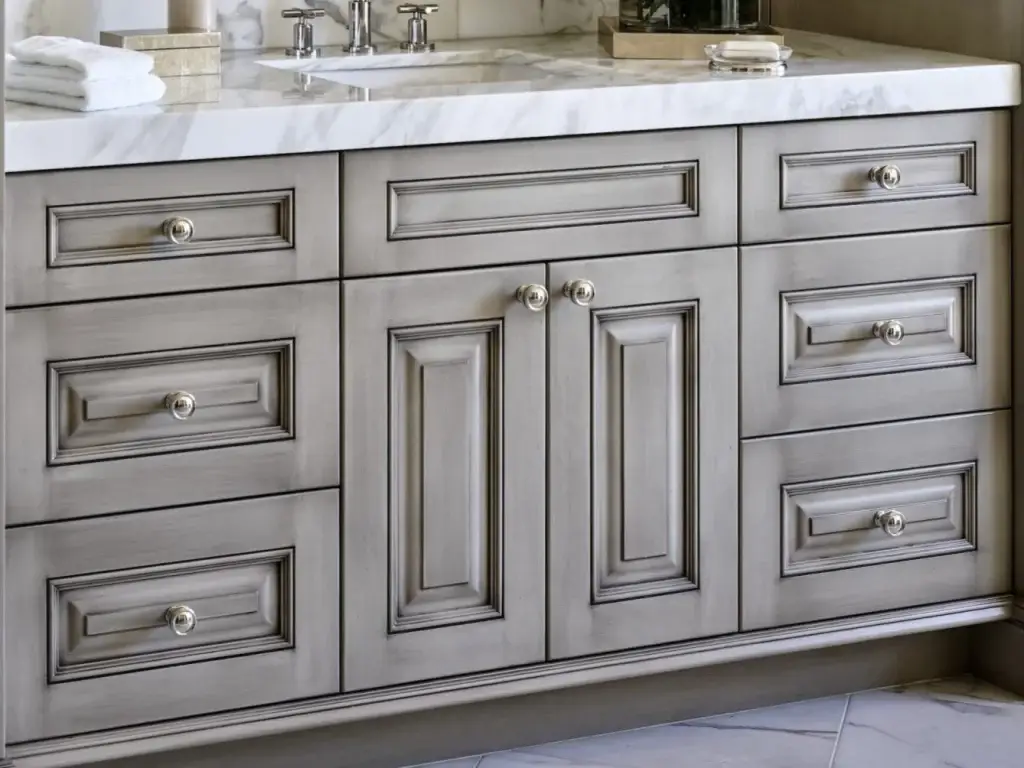
In high-end architectural millwork and estate residential developments, specifying raised panel door cabinets represents the pinnacle of classical woodworking heritage. While contemporary slab profiles rely on planar surfaces, the three-dimensional relief of a raised panel introduces deep shadow lines, stepped bevels, and old-world craftsmanship into a luxury residence. For general contractors, custom home builders, and architectural millwork estimators executing a classical traditional cabinets kitchen, French Country estate, or Colonial manor, raised panel casework serves as the visual and structural foundation of the interior envelope.
However, moving a traditional raised panel package from architectural blueprints to jobsite completion carries the highest rate of structural call-backs and warranty claims in the cabinet industry. Inexperienced builders frequently suffer catastrophic installation failures: winter panel shrinkage that reveals raw, unfinished wood borders along the frame perimeter (the notorious “halo effect”); summer humidity spikes that cause solid wood panels to expand tangentially, blowing apart mortise-and-tenon frame corners; fine hairline fractures stretching across painted multi-piece wood joints; and noticeable color or molding misalignments between cabinet doors, custom range hoods, and architectural island legs sourced from fragmented vendors. At ALLAND, we eliminate these liabilities through strict manufacturing engineering: factory pre-staining protocols that eliminate raw wood lines, elastomeric compression spacers that absorb natural timber movement, monolithic CNC moisture-resistant cores for painted orders, and fully coordinated, single-batch millwork fabrication.
The Complete Guide to Kitchen Cabinets with Glass Doors
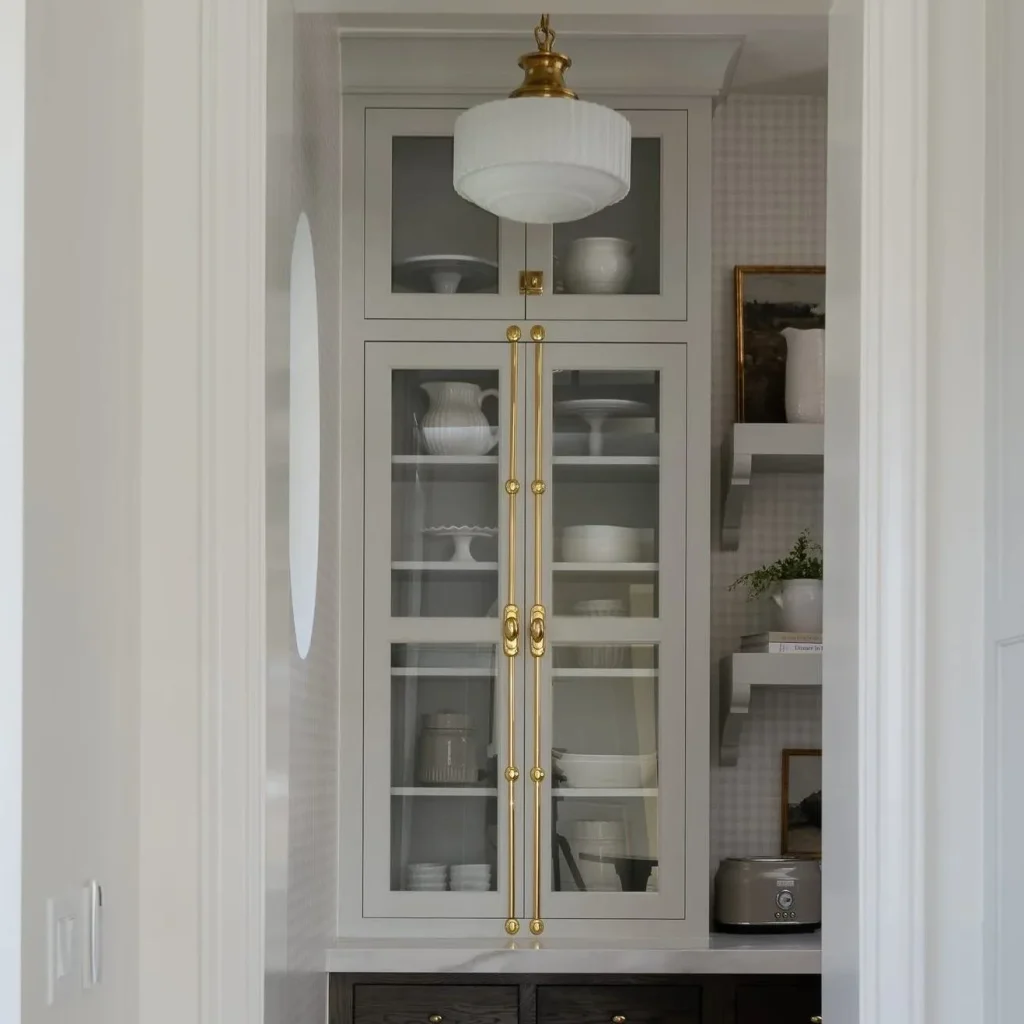
In luxury residential architecture and high-end multi-family developments, specifying kitchen cabinets with glass doors represents a deliberate transition from monolithic utility storage to curated architectural display. While solid slab or Shaker casework creates unbroken planes of wood or paint, integrating glass introduces visual depth, reflects natural daylight into deep kitchen layouts, and breaks up the monotony of extensive floor-to-ceiling casework. For general contractors, architects, and developers, executing a glass cabinet door kitchen schedule is not about replacing standard cabinetry entirely; it is an elevation strategy designed to create illuminated focal anchors across expansive open-concept living zones.
However, moving a glass cabinet package from design concept to jobsite installation introduces complex structural, mechanical, and safety risks. Glass adds significant dead weight that can pull standard cabinetry out of plumb, causing hinge sag, perimeter frame racking, and door binding over time. Furthermore, because the interior of a glass cabinet is completely exposed to view, common jobsite shortcuts—such as exposed LED wiring, raw fastener heads, mismatched frame-to-hardware finishes, and loose acoustic tolerances—become glaring defects that fail homeowner punch-list inspections. Achieving a high-end installation requires strict structural engineering: high-tensile extruded aluminum and hardwood frame joinery, tempered safety glass certified under North American building codes, precise hardware datum alignments, and fully concealed, factory-milled electrical wiring channels.
The Complete Guide to Modern Slab Kitchen Cabinets
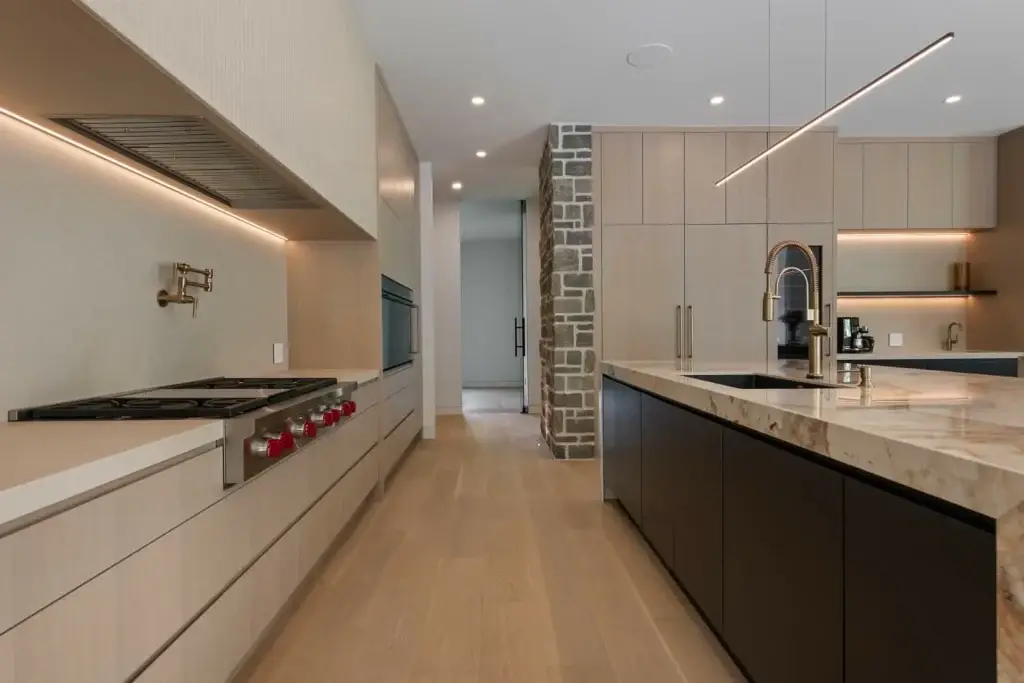
In contemporary architectural millwork, specifying a modern slab kitchen cabinet package represents the purest expression of minimalist design. By stripping away perimeter frame profiles, recessed center fields, and applied moldings, flat-panel casework shifts the entire aesthetic focus onto clean geometric datums, continuous materiality, and unyielding reveal alignments. For general contractors, commercial developers, and architects executing luxury multi-family towers or custom single-family residences, flat slab kitchen cabinets provide the seamless, flush vertical planes required to anchor open-concept layouts.
Yet, despite its deceptively simple appearance, the slab door is universally recognized among millwork engineers as the most structurally demanding and unforgiving profile in architectural cabinetry. Unlike traditional 5-piece framed doors—which inherently manage wood movement through floating center panels and expandable perimeter frames—a solid slab front possesses no internal framework to dissipate environmental stresses. When subjected to transatlantic container transport, rapid changes in indoor climate, or the thermal radiation of built-in high-capacity ovens, sub-standard slab doors are prone to severe structural failures. These issues include longitudinal bowing, edge-banding delamination, substrate swelling, and fractured grain alignments that can compromise an entire project handover. Achieving lasting stability across minimalist cabinet runs requires a strict manufacturing framework built on isotropic core physics, high-tensile structural bonding, and integrated internal hardware counter-measures.
The Complete Guide to Custom Slim Shaker Kitchen Cabinets
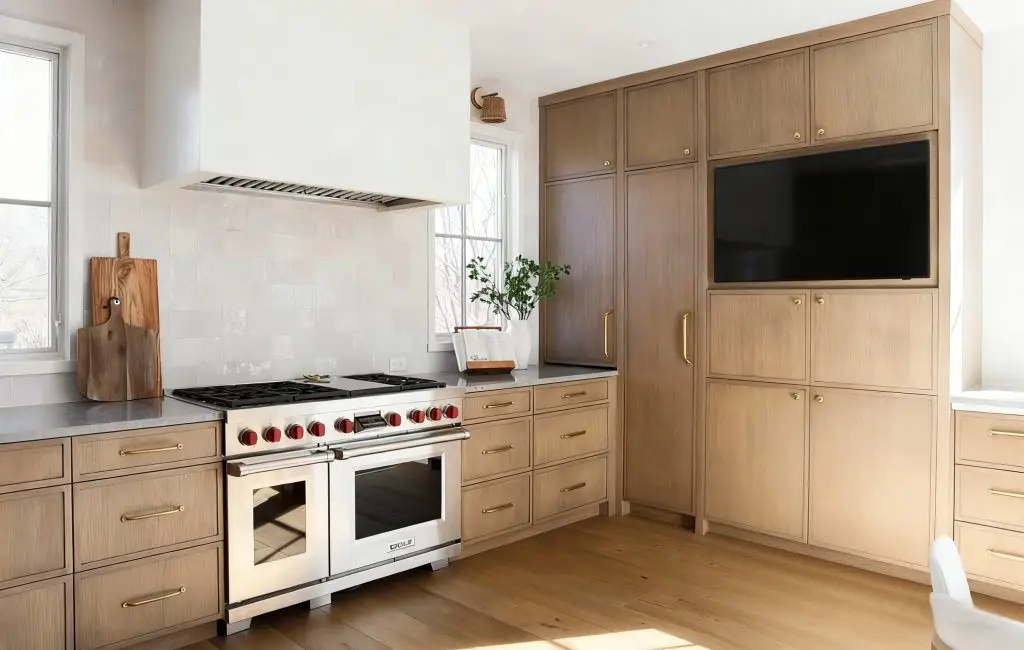
In contemporary architectural woodwork, specifying a slim shaker kitchen cabinet package represents the ultimate synthesis of traditional casework depth and sleek European minimalism. While conventional Shaker doors rely on broad frame members that can look visually heavy in modern interiors, the slim profile—frequently designated in architectural schedules as skinny Shaker or micro Shaker—narrows the framing perimeter down to an ultra-refined border. For general contractors, luxury custom home builders, and developers executing a modern minimalist kitchen or an upscale contemporary style kitchen, this subtle framing introduces delicate shadow lines across expansive cabinet elevations without cluttering the visual field.
However, moving a project from conceptual rendering to jobsite installation brings practical engineering risks that cause trade professionals to hesitate. Buyers frequently ask whether an ultra-narrow frame can handle daily stress: Will the joints loosen under the weight of heavy soft-close hinges? Will seasonal humidity swings crack the paint along narrow joint lines? How can standard pulls be mounted without screws piercing the thin center panel? At ALLAND, we answer these concerns by treating the slim Shaker not as a standard door with shaved-down dimensions, but as a completely re-engineered structural system. Through automated German CNC machining, isotropic moisture-resistant substrates, and reinforced micro-dowel joinery, we eliminate structural weakness and deliver lasting stability across custom builds.
Custom Shaker Kitchen Cabinets: Architectural Engineering Guide
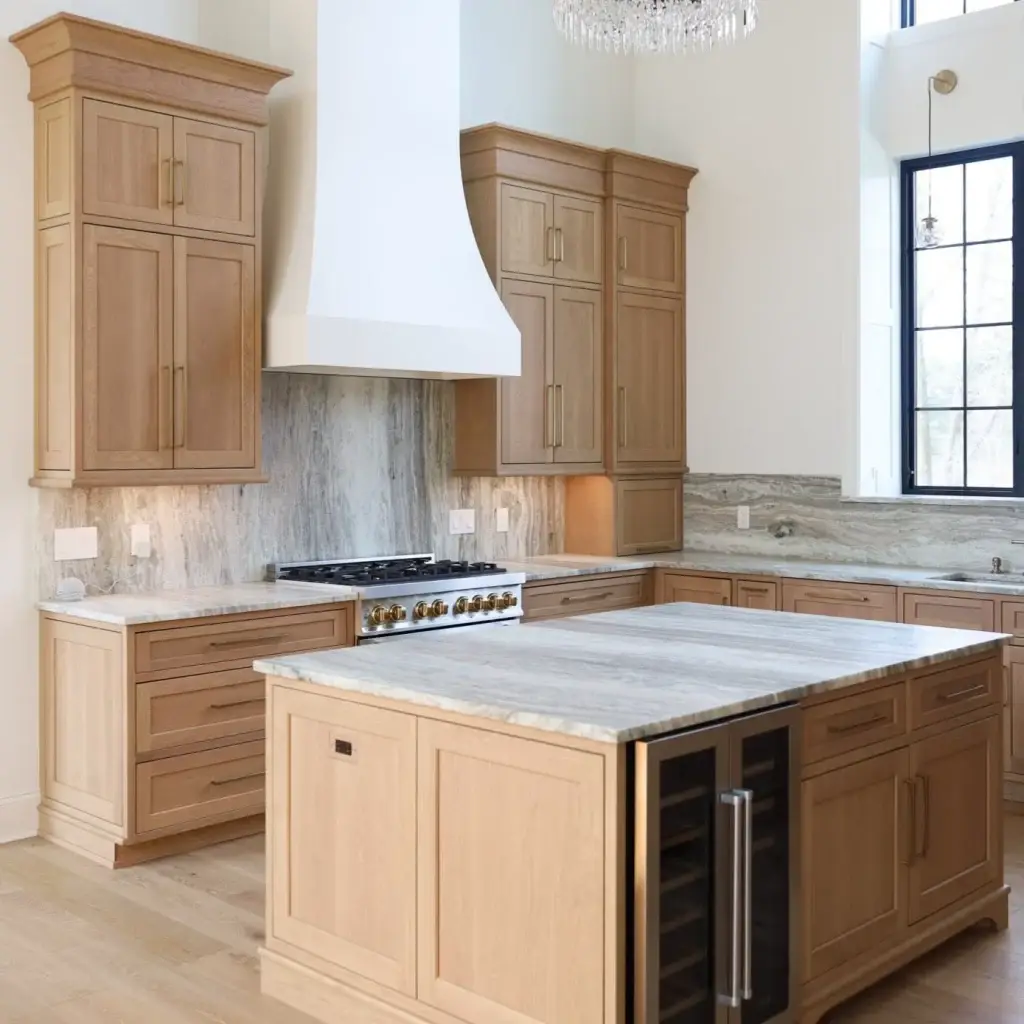
Specifying shaker kitchen cabinets for high-end residential and multi-family developments is a balancing act between timeless transitional design and strict structural millwork engineering. While the clean, recessed-panel geometry of the Shaker door has remained a staple in North American homes for over two centuries, today’s architectural standards require far greater precision than traditional carpentry ever demanded. General contractors, architects, and developers face real jobsite challenges when installing custom cabinetry: seasonal moisture expansion, hairline paint fractures along five-piece framing joints, wood movement across varying climate zones, and maintaining razor-thin perimeter reveals.
To achieve an enduring, high-performance installation, manufacturing custom shaker cabinet doors requires a deep understanding of timber physics, industrial coating chemistry, and specialized joinery mechanics. Whether specifying crisp painted finishes for a contemporary urban condo or hand-wiped natural hardwoods for an organic modern estate, every component—from the internal core substrate to the outer protective topcoat—must be engineered to resist warp, sag, and surface degradation. This technical specification guide walks through the structural fundamentals, finishing options, timber species selections, and emerging profile proportions that define modern bespoke Shaker casework.
Architectural Slab Door Kitchen Cabinets in Rift-Sawn Natural White Oak
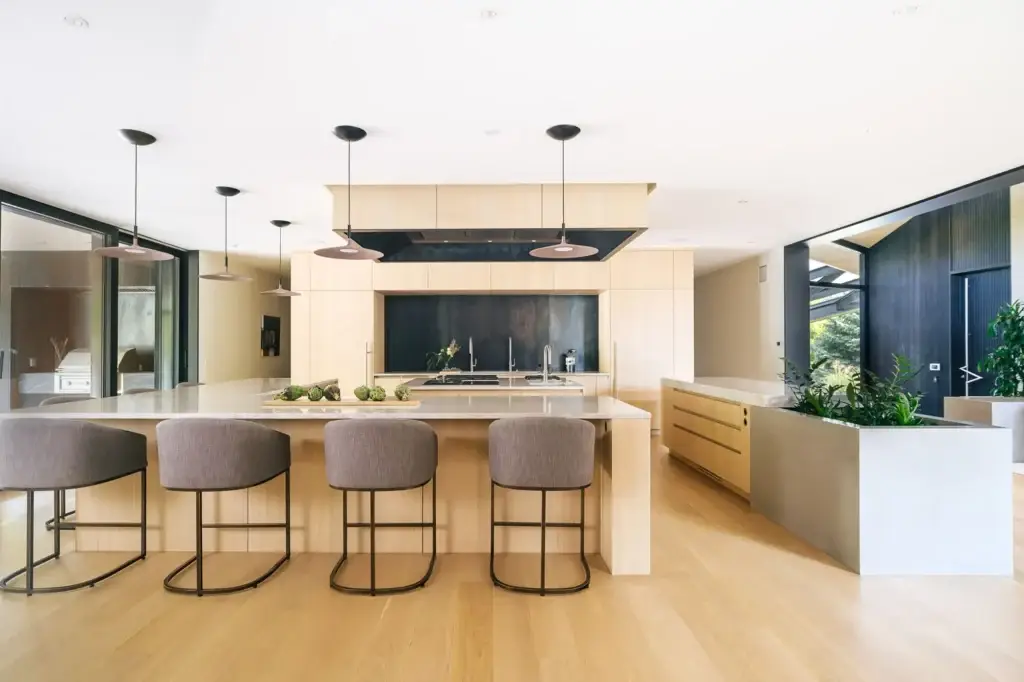
Executing a minimalist open-concept culinary space requires an intentional balance of seamless joinery, continuous wood grains, and architectural proportions. For custom home builders, interior designers, and general contractors, specifying slab door kitchen cabinets creates clean vertical elevations that celebrate natural wood textures while concealing high-density functional storage.
In contemporary estate projects, standard modular cabinetry often causes visual clutter through visible face frames and misaligned horizontal breaks. Mass-produced units often rely on low-grade edge banding that delaminates under kitchen moisture and uneven veneer sheets that disrupt vertical grain continuity. Our direct-factory manufacturing facility resolves these B2B pain points through bespoke 3/4-inch multi-ply plywood substrates, continuous book-matched rift-sawn white oak veneers, and precision-engineered modern slab door kitchen cabinets featuring integrated J-pull channel profiles.
Bespoke Traditional English Kitchen Millwork for Luxury Country Estates
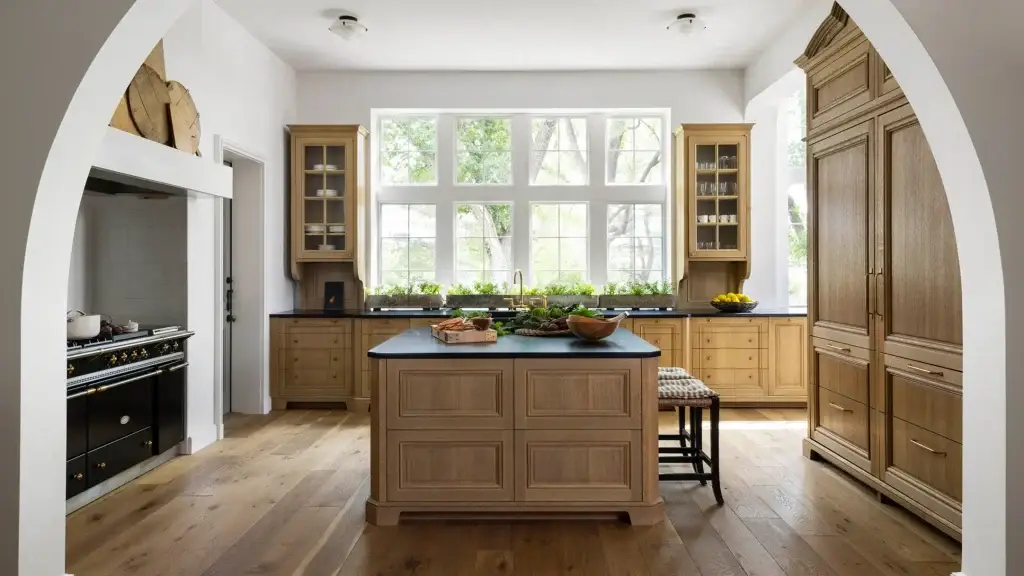
Crafting an authentic traditional english kitchen requires master-level joinery, unfitted furniture proportions, and natural wood character. For custom home builders, interior designers, and general contractors, developing a timeless english kitchen resolves a central aesthetic challenge: balancing the heritage romance of an Old-World manor with the precision and functional durability demanded by modern luxury residential developments.
When sourcing full-house millwork packages for high-end builds, standard modular cabinetry fails to replicate the architectural depth of traditional English joinery. Mass-produced units often rely on flimsy box construction, generic overlay doors, and synthetic veneers that lack tactile warmth. Our direct-factory manufacturing facility resolves these B2B pain points through bespoke 3/4-inch multi-ply marine plywood carcass construction, solid oak beaded inset face frames, and durable ultra-matte protective finishes.
Bespoke Honey Oak Modern Kitchen with Oak Cabinets for Luxury Estates
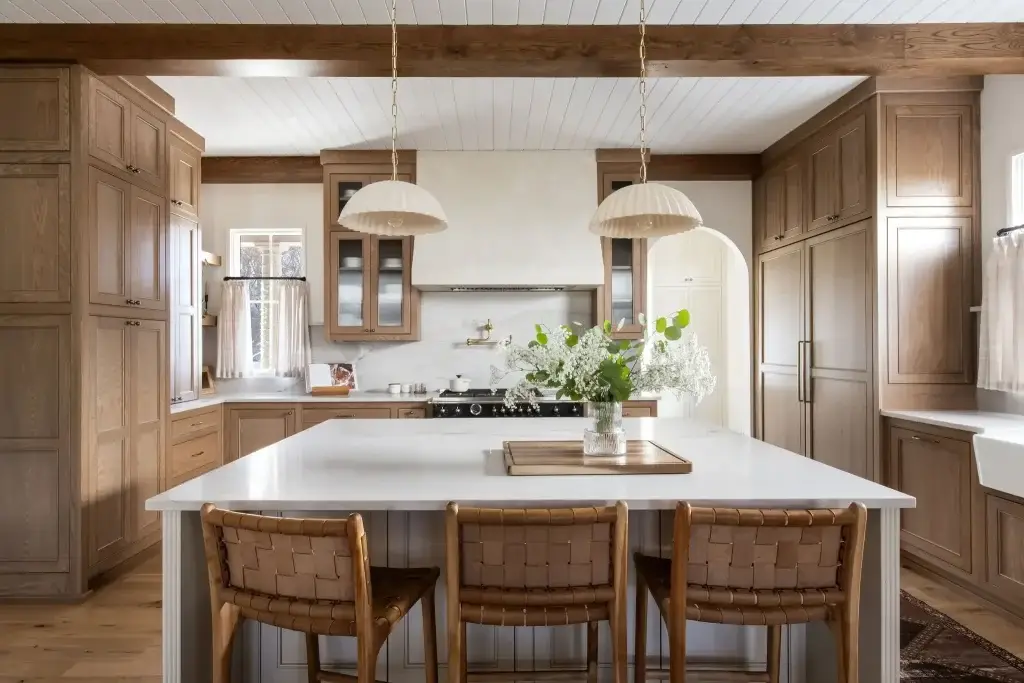
Designing a sophisticated honey oak modern kitchen with oak cabinets requires balancing the organic warmth of natural wood grains with clean, contemporary architectural lines. For custom home builders, interior designers, and general contractors, specifying modern honey oak kitchen cabinets elevates residential projects by replacing outdated orange tones with refined amber hues, ultra-matte protective topcoats, and bespoke millwork proportions.
When executing expansive whole-house joinery packages, standard builder-grade millwork frequently fails to meet architectural specifications. Mass-produced plain oak cabinets often suffer from inconsistent stain penetration, unstable core substrates that warp under humidity shifts, and fragile clear coats that yellow over time. Our direct-factory manufacturing facility resolves these B2B job-site pain points through precision-engineered 3/4-inch multi-ply marine plywood carcass construction, hand-wiped stain finishing, and automated CNC joinery.
Refined French Country Kitchen Ideas for Bespoke Residential Estates
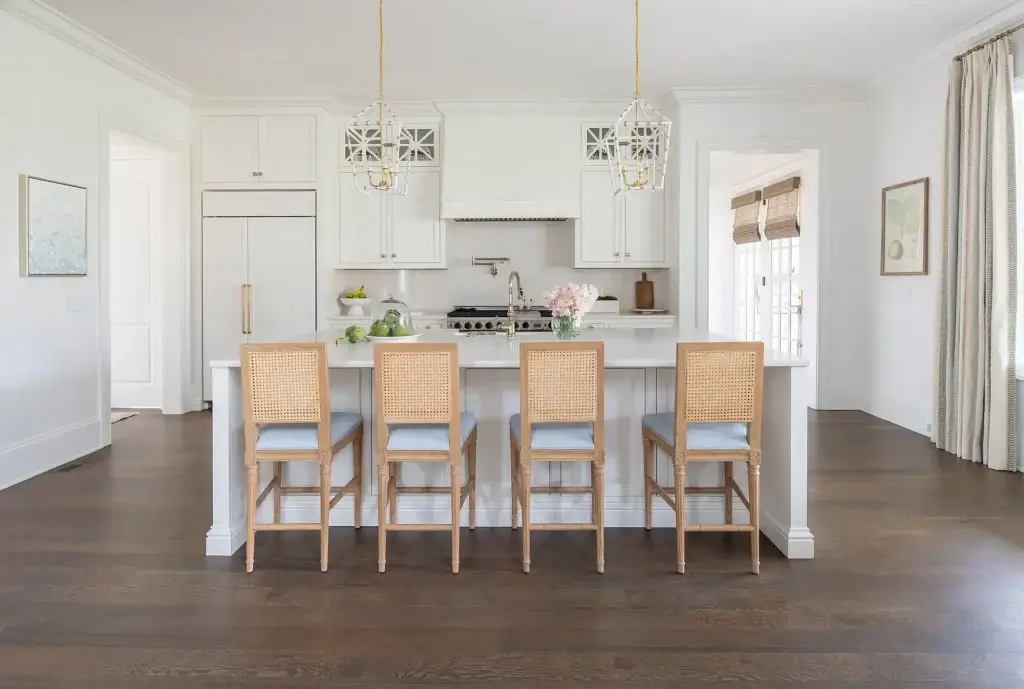
Creating an authentic french country kitchen within a modern luxury residence requires an artful combination of Old-World architectural joinery, soft classical proportions, and durable contract-grade cabinetry engineering. For custom home builders, interior designers, and general contractors, developing sophisticated french country kitchen ideas bridges traditional European romanticism and contemporary open-concept floor plans, delivering an enduring aesthetic that elevates whole-house millwork packages.
When sourcing whole-house millwork for high-end residential builds, standard modular cabinetry often fails to execute the intricate architectural detailing essential to a french kitchen design. Factory-built stock boxes frequently suffer from flimsy 1/2-inch particleboard sides, joint separation along face frames during seasonal humidity shifts, and cheap spray coats that lack depth. Our custom manufacturing facility eliminates these B2B job-site pain points through precision-built 3/4-inch multi-ply marine plywood boxes, solid hardwood beaded inset frames, and industrial-grade polyurethane finishing systems.
Bespoke Galley Kitchen Ideas for Modern and Historic Residences
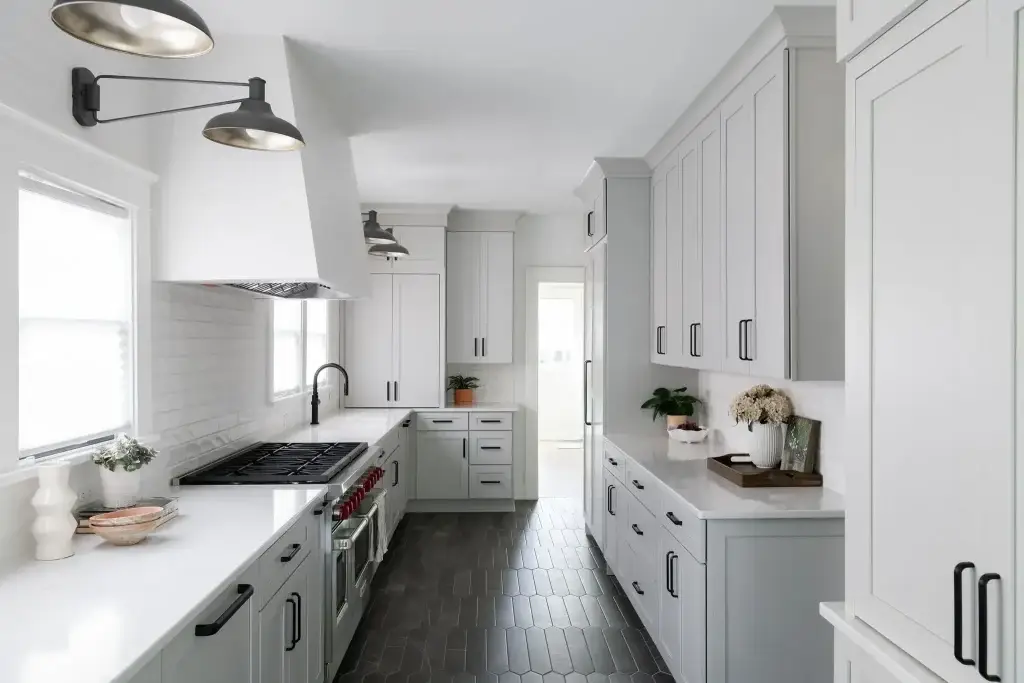
Optimizing a linear, parallel culinary corridor requires an intentional balance of high-density storage, ergonomic workflow engineering, and crisp architectural proportions. For custom home builders, interior designers, and general contractors, developing functional galley kitchen ideas solves a critical spatial challenge: maximizing vertical storage and prep surfaces within narrow structural footprints without sacrificing openness.
When renovating historic townhouses or outfitting contemporary urban residences, standard modular box cabinets frequently cause installation bottlenecks. Mass-produced units often suffer from rigid sizing that leaves awkward filler gaps along corridor walls, weak joinery that sags under heavy quartz countertops, and cheap painted finishes that chip quickly around high-traffic prep lanes. Our direct-factory manufacturing facility resolves these B2B pain points through bespoke 3/4-inch multi-ply marine plywood box construction, custom staggered-depth cabinetry runs, and durable factory-applied polyurethane coatings.
Curved Kitchen Islands: Styles & Space Planning
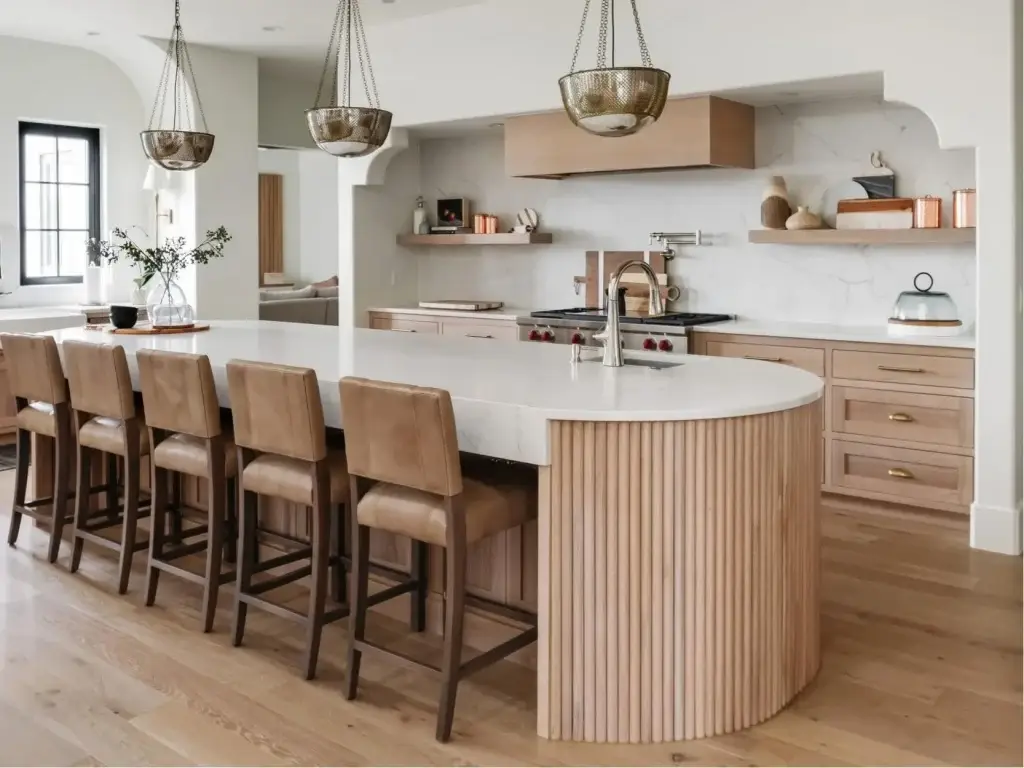
In contemporary luxury residential architecture, the expansive open-concept Great Room has fundamentally changed spatial planning. While rectilinear layouts long dominated mid-century and modern interiors, rigid boxy islands frequently create visual stiffness and physical circulation choke points in large spaces. Sharp 90-degree cabinet corners disrupt traffic flow between cooking hubs and adjacent living zones, introducing hazards in high-traffic homes.
Integrating a custom curved island solves this spatial challenge by softening angular geometry and introducing fluid motion to the kitchen. Far from being a mere decorative trend, a curved footprint serves as a functional and visual bridge between culinary workspaces and living areas. Executing these sculptural elements, however, requires precise alignment between cabinet door profiles, specialized bending substrates, and tight fabrication tolerances.
Double Island Kitchen Layouts: Architectural Design & Engineering Guide
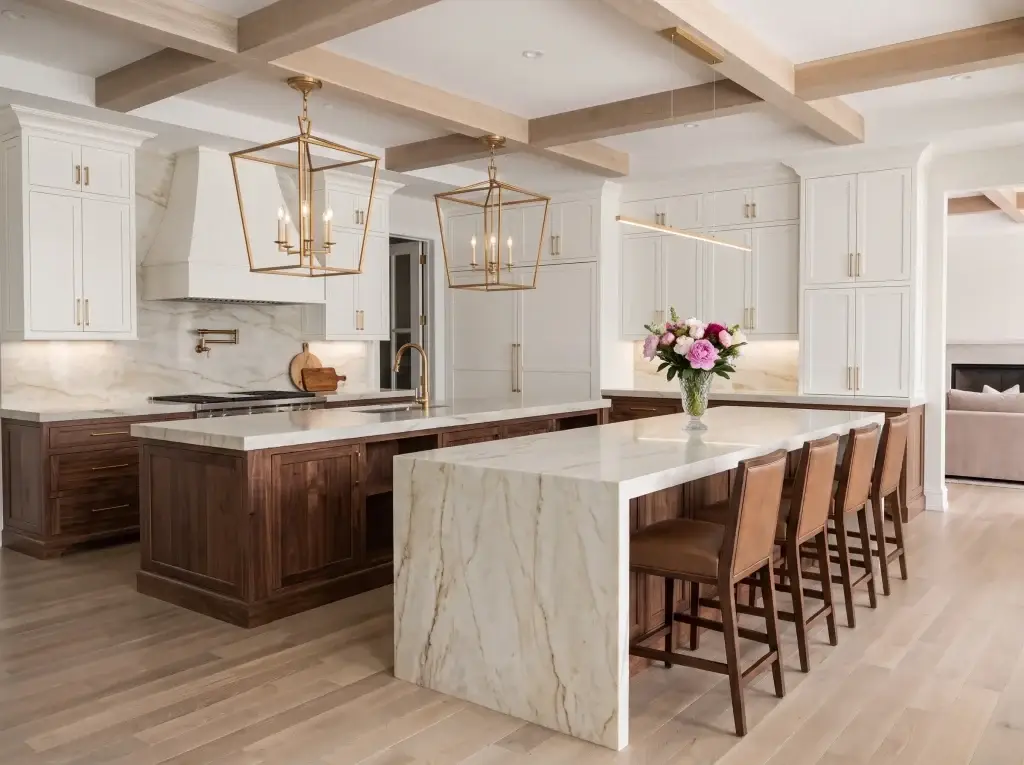
In modern luxury architecture, the expansive open-concept Great Room has reshaped residential spatial planning. Within these large footprints, a single kitchen island often struggles under competing demands: heavy culinary prep, sanitation, casual family dining, and social entertaining. Consolidating these opposing functions onto a single stone surface creates operational friction, countertop clutter, and traffic bottlenecks.
Engineering a double island kitchen layout resolves this challenge through strict functional decoupling. Rather than a mere aesthetic choice, a dual-island framework optimizes workflow velocity, improves mechanical, electrical, and plumbing (MEP) integration, and creates a clear architectural anchor for high-end properties.
What Is the Kitchen Work Triangle? The Architectural Design & Zoning Guide
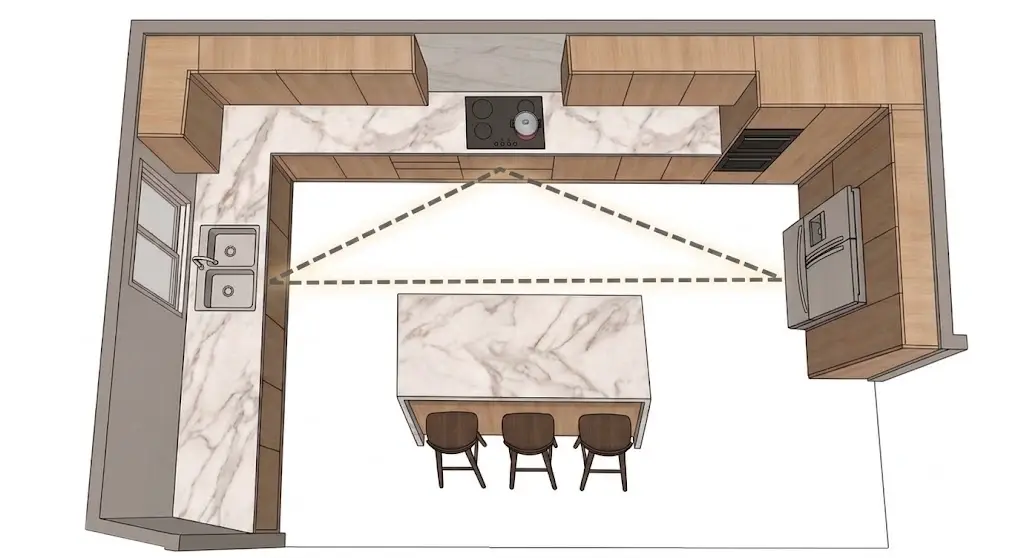
In the arena of residential architecture, luxury real estate development, and commercial custom cabinetry fabrication, spatial efficiency is measured not merely by aesthetic elegance, but by operational ergonomics and mechanical precision. When general contractors, architects, and estate developers analyze high-performance kitchen blueprints, a foundational question governs the floor plan evaluation: what is the kitchen work triangle? Developed originally in the 1940s by the University of Illinois School of Architecture as a metric to minimize construction waste and residential labor, the classic work triangle remains the baseline geometric standard recognized by the National Kitchen & Bath Association (NKBA) and the National Association of Home Builders (NAHB).
However, in contemporary luxury estate construction, where open-concept great rooms, expansive double islands, panel-ready column refrigeration, and multi-cook culinary demands predominate, applying a rigid 80-year-old three-point geometric formula without structural adaptation leads to severe spatial conflicts. Modern millwork architecture requires bridging time-tested ergonomic physics with modern multi-zone functionality.